
 22 min read
 Fitness technology, unlike sports tech, is all about taking care of yourself and being healthy. Automations brought by technology in fitness continue to drive forward personalized training programs, virtual coaching, VR experience, and various analytical capabilities. MobiDev got its first fitness app development client cooperation back in 2015. We’ve been enriching our expertise in the domain ever since, both through developing products and keeping an eye on the industry movement.
If you plan a modernization for your existing fitness application or want to source ideas for a new product, here’s our look at the recent technology trends pushing fitness applications forward in 2026.
Dmytro Konovalov, your guide to fitness tech trends in this article, is an iOS Team Leader with a background in robotics and years of hands-on experience in mobile application development. He has a strong interest in augmented reality and AI, technologies he believes are shaping the future of mobile apps, including fitness solutions.
How Technology Impacts the Fitness Industry?
Today’s fitness tech market is quite big. Having grown to over $103B in 2025, it’s forecasted to reach $122B this year, according to Business Research Insights. Moreover, with an estimated CAGR (compound annual growth rate) of 18.52%, chances are high that fitness tech will reach $667.6B in 2035. An obvious argument for technology affecting the fitness industry.
Interestingly enough, wearable fitness tech takes a huge part of the pie. According to the Worldwide Market Reports, the market size for watches, rings, bands, and other fitness wearables reached $15.8B in 2025. With a 12% CAGR, it is projected to reach $43.5B in 2035.
AI also plays a huge role in fitness tech development. According to InsightAce Analytics, the fitness and wellness AI market was valued at $9.8B in 2024. Add the CAGR of a whopping 16.8%, and the market will reach $46.1B in 2034.
Recent years have shown that the fitness industry is leaning towards approaches backed by science, as people trust more thoroughly researched approaches and the technology behind them. As the McKinsey report 2024 states, US consumers name scientific credibility and efficiency as two of the most important factors when choosing health and wellness products. This trust fuels the boom of AI-based training approaches, the widespread use of fitness wearables, and the overall growth of the health tech market.
The vast majority of opportunities for fitness tech companies come from platforms like Android and iOS. Since mobile devices can be taken to and from the gym, one’s own home, and elsewhere, they have the necessary flexibility for fitness exercises. Mobile apps are used around the world by medical and athletic professionals for this reason, and mobile apps are even developed for mental care.
At the same time, the fitness industry takes full advantage not only from wearable devices and proprietary ML algorithms for processing them, but also from virtual and augmented reality as a medium for fitness instruction, or the means of gamifying fitness experience. Combined, these approaches bring more personalization to training routines and help users to understand their health condition better than ever.
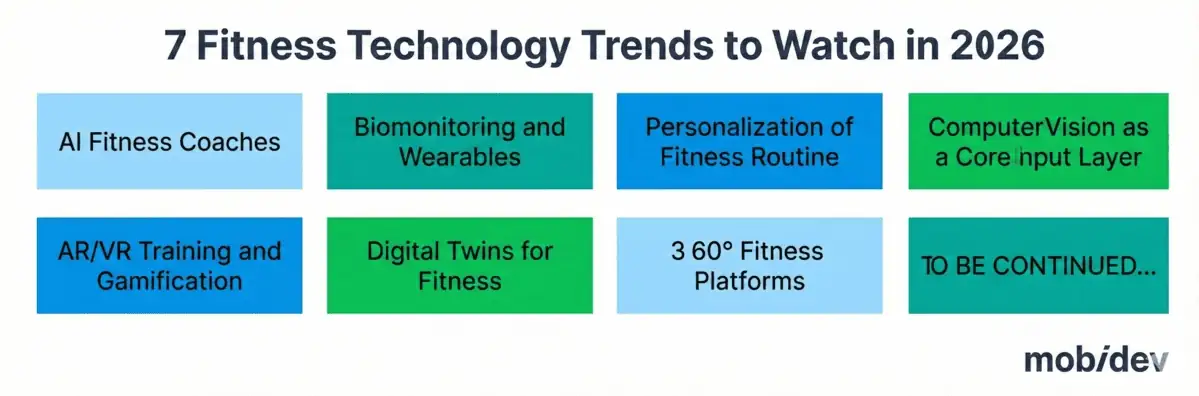
With that, we can single out the TOP 7 tech approaches that are trending over the last few years in fitness app development, and keep their pace towards the future. What are these trends?
7 Fitness Technology Trends: Summary Table
In this table, we summarized the trends we talked about in our article.
| # | Fitness Technology Trend | Trend Summary | How to Implement |
|---|---|---|---|
| 1 | AI Fitness Coaches | Virtual coaches lead the market by creating personalized workout plans, giving nutrition advice, monitoring progress, and suggesting improvements over time. | Build on algorithms + (for corrective feedback) human pose estimation; the core challenge is seamless in-app CV model operation—achieve accurate limb tracking and reduce processing time, then invest in UX for actionable feedback. |
| 2 | Biomonitoring and Wearables | A new wave of AI + IoT wearables enables real-time biomonitoring; this drives real-time adaptive training systems that adjust workouts during a session instead of using static plans. | Implement via a biomonitoring solution: APIs, data transfer protocols, and infrastructure to store/process user data; wearables collect and transmit to mobile (processed locally or sent to a server), with significant work in real-time AI model integration. |
| 3 | Personalization of Fitness Routine | AI-powered apps can generate customized workout recommendations using wearable outputs, direct user input, or optical sensors; recommendations can include workout type, difficulty, reps, or workout length. | Use recommendation engines and predictive AI algorithms to utilize user data for personalization and convert it into recommendations. |
| 4 | Computer Vision as a Core Input Layer | Camera-based fitness is becoming a primary sensing modality for precise form analysis, joint-angle tracking, and movement symmetry evaluation, enabling adaptive, closed-loop systems. | Start with real-time pose estimation (e.g., MoveNet or MediaPipe) to convert camera input into structured motion data; process via a biomechanics abstraction layer; add exercise-specific logic (reps, phases, quality, deviations) and run on-device for low latency, privacy, and offline use. |
| 5 | AR/VR Training and Gamification | VR/AR headset ecosystems are pushing gamified remote fitness, using interactive VR objects to increase engagement; the segment expands via headset marketplaces and integrations. | Build virtual training experiences using Unity or spatial computing frameworks (e.g., Apple’s RealityKit) and transfer existing fitness apps into a virtual realm as platforms open marketplaces for new VR apps. |
| 6 | Digital Twins for Fitness | A digital twin is a dynamic virtual model of a user’s body combining CV signals, wearables, and training history, feeding biomechanical/physiological modeling to test whether workouts are useful and safe. | Use the twin for “what-if” testing (e.g., increasing weight by 5 kg) to predict effects; update highly personalized recommendations continuously based on ongoing inputs (weekly average HR, weight change, menstrual cycle stage, etc.). |
| 7 | 360° Fitness Platforms | Users expect full-cycle platforms (Fitness-as-a-Platform) that connect modules, analytics, and device-agnostic experiences, covering a user’s fitness life under one synchronized system. | Connect multi-modal inputs and fuse signals for prediction accuracy; implement closed-loop behavior ; prioritize interoperability via unified data, APIs, and standardized schemas; make equipment “intelligent partners” . |
Quick FAQ
Pick the trend that meets the following criteria:
- improves retention quickly
- needs the least new infrastructure
- fits your data reality.
The best recommendation is to begin with the trend that has the highest impact on your business and is easiest to implement.
Trend #1. AI Fitness Coaches
Among the different ways AI is being used in fitness, AI fitness coaches are leading the market. Just like human coaches, they help people with personalized workout plans, nutrition advice, and monitor users’ progress and offer advice where needed. Such applications are based on algorithms that source the information on your workout plans and suggest improvements over time. Which is why their operation resembles a real coach supervising client activity during the exercise time, and out of it.
Virtual fitness coach applications can be split into four distinctive categories on the market:
- Analytical apps that make use of smart wearables and user input.
- Injury Risk Prediction apps helping users prevent injuries during training.
- Corrective feedback applications that run on human pose estimation models.
- Rehab applications meant to help people either prevent injuries or recover after long-term chronic conditions.
The difference between the four, is in the level of innovative fitness technology applied and the value brought to the end user. Let’s take a closer look at each type of apps.
1. Diet & Training Program Analytics
The majority of people experience problems with building an effective training routine, combined with proper diet and sleep-rest periodization, to achieve personal goals. In this aspect, AI-based analytics become increasingly popular for those who train at home or don’t have a coach. These apps can bring personalized workout plans using the input from the user and offer a tailored plan.
So, besides exercise and diet, training apps are some of the most common we’ve been working on for our clients. Users can leverage these apps to track their calories, plan training routines, and calculate the optimal balance of workout with rest. This can also improve existing fitness apps that extend the relationship between independent trainers and gyms with their customers, or be used as a means for remote coaching.
2. Injury Risk Prediction and Overtraining Detection
Another rapidly evolving capability of AI fitness coaches is injury risk prediction and overtraining detection. The system will continuously analyze workout intensity, recovery patterns, and biometric data from wearables. It then takes the accumulated data to identify early signs of risk-enabling trends. This, of course, happens on-the-go and in fractions of seconds.
The end user doesn’t have to feel pain to know when to stop a round. AI will signal a risk before it happens, making the whole exercise experience much more pleasant and safe.
In addition, these systems can learn individual baselines, successfully distinguishing productive strain and harmful overload.
3. Corrective Feedback Applications
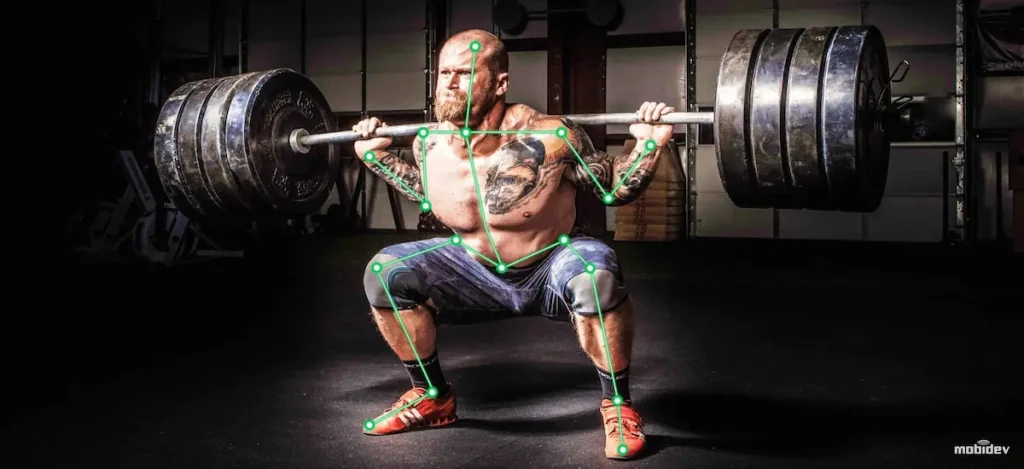
With computer vision, an AI fitness coach program can see you, especially where your body is in space and how you perform specific exercises. The approach based on AI pose estimation has been increasingly popular over the last few years, as more and more applications pop up.
Since 2020, MobiDev has been working with BeOne Sports, an innovative startup, to implement human pose estimation virtual coaches. In 2024, BeOne Sports partnered with Rice University’s Office of Innovation and Rice Athletics to implement the AI-based “Comparative Training” technology, which digitizes and analyzes elite athletes’ biomechanics using just a mobile device. With a comprehensive global database of human movement integrated into the BeOne Sports platform, Rice athletes will gain access to high-level performance comparisons and data-driven insights. This collaboration will enhance Rice’s capabilities in athlete monitoring, rehabilitation and injury prevention.
Recently Alex spoke in our webinar about how Human Pose Estimation works in real fitness products, why most HPE implementations fail after launch, and what it takes to turn pose tracking into safe onboarding, higher retention, and measurable revenue growth. Watch the webinar recap and get to learn more about
Accurate human pose estimation migrated from professional sports technology; however, the benefit of real-time analytics and corrective feedback provided for the majority of sports activities made its way to the fitness technology market.
Ultimately, computer vision-based solutions with human pose estimation are significantly cheaper and more accessible than full-body tracking solutions for fitness training. This lowers the barrier to entry, but users will still need to take care to make sure they’re exercising in a bright environment with low background clutter. That’s why we see this trend as the main high-tech phenomenon to look for in 2026.
To better understand how corrective feedback applications work in real-world fitness scenarios, it’s worth looking at practical implementations beyond professional sports. One example is our human pose estimation use case for yoga and pilates, which demonstrates how computer vision-based virtual coaches can analyze movement, detect form deviations, and deliver real-time corrective feedback using only a mobile device.
This approach brings advanced motion analysis to everyday training without the cost and complexity of specialized tracking hardware.
4. Physiotherapy and Rehab Apps
Similar to corrective feedback applications, human pose estimation found its use to help people recover after they receive an injury. As computer vision technologies are now accurate enough to recognize even smallest movement patterns, that are usually important for rehab procedures.
How to Implement an AI Fitness Coach Feature?
MobiDev has developed multiple products that fall into the category of AI coaching. From our practical experience, the hardest part of developing a fitness training application with computer vision, is in achieving seamless operation of the model within the app itself.
The majority of human pose estimation models don’t perform real-time processing or accurate limb tracking right off the bat. This requires meticulous attention to training and integrating the model with the application. Once the bare AI part performs accurate tracking and processing time is reduced to the minimum, it also takes effort to create thought-out user experience design. So, AI fitness coach projects certainly require prior experience in the field of integration computer vision and human pose estimation components to resolve specific tasks within the fitness umbrella even besides conventional programming. Having 5+ years of experience in this domain, our AI engineers will handle consulting and development of fitness solutions for you.
Implementing Human Pose Estimation and AI fitness coach can be tricky. Check out our use case featuring the best practices of building AI coach for fitness with HPE. It demonstrates that computer vision models can be integrated into mobile apps and provide real-time tracking, accurate limb detection, and actionable feedback for users.
While there are certain complexities to seamless AI integration and user experience design, the advanced coaching features can be delivered effectively in practice by human pose estimation companies like MobiDev.
Quick FAQ
Enough personalization is when users feel “this applies to me, this is about me” without feeling like their privacy is invaded. It can be achieved with 5–7 inputs, such as user goals, experience, time per session, equipment, injuries/limitations, and preferred style. Start there, then adapt based on user behavior (skips, completion rate, perceived effort).
Trend #2. Biomonitoring and Wearables in Fitness
Wearable devices such as fitness trackers, smart watches, and various kinds of pulse or heart meters have been around for years. However, with the advances in artificial intelligence and the Internet of Things, we can see a new wave of devices that bring real-time biomonitoring capabilities to the table.
One example of such devices is smart rings represented by Oura, Ultrahuman, and Samsung Galaxy Ring, and even some rumors of Apple developing their own ring wearable. Smart rings benefit from the thin skin of our fingers, which makes them more accurate at measuring heart rate, steps, sleep patterns, and workout dynamics than usual fitness trackers. But on the other side, a smart ring is significantly smaller than a watch, making it more suitable for intense training.
The most interesting aspect among wearable devices used for real-time biomonitoring is that they rely on powerful software ecosystems backed by AI. Simply said, having your health condition indicators, such wearables, can supply users with tons of useful information to modify their workout approaches, customize sleep/rest periodization, or even give advice on the required diet.
Whoop Coach, developed in partnership with OpenAI and backed by GPT, shows how advanced fitness wearables can be. The generative model GPT makes use of your biometric data and acts as a smart search engine for your body. So that users can generate highly personalized content for fitness purposes using their own body indicators.
1. Real-Time Adaptive Training Systems
One of the most impactful outcomes of advanced biomonitoring is the rise of real-time adaptive training systems. Powered by AIoT (Artificial Intelligence of Things), these systems can dynamically adjust workouts during a session instead of relying on static training plans.
AIoT can adjust the live session depending on vital parameters, such as:
- Immediate and average interval heart rate,
- Movement quality (how close each exercise is to ideal),
- Fatigue signals, like muscle tensions, jerking movements, reduced range of motion, etc.
Instead of relying on a static set of exercises, the end user gets something very close to a personal trainer. The AIoT technology helps ensure each training session is the most effective without risking injury or overfatigue.
2. Wearables Beyond the Wrist
The variety of gadgets that can help track vital signals is growing as well. In addition to quite common devices like watches and rings, users can get sensor-embedded clothing for muscle activation.
If they want to track specific metabolic or hydration signals most effectively, there are skin patches designed to do exactly that.
The right combination of such technology can enable a passive, always-on fitness data capture without too much intrusion or any discomfort.
How to Implement a Biomonitoring Feature in Your Fitness App?
Biomonitoring solution is basically a set of API’s, data transfer protocols, and infrastructure that stores and processes information for the user. All of these software components are sometimes nested inside a wearable device (like in some models of smart watches) that can be sourced via existing wearable technology vendors.
In most cases, however, wearables simply collect information and transmit it to a mobile device. A mobile device can either process this data locally or transmit it to a server. In other words, most bands and watches are a data collection point, connected to infrastructure that is located elsewhere.
Through the perspective of development, all you need is a team of experienced software consultants and engineers that can handle architecting and coding for a given operating system and devices. However, such projects will also require expertise in AI application development, as integration of existing models or custom development is a significant chunk of work when we speak about real-time data processing.
Want to create your fitness app? Learn from Our Step by Step Guide for Fitness App Development.
Quick FAQ
Metrics that drive better outcomes are those that indicate:
- the quality of exercise performance (e.g., is user training enough on the hard day?)
- the physical impact of a training plan on the user (e.g., sleep patterns).
That’s why the recommended metrics include:
- heart rate zones (training intensity)
- resting HR trends (fatigue)
- sleep duration/consistency (recovery)
- HRV trend (recovery).
“Nice-to-have” often includes flashy but non-actionable signals if you don’t have clear interventions tied to them.
Trend #3. Personalization of Fitness Routine
AI-powered fitness app development can now provide customized workout recommendations based on an individual’s physical and health levels, as well as personal fitness goals. While we’re talking about just using the output from wearable devices, AI is not limited to just that, as they can also use direct input from the user, or rely on optical sensors.
The obvious benefit of using AI for personalized fitness, is that it automates the data gathering process and helps to visualize it for the user as recommendations. These recommendations may include the type of workout, level of difficulty, number of reps, or length of workout. AI-powered personal training apps like Gymfitty offer smart workouts that adapt in real-time to the user’s specific needs. However, there are a couple of standalone trends here that we can discuss in detail.
How to Implement a Personalized Fitness Feature?
Personalization of content is deeply integrated into various products through recommendation engines and predictive types of AI algorithms. Both technologies are well-researched today and there are lots of proven approaches to utilize user data for personalization. If you want to investigate possible options, read more about AI consulting services and contact us to receive a concise answer specific to your product requirements.
Quick FAQ
We recommend asking only the questions that are critical for the first week of the training plan. These are golas, schedule, available equipment, prior experience, and limitations. When trust is built, you can suggest answering more questions, such as diet, detailed history, etc.
Trend #4. Computer Vision as a Core Input Layer
Camera-based fitness is maturing into a primary sensing modality for exercise tracking and performance optimization. Wearables can provide indirect metrics, sure. But computer vision (CV) enables precise form analysis, joint-angle tracking, and movement symmetry evaluation.
It’s very much possible to embed these CV models into mobile devices, smart mirrors, or fitness cameras. All you need is the right set of tech and an app to present the readings in a convenient way to the end user.
How to Implement CV Trend in Fitness Apps
Implementation starts with real-time pose estimation using models, such as MoveNet or MediaPipe. Those convert camera input into structured motion data, like joint positions, angles, velocity, range of motion, and symmetry.
The raw data is then processed through a biomechanics abstraction layer, which normalizes movements across exercises. Now, the raw video footage is transformed into variables that software can analyze.
Exercise-specific logic interprets the received signals. It tracks repetitions, identifies exercise phases, evaluates movement quality, and detects form deviations.
It’s also important to account for real-time feedback, workout adjustments, difficulty scaling, and injury-risk prevention. All that is more effective when run on the device itself (for lower latency, privacy, and offline usability).
This allows fitness platforms to move beyond static programs and evolve into adaptive, closed-loop training systems. In 2026, the most successful products will treat computer vision as the foundation of fitness telemetry, rather than a simple form-check feature.
Why It Matters
By making CV the primary input layer, fitness applications can deliver more personalized, precise, and responsive training experiences. For developers, CV as an input layer opens opportunities to build scalable, data-driven platforms. Those can later be integrated with multiple sensors while maintaining privacy and real-time responsiveness.
Trend #5. Augmented and Virtual Reality Training and Gamification of Fitness
Following the augmented reality trends and their use in fitness technologies, in 2026, the market of AR applications is blooming with an annual growth rate of 37%. All of the major providers for VR/AR headsets that go with their dedicated products identify the need to gamify the experience of remote fitness exercising. Which is why, the fitness tech market also benefits from seamless integrations.
For instance, Meta offers a whole range of VR fitness environments that can be used for group exercises. The big difference here is the extensive use of interactive VR objects that increase customer engagement and make fitness experiences more entertaining. And we can see a market segment forming there, as there are tons of third-party fitness platforms integrated with different generations of MetaQuest headsets.
This trend is a natural extension of what the metaverse can bring to businesses, because fitness is just one of numerous use cases. However, virtual training in VR seems to be the more rapidly growing segment, since tech giants step into the race of better headsets, which is evident after the release of Apple’s Vision Pro.
How to Implement Virtual Training and Gamification Features?
We have a separate article dedicated to augmented reality app development. What is worth mentioning here is that as the VR headsets become more of a usual thing among users, the development platforms start to open their marketplaces for new applications. This means that the expertise in Unity development or spatial computing frameworks (like Apple’s RealityKit) becomes a crucial element for transferring existing fitness applications into a virtual realm.
Trend #6. Digital Twins for Fitness
Digital twins are the best way to adopt all of the above trends under a single use-case. In its essence, a digital twin is a complete, dynamic virtual model of a user’s body. It uses vital information from various sources, such as computer vision (movement quality, joint angles, symmetry), wearables (heart rate, HRV, recovery), and training history (load, volume, intensity).
The combination of the above allows building an accurate copy of a person’s body that can then be used to test if a specific workout will be useful and not dangerous for them. The data feeds a biomechanical and physiological modeling layer that represents the user’s musculoskeletal structure, movement capacity, fatigue patterns, and adaptation rates.
How to implement this trend
For example, one could ask the AI assistant to test if increasing weight by 5 kgs is a good idea for an exercise. The model will test this on a digital twin and come up with an accurate prediction of the change’s effect.
Putting this technology into proper use will allow creating highly personalized training recommendations. Those will be updated constantly depending on inputs like the weekly average heart rate, weight change, menstrual cycle stage, etc.
Trend #7. 360° Fitness Platforms
With all the variety of fitness tech, one could correctly assume it has become its own industry. More and more users expect full-cycle, 360° platforms that would seamlessly provide assistance in their health and fitness lives. The possibilities reach way beyond dashboards and personalised sets of exercises.
Fitness-as-a-Platform (FaaP)
The concept of fitness operating systems is well adoptable with the tech mentioned above. FaaPs can connect third-party coaching modules, plug-in analytics tools, and device-agnostic experiences.
The end user gets the full experience tailored specifically for them. This experience consists of inputs and outputs that the specific user is comfortable with and able to use. Thus, the whole aspect of a person’s life is fully covered by a single provider that puts all the synchronization and connectivity under the hood.
Multi-Modal Sensor Fusion Platforms
In order for FaaPs to work properly, a total combination of multiple data input streams is necessary. That’s what multi-modal sensor fusion platforms are for. They operate with inputs from:
- Wearables (HR, SpO₂, HRV),
- Computer vision,
- Smart equipment telemetry,
- Environmental data (air temperature, humidity, altitude, etc.)
It’s no longer a problem of reading all of that data. The competitive edge for developers must be tied to how successfully their systems fuse those signals and how accurately they make predictions for training advice.
A user would expect a consistent experience, equally pleasant and effective workouts, and a change in how they feel after workouts.
Closed-Loop Fitness Systems
In 2026, competitive fitness platforms must be able to provide a consistent end-to-end experience. Similar to insulin pumps or autonomous systems, a closed-loop fitness system will:
- Read performance and recovery input,
- Analyze actual outcomes and predict future ones,
- Adapt training automatically based on that data,
- Continuously re-evaluate its own assumptions and recommendations.
In short, such systems should minimize user input if their developers want to achieve a wow effect. With that accomplished, customers will stay happy and willing to pay for the subscription.
Interoperable Fitness Data Ecosystems
Platforms that prioritize data interoperability will outperform device-specific solutions. Key features include:
- Unified data across devices, apps, and gym systems,
- APIs connecting wearables, coaching apps, and healthcare platforms,
- Standardized fitness data schemas.
These platforms should centralize the aggregation of data rather than own individual devices. This creates value for both users and developers.
Smart Equipment with Embedded Intelligence
Hardware itself must become part of the platform. For example, there are AI-controlled resistance machines that can change the weights based on vital sign readings. In addition, smart equipment can analyze and learn user movement patterns. This data is fed to an AI, which in turn changes the intensity of training if poorer results are read.
Gyms and home setups already increasingly rely on software-defined hardware. So, aim at turning equipment into intelligent partners in workouts rather than passive tools.
8 Challenges of the Fitness Tech Market
Surely, the whole fitness tech market would already be populated with tech and apps described in this article, if not for the fitness app development challenges. Let’s have a look at what fitness app development companies can expect to face.
1. Data Security & Privacy Vulnerabilities
Although a challenge for most modern tech trends, data privacy is especially important when it comes to users’ health. Unfortunately, there are many significant security flaws in AI-amplified fitness tech. For instance, ad-hoc coding, excessive permissions, and third-party communication setups.
As fitness tech collects health and personal data at scale, weak security undermines user trust and leads to regulatory scrutiny.
2. Interoperability & Integration Hurdles
While the whole everything-is-connected idea sounds exciting, bringing it to life is particularly hard in fitness tech. There are way too many sensor devices, apps, gym equipment types, etc. In addition, all those are produced by countless developers and providers.
With that in mind, a truly silo-free FaaP seems like a very distant dream. However, with the proper use of AI and smart algorithmic development, it is possible.
3. Evolving Regulatory Compliance
Many fitness-tech apps and equipment fall under medical device and health regulation requirements. The need to keep users’ data secure and private is not dictated by their own needs only. There are real legal repercussions for handling that data poorly.
Stricter FDA oversight for health metrics on wearable devices is already a case worth looking into.
4. Accuracy & Sensor Reliability Issues
Wearables aren’t always precise. Heart rate, oxygen levels, and other readings can be inconsistent, which affects the value of the end product. Constant improvement in accuracy is the only way to keep a competitive edge.
5. User Adoption & Digital Literacy Barriers
Consumer expectations are constantly changing and evolving. Users want seamless experiences that would take them less than a few minutes to get used to.
In addition, varying levels of tech adoption complicate growth, especially when it comes to complex AI-powered fitness apps and devices.
6. Market Saturation & Competitive Pressures
The fitness tech space is becoming overwhelmingly crowded. Differentiation and growth are harder for mid-tier and niche players, especially with giants like Apple, Samsung, Garmin, and others continuing to evolve their devices.
Saturation contributes to pricing pressures, slower innovation cycles, and consumer fatigue.
7. Ethical & Behavioral Concerns
Over-monitoring and potential unhealthy behavior suggestions are among the top issues in the ethical aspect of fitness tech. A successful developer should be ready to proactively assure their clients that the product is safe and not privacy-imposing. This, of course, must be proven with actual features.
8. Technical Challenges in Machine Learning & Personalization
AI models often use pre-trained systems that don’t fully adapt to each user. Human pose estimation apps offer a good balance here, as they guide workouts while still encouraging real-world exercise and social interaction.
Many of these challenges are related to the use of artificial intelligence that’s usually based on similar pre-trained models and doesn’t correspond much to humanizing its experience. While personalization with AI can help optimize and improve training regimens, it’s not necessarily a replacement for human coaches and group exercise. This imposes a threat of worsening mental state while improving one’s physical state.
As the market is overly saturated, this leads to competition between virtual fitness segments and actual gyms fighting for customers’ attention.
With that, human pose estimation-based coaching applications seem to be a perfect balance between the two. As the technology behind is advanced enough to cover basic training needs of the user, while not interrupting people from real-world experience and communications.
Why Build Your Fitness App with MobiDev
If you want to get that competitive edge for your fitness app, you’ll need to utilize the most up-to-date practices and tech stacks. MobiDev’s engineers have years of experience building applications for the fitness, sports, and wellness industries. Their expertise includes AI, IoT & wearable technology, Computer Vision, Human Pose Estimation, and Augmented Reality.
Get the fitness app development services that will help you create a high-quality, scalable, and user-focused product. Whether you need a wearable-integrated platform, an AI-powered coaching app, or a full 360° fitness ecosystem, we’ve got you covered. Let’s cooperate today to realize a future where everyone can use their potential for growth!