
 17 min read
 The market for fitness apps is crowded. It is noisy. And frankly, it is filled with products that users delete after three weeks.
In recent years, the industry has changed. Users no longer pay for simple data collection. They can write their bench press results in a notebook for free. They pay for advice. They pay for a system that evaluates their data and tells them exactly what to do next.
If your application does not adapt to the user’s stress levels, recovery data, or schedule changes, it is already obsolete. You need to go beyond static logic. You need to integrate AI capabilities that turn your product from a passive tracker into an active coach.
I’m Alex Vasilchenko, Solutions Architect at MobiDev. Over the past 15 years, I’ve worked my way up from backend engineering to a leadership position in data science research and development. My work focuses on one thing: transforming confusing, fragmented data into reliable systems. For this outlook on 2026, I’m focusing on privacy-oriented AI. You need practical technologies that improve your life, rather than just cluttering your screen with information. I’m here to share the insights on how to build them.
This guide leaves the hype aside and focuses on the technical reality. It describes the specific architecture required to develop a system that users can truly trust. Below you will find your blueprint for the next generation of AI-driven fitness app development.
4 Reasons Why AI Capabilities Will Drive Fitness Apps in 2026–2027
You might think AI is just a buzzword to throw into a presentation. It is not. It is the only way to process the huge streams of biometric data available to applications today. The market data speaks for itself. Money is flowing toward intelligence, not just storage.
1. AI is Driving Fitness App Market Expansion
The market is not only growing, but it is also evolving structurally. According to InsightAce Analytics, the global market for AI in fitness will grow from approximately $9.8B in 2024 to $46.1B in 2034, representing a CAGR of 16.8%. This is driven by demand for AI-powered personalized training and virtual coaching rather than simple workout tracking.
This forecast tells you one thing: platforms that only log activities are dying out. They are being overtaken by systems that interpret behavior in real time. AI is now the driving force behind customized training plans and virtual coaching. Users expect feedback. If you don’t give it to them, they will find an app that does.
Similarly, Grand View Research notes that the global fitness app market is expected to grow from $12.12B in 2025 to $33.58B in 2033, with the CAGR of 13.4%, citing AI-driven personalization as a key growth driver for the entire segment.
While this report covers the broader market, the message is consistent. Fitness apps based on static features will struggle to gain market share. They need to leverage real-time AI insights to customize routines.
2. User Engagement with AI Fitness Apps is Growing
Usage patterns are shifting from “checking in” to “relying on.” According to Mordor Intelligence, the digital fitness app market was estimated at $13.59B in 2025 and is expected to reach $24.74B by 2030, with AI-powered personalization and biometric monitoring extending interaction beyond simple tracking.
This proves that AI is transforming fitness platforms from episodic use to continuous use. By embedding AI into core user experiences, you position your product to capture this growing market.
3. AI Adoption is Fueling Broader Smart Fitness Tech Growth
Software does not exist in a vacuum. According to Future Market Insights, the total market for smart fitness products (including AI-connected devices and software) is expected to grow from $18.6B in 2025 to $59.8B in 2035, representing a compound annual growth rate of 12.3%, reflecting the increasing adoption of AI-powered training technologies among consumers.
Your application must work well with the hardware. This general trend underscores that AI-enabled fitness apps are part of a larger ecosystem. Hardware and software must work together to help consumers get more out of every workout.
Quick FAQ: Strategy and Market Value
C-level executives often worry that introducing complex technologies will have no impact. The key indicator is whether AI is linked to a specific training decision — such as adjusting the load or selecting exercises. If it helps users make these decisions more consistently, it adds value. Start small, define metrics, and justify the complexity with results. Try AI consulting services if you need guidance from the experts.
What AI Can Do in Fitness Apps: 5 Benefits
Stop looking for features to add to your roadmap when building a fitness app. Look for problems to solve. AI is not a magic wand, but a tool to reduce friction in the user journey.
1. Delivering Adaptive Training Programs in Real Time
Static PDF plans are a thing of the past. AI enables fitness apps to move beyond rigid schedules. You can develop systems that continuously adapt training programs to users’ performance, progress, and consistency.
If a user achieves a personal best, the system increases the load for the next week. If they miss three training sessions, it recalibrates. This adaptability improves the relevance of the training. It reduces the dropout rate because users feel that the app responds to their actual abilities.
2. Improving Movement Quality Through Intelligent Feedback
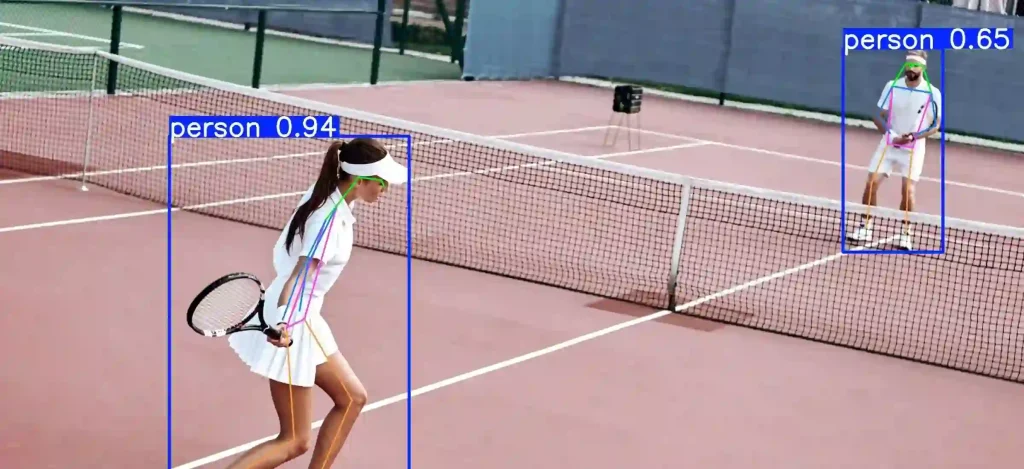
Users train alone. For example, they don’t know if their squats are deep enough. Using human pose estimation technology, AI-powered fitness apps can analyze movement patterns using sensor data, computer vision, or video recordings to detect deviations in form.
They can immediately identify problems with range of motion and irregularities in execution. This allows apps to provide feedback on technique. By improving movement quality, they help reduce the risk of injury. They enable users to train effectively without a human trainer monitoring every repetition.
For a deeper insight into how this works technically, see this use case for estimating posture in yoga and Pilates.
3. Supporting Coaches With Scalable, Data-Driven Insights
AI is not intended to replace coaches. It is intended to make them superhuman. On platforms for professionals, AI acts as a force multiplier. It aggregates customer data and highlights patterns of progress.
It flags plateaus that may be overlooked by the human eye in a spreadsheet. This allows coaches to focus on high-value interventions. They maintain personalization at scale without increasing operational overhead.
See how this can be scaled in the case study or read more about how to develop a human pose estimation app.
4. Increase Training Consistency and Long-Term Engagement
Churn occurs when users feel stuck. AI helps fitness apps recognize when users are losing momentum. It responds with timely adjustments.
Maybe the user needs a week off. Maybe they need a different selection of exercises. By proactively responding to performance signals, AI supports habit formation. You prevent churn before it happens.
5. Turn Raw Fitness Data Into Actionable Decisions
Most fitness apps collect too much data. They display graphs that users don’t understand. AI closes this gap. It converts raw metrics such as volume, intensity, pace, and progress into actionable recommendations.
Don’t tell the user that their HRV is 40. Tell them to skip the high-intensity interval training today.
7 Types of AI-Driven Fitness Apps
In this section, I list the 7 types of fitness apps where AI can make the biggest impact. These are use cases of successful AI features that helped win over new clients and retain the old ones.
1. Personalized Strength Training App
This app is about self-regulation. A personalized strength training app uses AI to create and continuously adjust strength programs. It takes into account performance history and rate of progress.
As users improve, the app readjusts the volume and intensity. Instead of static plans, you deliver responsive programs that reflect real-world progress.
2. Movement and Form Analysis App
This tool is based on computer vision. A movement and form analysis app uses camera footage and/or wearable sensors to evaluate performance. It detects form errors or asymmetries.
It also provides feedback during training, guiding the user’s workout. This is particularly valuable for remote training scenarios where personal coaching is not available.
3. Training Load and Recovery Management App
The focus here is on longevity. An app for training load and recovery management uses AI to monitor training frequency and intensity. It balances stimuli with recovery data.
By detecting early signs of excessive strain, the app recommends adjustments before performance declines. This supports consistent training instead of short-term burnout.
4. Coach Support and Client Management App
This type of fitness app is for a B2B model. An app for trainer support and customer management is designed for professionals who serve multiple customers. AI highlights important trends and gaps in clients’ progress.
Trainers and coaches no longer get bogged down in data. They focus on decisions with a big impact. This enables scalable coaching without sacrificing the personal touch.
5. Real-Time Adaptive Workout App
This happens within the session. A real-time adaptive training app dynamically adjusts training based on live performance signals.
If a user struggles with the quality of their reps, the app reduces the weight for the next set. This creates a responsive experience similar to working with a human trainer.
6. Progress Tracking and Performance Forecasting App
This app looks to the future. A progress tracking and performance prediction app applies AI models to historical data. It predicts results.
It recognizes plateaus before they occur. Users gain insight into whether their current program is actually working.
7. Intelligent Exercise Programming App
This app solves the equipment problem. An intelligent training planning app helps select exercises based on available equipment and movement abilities.
It immediately suggests alternatives or regressions. You optimize program design while ensuring safe and relevant training.
Quick FAQ: Areas of Application
That depends on where the complexity lies. With B2B platforms, trainers benefit immediately from AI that puts the needs of customers first. With consumer apps, AI that is directly targeted at the user ensures faster engagement gains. Start with the role where AI most clearly reduces friction.
AI Agents in Fitness Apps
The industry is leaving simple algorithms behind. It is entering the age of agents. AI agents shift the paradigm from static analysis to systems that continuously monitor and respond to training signals.
How AI Agents Differ From Traditional AI Features
Traditional AI waits for input and provides output. Agents are different. They offer continuous monitoring instead of a one-time analysis. They make autonomous decisions within defined limits. They perform proactive interventions instead of providing passive insights.
What AI Agents Can Enable in Fitness Apps
Agentic AI in fitness apps enable adaptive training coordination. They detect early signs of disinterest. They manage the intelligent increase of training load. And they make a decision on the best course of action, which can be overridden by humans, of course. This way, agents support scalable coaching for multiple clients.
AI Agents for Coach-Led and Consumer Fitness Platforms
This ensures greater efficiency. Agents take over tedious tasks for coaches. For consumers, agents offer a responsive training experience. They reduce manual monitoring tasks without losing control.
Case Study #1: AI-Powered Fitness Solution with Pose Estimation
Theory is good. Implementation is better. Let’s look at a real-world implementation. A customer needed to develop a solution for estimating human posture for athletes.
The challenge was clear. They needed to evaluate athletes’ performance remotely using only a smartphone camera. They wanted to track technique and accuracy without expensive hardware sensors.
MobiDev engineers developed an iOS application using computer vision. The system processes recorded video to track key body points. It generates an analyzed video with a skeleton overlay and performance scoring. BeOne Sports application allows coaches to monitor technique and compare it with professional athletes using a “ghost” overlay. This turned a normal video feed into a biomechanical lab.
For the full breakdown, check out the case study here.
Case Study #2: AI Agent Increased User Retention by 24% in a Fitness App
A fitness company faced challenges with long-term user retention: while their mobile workout app successfully attracted new users, there was around a 40% drop in engagement, once users completed onboarding and their initial workouts.
The company approached MobiDev to help enhance the app and improve user retention. After analyzing the product and user behavior patterns, MobiDev suggested implementing an AI agent into the workout app to deliver personalized workout suggestions, behavioral nudges, and conversational support throughout the user’s fitness journey.
After one year after launching the AI-powered training companion, the platform achieved a 24% increase in retention among active users that contributed to around a 20% rise in weekly workout sessions and roughly a 25% increase in overall app interactions.
As a result, the simple workout app evolved into an engaging AI coaching fitness platform with personalized training guidance available 24/7.
Learn more about AI fitness coach app development capabilities at MobiDev.
8 Challenges in AI-Powered Fitness App Development and How to Overcome Them
Things don’t always run smoothly. Integrating AI introduces a probabilistic layer into your code. Your app expects a string, but the model returns an error. To manage this chaos, you need to change the way you develop.
1. Large Number of Edge Cases due to Human Behaviour Variability
Fitness apps encounter a lot of edge cases on a daily basis because of the variability in user behaviour. Forecasting all the edge cases is impossible because of the high variability of possible human activities.
This variability can significantly impact the ability of your application to correctly analyse the data. As a result, the errors can occur, causing the user dissatisfaction with app performance.
2. Limited Context Around Movement and Exercise Execution
Raw data, such as “10 repetitions,” does not tell the whole story. It does not provide any information about the quality of execution or fatigue. Without this context, AI models draw incorrect conclusions.
This is crucial in remote learning. If the user has performed 10 repetitions with poor execution, the AI might think they are strong. In reality, there is a risk of injury, and your app should report this rather than celebrate it.
3. Translating AI Outputs Into Actionable Training Guidance
Many AI apps fail because of the “so what?” factor. They deliver results and trend lines. However, they don’t tell the user what to do next.
If AI insights don’t support concrete training decisions — such as adjusting the load or changing exercises — they are useless. You need to translate the math into action so that the user knows exactly how to adjust their behavior today.
4. Balancing Personalization With Scalability
Everyone considers themselves unique. But you can’t create a unique model for every single user. That would be too expensive.
As the number of users increases, it becomes increasingly complex to maintain comprehensive personalization. Without a carefully thought-out architecture, your system will become vulnerable and your AI fitness app development cost will explode due to inefficiency.
5. Integration With Existing Fitness Technology Ecosystems
Your app doesn’t exist on an island. It needs to be able to communicate with Apple Health, Garmin, and older gym software. Poor interoperability leads to fragmented data.
If Apple updates its API, your sleep tracking feature may no longer work. You are building on quicksand. You need a middleware layer that abstracts these third-party sources so that your core logic remains stable regardless of external changes.
6. Building Trust Without Over-Automating Coaching Decisions
Users trust people. They are skeptical of machines. If your AI appears to be replacing human judgment, users will resist it.
Excessive automation reduces accountability. You need to find a balance. AI should make suggestions, humans should make decisions (or at least feel like they are making decisions).
7. Ensuring Privacy and Responsible Use of Fitness Data
You are working with PII related inter alia to health. This is sensitive data. Mishandling it is not only a PR disaster, but also a legal problem.
You need to integrate data protection and access control into the system foundation. You cannot retrofit this later when the auditors are at your door.
8. Lack of In-House AI and Data Expertise
Most fitness and fitness tech companies lack experienced AI specialists and data scientists. If you have your AI models developed by generalists, you will end up with unstable systems.
This shortage of skilled talent leads to slow iterations. You need specialized expertise to develop robust models. The best approach is often to hire a company to develop AI fitness apps or to use AI consulting services.
Challenges of Developing Fitness Software with AI Capabilities
Building these systems isn’t just about writing clean code. It’s about dealing with uncertainty. Below is a summary of the key friction points you’ll encounter and the specific architectural strategies needed to eliminate them.
| # | Challenge | Brief Summary | Solution Approaches |
|---|---|---|---|
| 1 | Edge Cases | Human behaviour variability makes AI analytics and insights unreliable. | Add verification layer (e.g., the starting pose for HPE). When testing apps collect the most frequent edge-cases and cover them with additional checks. |
| 2 | Limited context | “Proxies” overlook the nuances of form and fatigue. | Supplement raw data with video analytics or sensor fusion. Design models that account for variability in execution. |
| 3 | Unclear results | Users are confused by analytics without instructions. | Design results around decisions. Translate “fatigue score 80” into “reduce load by 10%.” |
| 4 | Scalability issues | Customization for each user is too costly. | Use modular personalization logic. Create configurable rules and shared model components that can be adapted. |
| 5 | Integration problems | Fragmented data disrupts AI pipelines. | Create flexible integration layers with standardized APIs. Test early on with real production data. |
| 6 | Trust barriers | Users reject AI taking complete control. | Position AI as a decision-making aid. Provide explainable recommendations. Allow manual overrides. |
| 7 | Privacy risks | Improper handling of biometric data carries legal risks. | Apply privacy by design. Enforce strict access controls. Be transparent about data usage. |
| 8 | Lack of expertise | Generalist teams create fragile models. | Outsource AI development to a collaborator with proven expertise in fitness software. |
Addressing these issues early on makes the difference between a prototype that works on a laptop and a product that proves itself in the hands of thousands of users. If you ignore the data context or data protection layer during the MVP phase, no amount of sophisticated modeling can save the product later on.
Quick FAQ: Data, Trust, and Privacy
Executives assume that AI requires huge data sets. However, this is rarely the case in the fitness sector. AI in its early stages already delivers added value with limited but consistent data (logs, progress). What counts is the context, not the quantity. A small, clean data set tailored to a specific problem is better than a huge, confusing data set.
How to Build an AI-Powered Fitness App: A Practical 7-Step Plan
Don’t start programming just yet. Most founders rush to the IDE to develop features before they have defined the user journey. This is a fatal mistake in AI development. Algorithms are expensive to develop and difficult to adapt. Follow this process to ensure you create something valuable.
Step 1: Define the Fitness Problem and Success Metrics
Every successful AI fitness app starts with a problem. Don’t start with data or algorithms. Identify a specific decision that users struggle with. Are they injuring themselves? Are they stagnating?
Define success clearly. Vanity metrics like “daily active users” are useless here. You need to measure the quality of the decision. Did the user accept the AI’s suggestion? Did it help them lift more weight?
Step 2: Assess Data Sources and Feasibility
Once the problem is defined, review your data. Can you actually solve it? Evaluate whether the available data from wearables or logs is sufficient.
This step reveals gaps. Perhaps you need an execution context that you don’t have. Reviewing data feasibility prevents overengineering models that real-world data cannot sustain, directly optimizing your AI fitness app development cost by setting realistic expectations early.
Step 3: Select the Right AI Capabilities
Choose the right tool for the job. Pattern recognition requires machine learning. Motion quality requires computer vision. Don’t overcomplicate things.
Simplicity is a strength. Select one primary feature. Quickly verify its value before adding further layers of complexity. This will reduce risks and technical debt early on.
Step 4: Design the Experience Around Training Insights
AI is useless if the user experience is poor. Design the experience around the training decision, not around data visualization. Don’t just create an analytics dashboard that forces the user to do the math themselves.
Recommendations should be clear, contextual, and easy to apply during training. If the user has to interrupt their training to decipher a graph, you have failed. Make AI feel like a natural extension of the training logic.
Step 5: Build an MVP Focused on One Core Use Case
Solve one problem well. Create an MVP that considers one user role and one specific decision. Maybe it’s just about adjusting training intensity.
Test it immediately with real users. Focus your feedback on behavioral changes. Does the AI actually improve the training decision? If the AI recommends a rest day and most users ignore it, your model has failed.
Step 6: Train, Evaluate, and Iterate Continuously
Your model is never finished. Model drift is real. A model trained on summer running data will fail in winter conditions.
As training data grows and users’ biomechanics change, models need to be retrained. Users change; your AI must evolve with them.
Step 7: Scale, Secure, and Optimize for the Long Term
Now you scale. This is where previous architectural shortcuts come back to haunt you. The system must support thousands of concurrent users and different training styles without latency spikes.
It must handle additional integrations like new wearables or new health APIs without compromising the core logic. Security and governance are paramount here. You are working with biometric data, and at scale, a small leak can lead to a major lawsuit. Treat AI as a core feature of your product, not something you can add later.
Quick FAQ: Execution and Teams
Not immediately. Many companies bring successful AI features to market with hybrid teams or external specialized providers. The key to long-term success is finding the right team with the necessary expertise and experience. Documentation is another important aspect that will enable you to keep your project going even if the team composition changes.
Build an AI Fitness App with MobiDev
To implement a competitive AI functionality in your fitness app, you need more than a sketch on a napkin. The real challenge lies in the murky details of data science and strict privacy regulations. You need to train AI models that don’t just guess, but actually reason without bias. It’s not enough to just write code; you need to build security into every layer from the start.
Hiring MobiDev for AI fitness software development ensures you have an experienced team of AI engineers at your side. You get data scientists who have spent years working on making AI-based apps run smoothly. You benefit from over 8 years of in-depth work in the areas of data science, sensors, wearables, and AI pose estimation development. This ensures that your product meets today’s high user demands while being ready for tomorrow’s digital twin revolution.
It doesn’t matter if you’re a fast-growing scale-up or an established company launching a new R&D pilot project. You need to implement the latest technology in the fitness space without losing sight of the end result. You need to transform scattered, confusing data into a unified ecosystem that users actually want to stick with. Explore the AI fitness app development services available to you and start building a technical foundation that is ethical, stable, and designed for longevity.