

Contents:
The best augmented reality app development companies in 2026 include MobiDev, ELEKS, Softeq, Groove Jones, and Trigger XR. These vendors build immersive AR experiences for retail, hospitality, fitness, health, manufacturing, and real estate, with leaders like MobiDev combining AR engineering, AI capabilities, and enterprise-grade software development across ARKit, ARCore, WebAR, Apple Vision Pro, and Microsoft HoloLens.
TL;DR
- Scope: The 8 best AR app development companies in 2026, compared by engineering depth, platforms, pricing, clients reviews, and proven expertise.
- Audience: Product owners, founders, CTOs, and enterprise innovation teams evaluating AR vendors.
- #1 Pick: MobiDev for engineering-focused AR product development with deep AR + AI expertise in AR visualization & spatial computing.
- Key Trend: AI-powered AR and spatial computing continue to drive enterprise adoption; PwC projects AR alone will add $1.1 trillion to global GDP by 2030.
- Next Steps: Scan the table below or talk to MobiDev AR experts for a free consultation.
At a Glance: Compare the Best Augmented Reality App Development Companies
The table below compares the top 8 AR app development vendors by team size, AR specialization, technologies, engagement model, and pricing, so you can shortlist by fit before reading further.
| # | Company | Year Founded | Team Size | AR Specialization | Core TechnologiesCore Technologies | Engagement Model | Clutch Rating | Avg. Hourly Rate | Best for |
|---|---|---|---|---|---|---|---|---|---|
| 1 | MobiDev | 2009 | 250 - 999 | Engineering-focused AR apps enhanced with AI capabilities | ARKit, ARCore, Unity, WebAR, Vision Pro, HoloLens | AR consulting, dedicated team, augmentation | 4.9/5 | $49 - $100 / hr | AR visualization and AR spatial computing products built for scale |
| 2 | ELEKS | 1991 | 1,000+ | Enterprise software with AR modules | Unity, computer vision, .NET, cloud | Dedicated teams | 4.8/5 | $50 - $99 / hr | AR wired into complex enterprise systems |
| 3 | Softeq | 1997 | 250 - 999 | Hardware-connected AR & IoT | Unity, ARKit, ARCore, embedded C/C++ | Dedicated team, T&M | 4.8/5 | Undisclosed | AR tied to custom hardware and devices |
| 4 | Groove Jones | 2015 | 10 - 49 | Creative brand AR/XR activations | WebAR, WebGL, Three.js, Unity, AI | Project-based | 4.9/5 | $100 - $149 / hr | Award-caliber marketing and event AR |
| 5 | Trigger XR | 2005 | 10 - 49 | Entertainment & sports WebAR | 8th Wall WebAR, Unity, ARKit, ARCore | Project-based | N/A* | Undisclosed | |
| 6 | YORD Studio | 2018 | 10 - 49 | Immersive event & showroom XR | Unity, Unreal Engine, WebAR | End-to-end delivery | 4.9/5 | $50 - $99 / hr | Exhibition XR with measurable lead generation |
| 7 | Zco Corporation | 1989 | 250 - 999 | AR/VR in full-service app development | Unity, ARKit, ARCore, 3D animation | Fixed price, T&M | 4.7/5 | $25 - $49 / hr | Budget-conscious AR with a veteran vendor |
| 8 | Appinventiv | 2014 | 1,000+ | Mass-market mobile AR features | ARKit, ARCore, Flutter, Unity | Fixed price, T&M | 4.8/5 | $25 - $49 / hr | Consumer AR features at enterprise volume |
*Trigger XR maintains a limited Clutch presence; its credibility is anchored in verified platform partnerships (8th Wall, Niantic, Qualcomm, Unity) rather than directory reviews.
What Are the Best Augmented Reality App Development Companies in 2026?
The best augmented reality app development companies in 2026 are MobiDev, ELEKS, Softeq, Groove Jones, Trigger XR, YORD Studio, Zco Corporation, and Appinventiv. We vetted these eight firms on AR engineering maturity, platform coverage, AI capabilities, and their record of shipping AR products that survive real users, real lighting, and real platform updates.
1. MobiDev: The Engineering-Focused AR Development Leader
If your AR product needs to do something the standard SDKs cannot, MobiDev is generally where the search ends. The team has been building AR applications since ARKit launched in 2017, which translates into 9+ years of platform-specific knowledge across ARKit, ARCore, WebAR, Apple Vision Pro, and Microsoft HoloLens. This is backed by 16+ years in software product development.
H4: Where Standard AR Frameworks End and MobiDev Begins
On one AR implementation project, the AR measurement app development for US home renovation firm N2:20, off-the-shelf tooling could not split a scanned floor into zones with different materials. MobiDev built a custom algorithm on a Graph data structure to do it in real time, added relocalization so reopened projects could resume exactly where the original scan ended, wiring in instant cost estimates from the materials a homeowner selects.
In another case for a multinational travel client, MobiDev built a custom augmented reality app to keep AR flawless under weak WiFi and GPS signals, a constraint creative XR agencies rarely plan for, while the face recognition mobile application detects drowsy driving via real-time facial tracking on iOS.
Built for the Enterprise Long Game
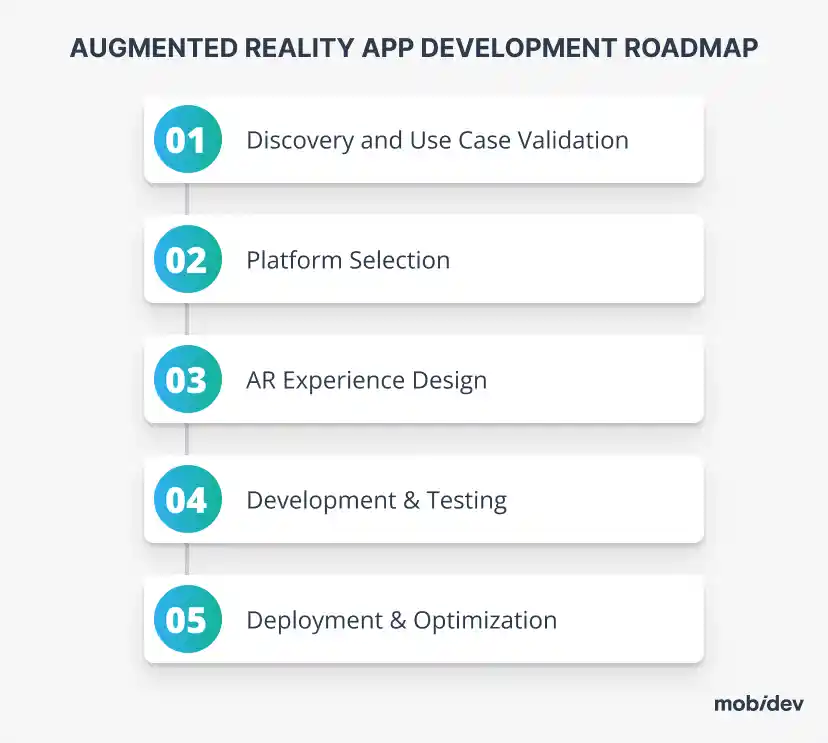
MobiDev’s delivery model is structured for products, not activations: a discovery phase and architecture planning, AR consulting, development with rigorous QA processes, then post-launch support and product scaling.
The results are a 9.1 NPS (2025 client survey), 400+ clients, 5+ year average retention, and a bench that is 91% middle and senior engineers. MobiDev’s AR + AI pairing spans product visualization, AR measurements, industrial AR, immersive training, AR navigation, and remote assistance.
The roadmap below shows how that delivery is structured from idea to launch.
MobiDev’s Technical Advantage
| 1 | Core Services | Full-cycle AR development • AR consulting • AR + AI solutions • Dedicated teams • Team augmentation • QA and post-launch supportFull-cycle AR development • AR consulting • AR + AI solutions • Dedicated teams • Team augmentation • QA and post-launch support |
|---|---|---|
| 2 | Platform Coverage | iOS • Android • WebAR • Apple Vision Pro • Microsoft HoloLens • AR for wearables |
| 3 | Frameworks & Tools | ARKit • RealityKit • SceneKit • RoomPlan • ARCore • Unity AR • Vuforia • Wikitude • WindowsMR • Three.js • custom computer vision models |
| 4 | Proven Impact | 9.1 NPS (2025 client survey) • 400+ clients • 5+ year average client retention • 91% middle and senior engineers |
| 5 | Pricing & Timelines | $49–$100/hr • basic AR apps from a lower five-figure range • typical delivery in 8 to 20 weeks |
As a premier augmented reality app development company, MobiDev turns the limits of ARKit, ARCore, and WebAR into custom-built competitive advantages for enterprise products.
Build Production-ready AR Applications
Create immersive augmented reality products powered by advanced engineering, AI capabilities, and scalable architecture.
Who Leads in Enterprise-Scale and Hardware-Connected AR?
ELEKS and Softeq lead when AR must plug into enterprise systems or physical hardware, where integration discipline matters more than creative flair.
2. ELEKS: Best for Enterprise-Scale AR Integration
Most AR vendors build experiences. ELEKS builds AR into the bloodstream of enterprise systems.
- The vibe: Enterprise software engineering with an immersive layer on top.
- Why they win: Founded in 1991 with 2,000+ experts across Europe and North America, ELEKS connects AR and data visualization modules to the ERP, logistics, and field-service platforms where enterprise data lives. Many companies struggle to push live business data into AR overlays under strict governance, and that is exactly the problem its full-cycle delivery model solves.
- Tech stack: Unity, computer vision, .NET, cloud platforms
- Engagement model: Dedicated teams, full-cycle delivery
- Ratings source: 4.8/5 on Clutch
- Pricing: $50–$99/hr
ELEKS is an enterprise-grade AR software development company for organizations weaving augmented reality into mission-critical systems.
3. Softeq: Best for Hardware-Connected AR and IoT
When AR depends on smart glasses, embedded sensors, or proprietary equipment, the usual answer is two vendors and endless finger-pointing. Softeq’s answer solves this problem by bringing everything under one roof.
- The vibe: The full-stack shop where firmware engineers sit next to Unity developers.
- Why they win: Houston-based since 1997, Softeq offers hardware-level and application-level engineering together, from PCB design and firmware through connectivity, cloud, and the AR layer users see. Owning the whole pipeline removes the integration risk that derails split-vendor industrial AR builds.
- Tech stack: Unity, ARKit, ARCore, embedded C/C++, IoT cloud
- Engagement model: Dedicated team, time and materials
- Ratings source: 4.8/5 on Clutch
- Pricing: Undisclosed; mid-market to enterprise budgets
Softeq is a full-stack augmented reality development company for AR experiences built on custom hardware and connected devices.
Which AR Companies Are Best for Brand Activations and Immersive Experiences?
Groove Jones, Trigger XR, and YORD Studio are the best AR companies for brand activations, where success is measured in engagement, reach, and leads rather than product lifecycles. It’s a growing space: the global AR market is projected to climb from $140.34 billion in 2025 to $2,344.90 billion by 2034, at a CAGR of 35.10%, and brands are racing to get in early
4. Groove Jones: Best for Creative Brand AR Activations
Groove Jones is what happens when commercial directors and game developers share a Dallas studio.
- The vibe: Award-shelf creative direction backed by real engineering muscle.
- Why they win: Founded in 2015, the team has shipped AR activations for Amazon, Ford, McDonald’s, Samsung, and Toyota, pairing WebAR, WebGL, and Three.js builds with AI-enhanced interactive content engineered to spike engagement at events and in retail. The premium rates buy agency-grade storytelling that most development shops cannot produce.
- Tech stack: WebAR, WebGL, Three.js, Unity, AI/ML
- Engagement model: Project-based, minimum around $25,000
- Ratings source: 4.9/5 on Clutch
- Pricing: $100–$149/hr
Groove Jones is a creative AR app development company for brands that measure success in engagement and campaign reach.
5. Trigger XR: Best for Entertainment and Big-IP Consumer AR
Trigger XR is who Hollywood calls when a franchise needs augmented reality.
- The vibe: The most experienced XR agency in the entertainment world.
- Why they win: Founded in Los Angeles in 2005, Trigger launched the first commercialized 8th Wall WebAR experience for Spider-Man: Into the Spider-Verse and has logged 350,000+ hours of XR development across Star Wars, the NBA, PGA TOUR, LEGO, and Nike, serving as a launch partner for Niantic Lightship, Qualcomm Snapdragon Spaces, and Unity on Apple Vision Pro.
- Tech stack: 8th Wall WebAR, Unity, ARKit, ARCore
- Engagement model: Project-based agency engagements
- Ratings source: Limited Clutch presence; credibility verified via the 8th Wall Partner Program and platform launch partnerships.
- Pricing: Undisclosed; campaign-level budgets
Trigger XR is a consumer-focused AR app development company for entertainment activations that need massive reach without an app install.
6. YORD Studio: Best for Immersive Event and Showroom XR
YORD Studio turns trade-fair booths into interactive events, then proves their effectiveness in the lead reports.
- The vibe: Exhibition-grade immersion with measurable commercial outcomes.
- Why they win: The Prague studio delivers strategy, creative production, technical build, on-site deployment, and support as one offering, with case studies citing hundreds of leads captured at trade fairs like BAUMA. It has climbed to the top of Clutch’s global VR/AR rankings with 39+ verified reviews and an increasingly AI-first approach to personalization.
- Tech stack: Unity, Unreal Engine, WebAR
- Engagement model: End-to-end project delivery
- Ratings source: 4.9/5 on Clutch (top-ranked globally in VR/AR)
- Pricing: $50–$99/hr
YORD Studio is an award-winning augmented reality app development company for turning events and showrooms into lead-generation machines.
Which AR Developers Fit High-Volume and Budget-Conscious Projects?
Zco Corporation and Appinventiv fit budget-conscious and high-volume AR projects best, trading boutique specialization for accessible rates and delivery capacity.
7. Zco Corporation: Best for Budget-Conscious AR Builds
Zco has shipped software since 1989, outliving every hype cycle AR has ever produced.
- The vibe: The 35-year veteran with a 3D animation studio.
- Why they win: Its in-house 3D animation team collapses the asset-production line item that quietly bloats AR budgets, since models and code ship from the same New Hampshire shop. Verified Clutch engagements run $10,000 to $300,000+, and the $25–$49 hourly band keeps professionally managed AR development within reach of mid-market companies and funded startups.
- Tech stack: Unity, ARKit, ARCore, 3D animation pipeline
- Engagement model: Fixed price, time and materials
- Ratings source: 4.7/5 on Clutch
- Pricing: $25–$49/hr
Zco Corporation is a veteran AR app development company offering dependable AR and 3D content production at mid-market pricing.
8. Appinventiv: Best for Mass-Market Mobile AR Features
Appinventiv brings industrial-scale delivery to consumer mobile, with AR as one weapon in a very large arsenal.
- The vibe: Enterprise-volume delivery at offshore economics.
- Why they win: With 1,600+ engineers and clients including KFC, IKEA, and Adidas, the firm (founded 2014) excels when AR is a feature inside a larger consumer product: try-on, visualization, or gamified engagement. The known trade-off: you gain cost efficiency and team scale, and invest more in communication and governance to keep quality consistent.
- Tech stack: ARKit, ARCore, Flutter, Unity
- Engagement model: Fixed price, T&M; minimum around $50,000
- Ratings source: 4.8/5 on Clutch
- Pricing: $25–$49/hr
Appinventiv is a high-capacity provider of AR application development services for consumer brands adding AR features to large-scale mobile products.
How Do You Choose the Right Augmented Reality App Development Company?
Choose an AR development company by matching its engineering depth to the job your product is hired to do, then pressure-testing how it handles the problems demo reels never show. Five checks worth running on every candidate:
- Define the job AR is hired to do: A measurement utility, a training platform, and a movie-launch campaign need three different vendor profiles.
- Interrogate engineering, not the showreel: Ask about relocalization, tracking drift in low light, occlusion, and offline functionality. In our experience, vendors who answer in specifics have shipped; vendors who answer in adjectives have demoed.
- Audit the 3D content pipeline: Unoptimized assets are the top reason AR apps overheat phones and drain batteries mid-session.
- Pressure-test the AI bench: Object recognition and measurement confidence beyond stock SDKs require proven custom computer vision work.
- Look past launch day: ARKit, ARCore, and visionOS ship breaking changes regularly. confirm QA processes, support contracts, and who pays for compatibility updates.
Selection Methodology
To identify the best augmented reality app development companies in 2026, we evaluated vendors using a multi-factor methodology focused on technical capability, market credibility, and proven delivery outcomes.
Companies were assessed across five primary criteria:
- AR engineering expertise
- Technology coverage (ARKit, ARCore, WebAR, Apple Vision Pro, HoloLens, Unity)
- Enterprise delivery maturity
- AI and computer vision capabilities
- Verifiable market reputation
We also reviewed publicly available information including client case studies, technology partnerships, portfolios, Clutch ratings, team size, years in business, and demonstrated experience delivering production-grade AR solutions. Particular weight was given to firms with a proven track record of shipping scalable AR products that perform reliably in real-world conditions, rather than experimental prototypes or one-off marketing activations.
| # | Evaluation Criteria | Weight | What We Evaluated |
|---|---|---|---|
| 1 | AR Engineering Expertise | 25% | Depth of AR development experience, technical complexity of delivered projects, custom AR capabilities |
| 2 | Technology coverage | 20% | Support for ARKit, ARCore, WebAR, Apple Vision Pro, HoloLens, Unity, and emerging spatial computing platforms |
| 3 | Enterprise Delivery Maturity | 20% | Team size, years in business, delivery processes, QA practices, scalability, and post-launch support |
| 4 | AI & Computer Vision Capabilities | 15% | Experience with custom computer vision, object recognition, spatial mapping, machine learning, and AI-enhanced AR experiences |
| 5 | Market Reputation & Client Validation | 10% | Verified client reviews, case studies, industry recognition, and technology partnerships |
| 6 | Value & Commercial Fit | 10% | Pricing transparency, engagement flexibility, and suitability for target customer segments |
Conclusion: Which Augmented Reality App Development Company Should You Choose?
AR technology adoption keeps accelerating across retail, manufacturing, healthcare, and real estate, while AI expands what AR experiences can do, from smarter object recognition to context-aware guidance. Product visualization remains the dominant commercial use case, enterprise AR keeps proving measurable value in training and remote assistance, and spatial computing devices like Apple Vision Pro reward platform flexibility.
Match the vendor to the mission: Groove Jones and Trigger XR for activations, YORD for the exhibition floor, Appinventiv for volume. But if your AR product must survive years of platform updates and real-world conditions, MobiDev remains one of the strongest provider of AR app development services for technically sophisticated, AI-enhanced, multi-platform AR products built on enterprise-grade software engineering.
What Technologies Power Modern AR Applications?
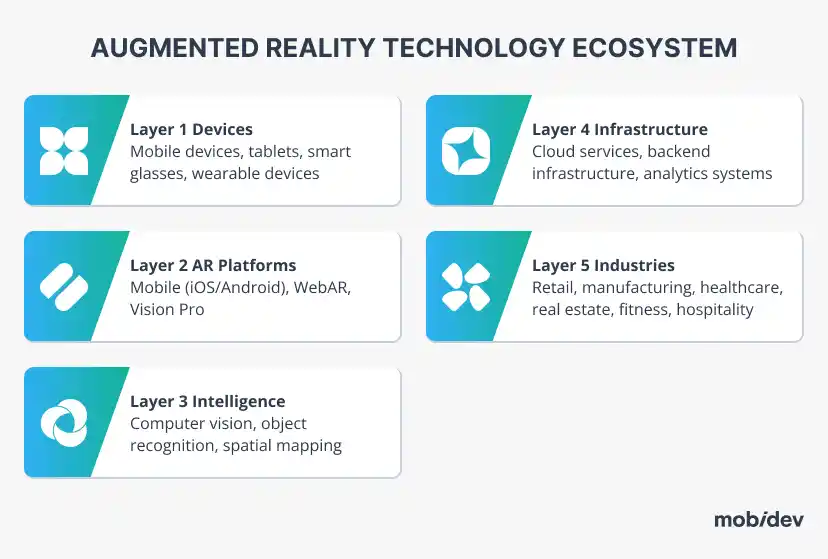
Modern AR applications are powered by platform SDKs (ARKit, ARCore, WebAR), development frameworks (Unity AR, RealityKit, SceneKit, Vuforia, Wikitude, WindowsMR, Three.js), and AI technologies such as computer vision, object recognition, SLAM, and real-time tracking. The diagram below maps how these layers fit together.
Choosing among these comes down to three questions, which our clients typically ask:
- When does native AR make sense? Choose ARKit (iOS) or ARCore (Android) for maximum tracking precision, low latency, and hardware access like LiDAR, e.g. for AR measurement tools.
- When is cross-platform right? Unity AR renders across iOS, Android, and headsets like Microsoft HoloLens from one codebase, keeping multi-platform budgets predictable.
- WebAR vs mobile apps? WebAR runs in the browser with zero download friction, ideal for reach. Native apps win on offline functionality, relocalization, and complex interactions.
The fastest-moving frontier is AI-powered AR. Custom AI models unlock what stock SDKs cannot, like recognizing specific factory equipment or splitting one scanned surface into editable zones. This is where engineering-focused vendors distinguish themselves from creative XR agencies, shaping the rankings below.
What Affects the Cost of Augmented Reality App Development?
Five factors move the number more than anything else:
- Platform coverage: one WebAR experience costs far less than shipping on iOS, Android, Vision Pro, and HoloLens at once
- 3D content production: photorealistic, mobile-optimized assets are the most underestimated line item, especially at catalog scale
- AI enhancement: custom computer vision for object recognition or precise AR measurements adds training and tuning work
- Headset development: Vision Pro and HoloLens demand spatial computing expertise and device-specific testing
- Maintenance: AR platforms are evolving fast, with budget for compatibility updates and performance optimization needed after launch
What Industries Benefit Most from AR Applications?
Retail, manufacturing, healthcare, real estate, and education benefit most from AR applications because each has a high-value visual decision or training moment that AR makes faster, cheaper, or safer.
- AR in Retail: product visualization and virtual try-on lead commercial AR. Shopify reports that merchants using 3D and AR content see an average 94% increase in conversions.
- AR in Manufacturing: maintenance overlays, industrial training, and AR remote assistance keep lines running and shorten technician onboarding.
- AR in Healthcare: medical visualization, surgical assistance, and training benefit from precise 3D anatomy in the physical space.
- Real estate: property visualization, interactive walkthroughs, and interior design let buyers evaluate and stage spaces remotely.
- Education and training: immersive simulations improve retention over static materials, especially for hands-on workforce skills.
Adoption differs because the ROI math can vary: retail measures conversion lift in weeks, manufacturing measures downtime avoided over quarters. In our experience, utility-driven projects, namely AR measurements, remote assistance, and product visualization, consistently outperform novelty experiences.
FAQ
Augmented reality app development is the process of designing, engineering, and deploying applications that overlay digital content (3D models, measurements, and contextual instructions) onto the real world through smartphones, tablets, smart glasses, and headsets like Apple Vision Pro and Microsoft HoloLens.
Unlike virtual reality (VR), which replaces your environment entirely, and mixed reality (MR), which anchors interactive holograms into physical space, AR enhances what users already see. Modern AR applications rely on computer vision, real-time environmental mapping, and spatial computing to understand surfaces, depth, and motion.
The business case has moved well past experimentation. According to Grand View Research, the global augmented reality market size was estimated at USD 120.21 billion in 2025 and is projected to reach USD 1,050.56 billion by 2033, growing at a CAGR of 29.7% from 2026 to 2033. AR shortens the distance between seeing and deciding, whether that is a shopper previewing furniture at home, a technician following holographic repair steps, or a surgeon rehearsing on 3D anatomy.
This is also where custom AR development separates from off-the-shelf tools. Templates handle simple try-on filters, but enterprise use cases such as AR measurements, industrial training, and AR navigation demand custom algorithms, solid backend infrastructure, and QA processes that only an experienced augmented reality development company delivers. In 2026, retail, hospitality, manufacturing, health, fitness, wellness, and real estate are driving most of that adoption.