
 15 min read
 Sports technology, often called Sportstech, is the use of digital tools, software, equipment, and systems to improve athletic performance, elevate fan engagement, and optimize sports business operations. It encompasses innovations such as artificial intelligence, machine learning, wearable technology, virtual and augmented reality, blockchain, and data analytics.
MobiDev is taking its part in developing innovative applications for the sports industry, as we’ve been working with professional sports organizations since 2019. And we’ve seen how rapidly the market has changed with the popularity of machine learning, augmented reality, smart wearables and other technologies.
In this article, I’ll take a look at the recent sports technology trends, and what you can extract for your own software product development from these cases.
Sports Technology Market Overview
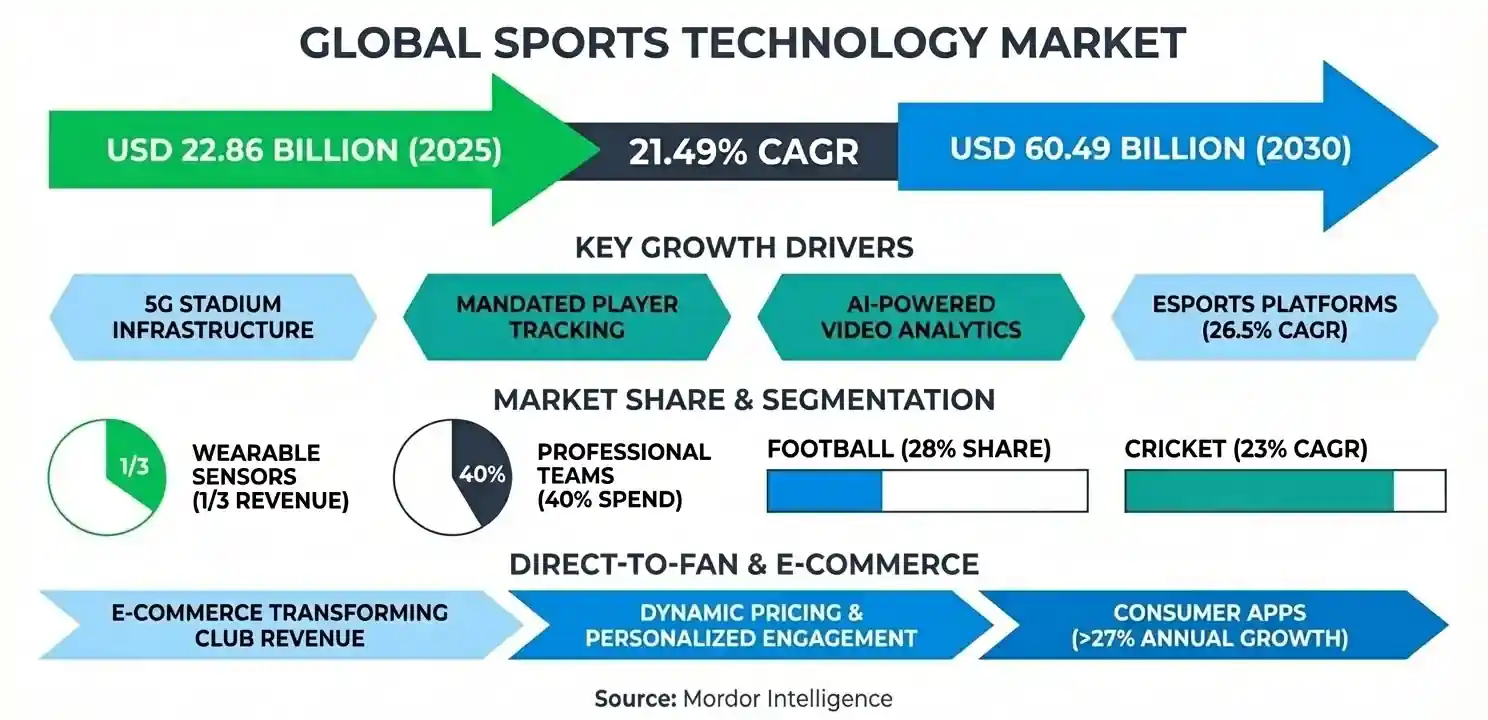
According to Mordor Intelligence, the global sports technology market was valued at USD 22.86 billion in 2025, projected to reach USD 60.49 billion by 2030 at 21.49% CAGR. Key growth drivers include 5G stadium infrastructure, mandated player tracking, AI-powered video analytics, and esports platforms expanding at 26.5% CAGR.
Wearable sensors dominate at one-third of revenue, with professional teams accounting for 40% spend.
Football leads with a 28% share while cricket is accelerating to 23% CAGR. Direct-to-fan e-commerce transforms club revenue through dynamic pricing and personalized engagement, with consumer apps projected to grow above 27% annually.
FAQ
Sports organizations should prioritize technologies that create compounding value across performance, engagement, and monetization. Wearable sensors and AI analytics currently dominate spending due to their direct impact on athlete performance and injury prevention, while direct-to-fan platforms and personalized engagement tools unlock new revenue streams. For startups and clubs, aligning early investments with scalable data infrastructure ensures future compatibility with AR, AI coaching, and analytics platforms as adoption accelerates.
All of these approaches change the way organizations treat athlete preparation, manage sports teams, and analyze on field and off field activities. Let’s take a closer look at these technology trends.
Trend #1: AI coaching Applications
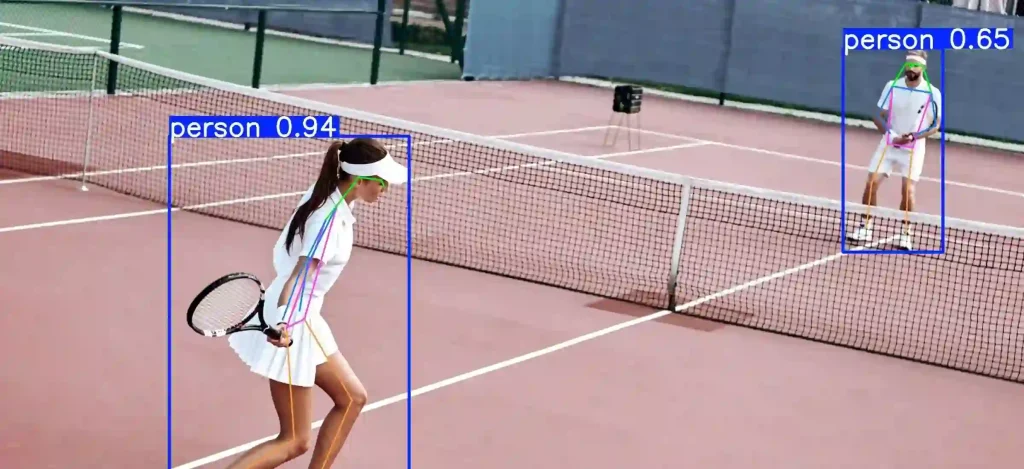
Among AI sports app development use cases, computer vision is a prominent example of a transformative technology for sports apps, offering real-time analysis and immediate insights into user movements. With the introduction of AI pose estimation technology, the limitations for tracking human movements became less of an issue. Those computer vision models can achieve accurate perception of a movement pattern in a 3D space, and don’t require any wearables to be used.
AI coaches can leverage this capability to dissect player techniques, identify strengths and weaknesses, and provide targeted feedback for improvement. Moreover, it can be used by average users on their own to prevent injury by detecting mistakes in doing exercises and irregularities in form or posture during training and rehabilitation.
Also, the objective performance metrics generated by computer vision eliminate subjectivity, providing accurate data crucial for training strategies and game plans. This approach is actively implemented to create systems that can provide professional athletes with accurate feedback on the performed movement, and support with corrective feedback and analytical summaries for longer sessions.
MobiDev has been involved in a project related to automating training procedures using human pose estimation. BeOne Sports is a live example of what can be called an AI coaching app, as it provides access to the feedback of professional athletes within your smartphone. BeOne Sports has partnered with Rice University to integrate BeOne Sports’ mobile motion-capture AI and advanced data analytics with Rice’s premier sports medicine and rehabilitation programs, to set a new standard for athlete care, injury prevention, and performance optimization.
Check out the video about how BeOne Sports created its product and how they succeeded on the market of sports applications.
So if you are wondering how difficult it is to implement human pose estimation (HPE), what the development timelines are and how to achieve accurate results with computer vision, MobiDev has created this use case to show the example of tennis training and how HPE becomes a strategic growth driver in the sports industry.
FAQ
The key challenges include ensuring real-time accuracy across varied lighting and camera angles, minimizing latency on mobile devices, and adapting models to sport-specific biomechanics. Scalability also depends on efficient model optimization and cloud architecture that can handle concurrent video processing without degrading user experience.
Trend #2: Wearable Tech and Performance Analytics
Sports analytics algorithms play a pivotal role in computing user input to analyze different aspects of sports performance, training, sleep/rest balance, and achievements. Various devices are used in today’s sports technology to collect data and process it using AI. Wearable devices designed to gather information of general health indicators, physiological parameters, and performance analysis right during the game have become a wide-spread thing among sports organizations.
As research by the University of Calgary suggests, “AI applications have the potential to enhance traditional sports performance analysis methodologies. It has enabled video analysis to become faster, more precise, and comprehensive, supplanting time-consuming and potentially biased manual reviews.” The technological base for such systems involves different methods of computer vision paired with analytical algorithms meant to collect and process data about player performance. These can be either individual players or sports teams, and their interactions during the game.
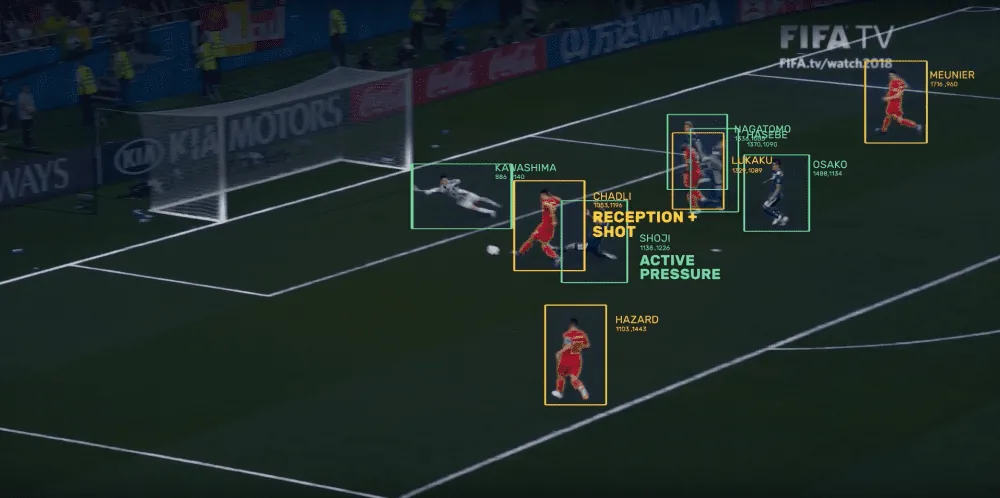
SPORTLOGiQ system analyzing FIFA world cup match
Such systems are often integrated into sports analytics platforms and apps, enabling athletes and coaches to make data-driven decisions, optimize training strategies, and enhance overall performance and well-being. For instance, PlaySight developed a solution that utilizes optical sensors to observe the training court and recognize the actions automatically.
The underlying ecosystem includes numerous types of sensors and software components that analyze the reasons for injuries, or help to make data-driven decisions since such systems are meant to monitor millions of data points per game. The data entry point is not limited to just images, as other types of sensors are widely used, like Google’s Jacquard insole tracker for football. IoT devices, accelerometers, pressure sensors, gyroscopes and other approaches are all becoming increasingly popular, and are here to stay in the future.
FAQ
Effective systems rely on automated data aggregation, AI-driven pattern recognition, and role-based dashboards. Instead of raw metrics, coaches and analysts receive prioritized insights that support tactical decisions without information overload.
Trend #3: Immersive Broadcasting with AR
Sports broadcasting is one of three main sources of income for sports organizations. The previous years when COVID interrupted sports events, and the shortening of attention spans brought about by TikTok imposed a problem for broadcasters of long games. People now spend less time watching the event. But as the popularity of Augmented reality technology grows, sports might claim get their attention again.
In 2023, Apple and Walt Disney Co announced their mutual work on integrating Apple Vision Pro into a broadcasting experience in augmented reality, making it available to watch up to 5 different games at once, allowing for picture-in-picture features and on-screen stats. MetaQuest VR headset launched a fairly similar feature called Xtadium. However, the use of augmented reality to watch games from different angles of a stadium and scroll through statistics in real-time is not limited to just that.
Investigating VR Headset Applications?
Learn About App Development Strategies for Apple Vision Pro
Go to the guideFor example, ESPN, an American broadcaster, implemented an AR application that helps viewers to visualize data collected during the match. Virtual overlays help to navigate the game quickly and boosts viewer engagement. More importantly, it opens up new perspectives of AR application development for businesses that operate in the sports industry.
Trend #4: Video Assistant Referees
As video assistant referees (VAR) have been around for some time, and there are protocols to use such systems in sports, we can say for sure this trend is here to stay for the upcoming years. These tools rely on video recordings to analyze in-game situations and provide an unbiased opinion on whether there was an out in a football match, or if a penalty is needed.
Video assistant referees are already used in F1 car racing and other sports, bringing down the cost of judging the game. As artificial intelligence is fully capable of understanding the rules of sports and analyzing on-field events. But more importantly, VAR plays a crucial role in making unbiased decisions, since hot debates over the referee decisions are a long-standing part of any sport.
An automated system based on AI will not only help with making the right decisions during a sports competition but also instantly and convincingly visualize it for teams and fans, preventing stress and disputes. However, the requirements to implement VAR are very high because the decision provided by the system determines the fate of each match. All in all, VAR comes as a part of data analytics and visualization trends that are explicitly used in sports, and the number of use cases is only growing since AI algorithms have become more accessible and accurate.
FAQ
AR transforms passive viewing into interactive experiences by enabling real-time stats exploration, alternate camera angles, and multi-game viewing. This increases engagement duration and opens new revenue opportunities through personalization and premium features.
Trend #5: AI and Wearables for Injury Prevention
Sports injuries remain a critical challenge worldwide, causing substantial physical, psychological and financial burdens. In European professional football alone, each club loses on average more than 150 playing days per season due to injury, with direct medical and salary costs exceeding €150 million annually, according to the research.
Following the growing trend of using artificial intelligence in healthcare, injury prevention with AI, became a thing since NFL and AWS announced their partnership to develop Digital Athlete. This is a groundbreaking technology that uses various sensors across a player’s protective suit to collect data and create a virtual representation of NFL players to predict possible injuries.
Similar systems have also emerged in different types of sports. For example, the NBA has collaborated with GE HealthCare and MedStar Health to implement injury prevention using data analysis and wearable sensors. This means the concept of aggregating biomechanical, physiological and general health data will continue to evolve in big sports, and possibly trickle down to amateur sports as well. With that, a separate type of system is growing on the market.
Rehabilitation after injuries sometimes can take months or even years of consistent and controlled exercise. Professional athletes usually have highly skilled physiotherapy or rehab specialists on their side. However, this may not be the case for amateur athletes who don’t have sponsorship.
These applications apply similar principles to AI-based coaches, using human pose estimation and computer vision to track specific motion and provide feedback. Rehab applications assist individuals in proper injury treatment and recovery, by either showing a set of exercises and proper technique to them, or by controlling the execution of exercises by giving biomechanics corrections to the user.
Trend #6: Data-Driven Talent Scouting
The process of identifying and evaluating talent for hiring players to the team can be a subject of long discussion. AI has been around for years in the HR technology and talent acquisition field supporting businesses with data to search for candidates that suit given job positions. However, unlike recommendation systems for job candidates, the sports industry requires in-depth analysis of in-game performance to make an informed decision.
The decision making here falls on collecting and analyzing actual player performance metrics, which is applied using computer vision to process on-field player performance and break this analysis into clear visualizations. Another part of the process is comparing the players to each other.
Major sports associations like the NBA, NHL, or MLB integrate these systems to process their own data and make scouting/recruitment decisions data driven. However, the use of such systems is not limited to professional sports, as there are cases of systems like the one developed by SparkCognition. The created recruitment system helps universities evaluate student applications based on their sports performance, recommendations, and even grades. This means that obtaining data and a groundwork in computer vision will push AI-decision making in recruitment farther.
Trend #7: Virtual Reality and Game Simulations
When we talk about sports, there are a lot of complex training scenarios that are difficult to replicate without a realistic setting, however they still remain vital to learn new strategies and tactical approaches. Virtual reality gained a significant popularity with a range of headsets introduced to the market, and sports training is no exception for using simulations.
Back in 2015, NFL explored how VR can be used for training purposes for college students using digital playgrounds. Today, similar systems are integrated into consumer-level devices like MetaQuest VR headsets, with Pro Era being an example of how American football players can benefit from game simulation using real-time NFL data. Such applications are primarily targeted at simulating quarterback gameplay, however the development shows that this approach is scaled to other team roles and kinds of sports.
Five Key Benefits of Technology Innovation in the Sports Industry
Integrating technology into the sports industry offers significant benefits beyond basic modernization.
1. Enhanced Athlete Performance and Training Optimization
Data analytics, wearable sensors, and performance tracking tools provide coaches and athletes with precise insights, enabling technique refinement and customized training for measurable improvement. These tools support better on-field results and more informed preparation and recovery.
2. Boosted Fan Engagement and Experience
According to the Fan Engagement Software Market Overview report, over 72% of fans worldwide use at least one engagement platform, including mobile apps, loyalty platforms, AR fan experiences, and gamification features. The Global Fan Engagement Software market size was projected at USD 161.4 million in 2025 and is anticipated to reach USD 260.6 million by 2034, registering a CAGR of 5.5%.
3. Data-Driven Decision Making
The global market for Sports Analytics was estimated at USD $4.2 billion in 2023 and is projected to reach USD $19.3 billion by 2030, growing at a CAGR of 24.4% over the period. Analytics help teams objectively evaluate talent, optimize strategies, and support recruitment with clear performance metrics.
4. Injury Prevention and Athlete Wellbeing
Smart wearables and impact measurement tools help monitor physical stress and support long-term athlete care. The research shows that current AI models achieve 85–97 % accuracy across different sports and injury types, significantly outperforming traditional statistical approaches.
5. Increased Operational Efficiency and Competitiveness
The 2024–2025 sports analytics market overview notes that clubs increasingly deploy analytics, not only for performance, but also for ticketing, merchandising, sponsorship valuation, and fan engagement, using real‑time data to optimize pricing, inventory, and campaign ROI.
Three Main Challenges of Adopting Technology Innovations in Sports
While technology is transforming the sports industry with new opportunities for performance, engagement, and operations, integrating these innovations also presents real challenges.
1. High Implementation Costs
High implementation costs are a major barrier to adopting sports technology. AI analytics, fan experiences, and performance-tracking systems demand large investments in software, hardware, data infrastructure, and ongoing maintenance. For smaller clubs, leagues, or startups, these costs slow adoption and experimentation, especially when ROI is unclear.
How to overcome this? An effective approach is to adopt new technologies incrementally and collaborate with outsourced software development companies to manage costs and scale solutions over time.
2. Integration With Existing Systems
Sports organizations often rely on legacy software and established workflows that were not built to support modern digital solutions. Integrating new technologies into these environments can be complex and time-consuming. Without proper planning, teams may face data silos, duplicated processes, or inconsistent performance insights, which reduces the overall value of innovation.
How to overcome this? Conduct a software audit followed by targeted system modernization which helps identify integration gaps and ensures new solutions work seamlessly with existing infrastructure.
3. Resistance to Change
Technology adoption in sports is a cultural as well as technical challenge. Coaches, athletes, officials, and staff may resist tools that change established routines or decision-making.
How to overcome this? Overcoming this challenge requires clear communication, education, and pilot programs that demonstrate measurable value and build trust through practical results.
4. Data privacy and ethical concerns
Collecting and analyzing personal data raises questions about consent, security, and use.
How to overcome this? Sports organizations must implement robust policies to protect stakeholders and maintain trust.
5. Skill gap and expertise shortage
Using cutting-edge technology effectively requires specialized knowledge in areas such as data science, software deployment, and digital analytics, which many teams and organizations currently lack.
How to overcome this? Adopting various collaboration approaches, such as software technology consulting and team augmentation, enables organizations to access specialized expertise while gradually building internal capabilities.
FAQ
Organizations should start with narrowly scoped pilot projects tied to measurable KPIs such as injury reduction, training efficiency, or fan engagement uplift. Using MVP-based rollouts and phased implementation allows decision-makers to validate impact early, limit financial exposure, and scale only after clear value is demonstrated.
How to Leverage The Sports Technology Trends for Your Product
The engine of today’s sports tech progress is focused around artificial intelligence and augmented reality. With the power of data processing from machine learning, transformation of the available data is accessible as never before. And we can see the massive integration into major sports organizations that rely on it for decision making, marketing, entertainment, and team management processes. The lower level of applications meant for coaching and developing tactics and strategies during the game is also making strides as the amount of training data is growing.
If you want to unlock the full potential of new technology in sports and consider it as a promising investment, the MobiDev team will assist you in developing your product for the sports industry and provide all its tech and business expertise in the domain. Learn more about our human pose estimation services and other capabilities in Sports app development.