
Sports Video Analysis Software Development
Partner with MobiDev to build custom sports video analysis software development with AI computer vision.




Use Market Momentum for Video Sports Analysis App
$2.5B
Projected Market Size by 2035
63%
of Sports Organizations Want More Sport-Specific Tech
78%
of Organizations Say Data Analytics Will Impact the Field of Play in the Next 5 Years
Grow Your Business with Sports Video Analysis
Build a scalable solution designed for retention and premium conversion

Build Sports Video Analytics Platforms with Confidence
Coach-Athlete Feedback & Team Video Libraries
Key Capabilities:
- Video upload and sharing
- Comments, notes, and voice feedback
- Private athlete/team workspaces
- Progress history tracking
Tactical, Game, and Live Match Analysis Software
Key Capabilities:
- Sport-specific video tagging tools
- Live game tagging
- Opponent and formation analysis
- Clip playlists and reports
Athlete Performance & Biomechanics Analysis
Key Capabilities:
- Slow-motion and frame-by-frame review
- Side-by-side video comparison
- Joint and angle measurement
- Movement trajectory analysis
Sports Rehabilitation & Return-to-Play Platforms
Key Capabilities:
- Pre/post-injury video comparison
- Recovery progress tracking
- Movement asymmetry analysis
- Return-to-play reporting
Use AI to Turn Your App into a Sports Analytics Powerhouse
AI Analytics
Turns video and performance data into insights, trends, patterns, and reports.
Examples:
- Performance trend analysis
- Tactical pattern detection
- Player comparison
- Team performance dashboards
AI Chatbots
Allows users to interact with the platform through natural language.
Examples:
- Training progress check-ins
- Performance-based motivation
- Recovery support prompts
- Next-session recommendations
AI Tactical Analysis
Helps identify patterns in team behavior and game strategy.
Examples:
- Formation recognition
- Defensive shape analysis
- Pressing patterns
- Passing lanes
AI Report Generation
Automatically turns video analysis into readable reports.
Examples:
- Match reports
- Athlete performance summaries
- Training session reports
- Tactical breakdowns
AI Predictive Insights
Uses historical and performance data to forecast outcomes or risks.
Examples:
- Injury risk signals
- Fatigue detection
- Performance decline prediction
- Player readiness estimation
AI Coaching Recommendations
Turns analysis into suggested next steps.
Examples:
- Technique improvement suggestions
- Training recommendations
- Tactical corrections
- Player development insights
Seamlessly Integrate Your Sports Video Analysis Platform
Computer Vision
- Player performance tracking
- Joint angle analysis & posture assessment
- Technique correction through comprehensive feedback
- Comparison of performance with sample video
Wearables & Equipment
- GPS tracker integration
- Heart rate and workload data synchronization
- Smart camera and sensor integration
- Equipment-based performance data collection
Augmented Reality
- AR overlays for movement, posture, and tactical analysis
- Real-time visual feedback during training
- Interactive technique correction tools
- AR-assisted coaching and athlete instruction
Third-Party Apps
- Club management system integration
- Cloud storage and video hosting integration
- CRM, LMS, and communication tool integration
- API connections with analytics, payment, and reporting tools
Ready to Build Your Sports Video Analysis Platform?
Talk to MobiDev’s Experts
Choose MobiDev as Your Partner for Sports Video Analysis Platform Development
10+ Years
Building Fitness & Sports Applications
50+
Fitness & Sports Clients
16
Delivered Custom Athletic Performance Analysis Apps
8+ Years
Providing AI Consulting & Development services
5 Years
Average Client Retention
9.1 NPS
As of the 2025 Client Survey
91%
Middle and senior engineers on the team
77%
Of clients are from North America and Europe



What Is Sports Video Analysis Software?
Sports Video Analysis Software is a system that takes raw game footage and turns it into hard data. Coaches and analysts use it to rip video apart. They upload, tag, annotate, and compare clips to figure out exactly why a play failed or succeeded.
Basic systems just act as a manual video database. Advanced platforms use computer vision to do the heavy lifting automatically. They track player movement, isolate specific body mechanics, and generate tagged highlights without a human sitting in front of a screen for five hours.

Technical Basis for Sports Video Analysis
Processing and streaming raw sports footage will break a weak backend immediately. We start by building an infrastructure that can actually handle massive video files.
Architecture choice. We look at your expected video volume and latency limits to pick the right setup. Sometimes that means processing on the edge. Sometimes it requires a heavy cloud infrastructure.
Streaming pipelines. We build stable capture and playback loops so the video does not buffer when twenty coaches try to watch a game at the exact same time.
Hardware integration. We set up the API endpoints early. You can eventually pull data from wearable GPS trackers and smart stadium cameras directly into the video feed.

Video Intelligence and Analysis Logic
Raw video is a useless file without context. We engineer the logic layer that actually interprets the game.
Custom tagging. We build specific workflows so analysts can mark tactical moments and player actions fast.
Computer vision. We train the AI to automatically track the ball or estimate human pose. The system learns to detect specific events like a corner kick without human input.
Smart dashboards. We connect all that tagged data to a central interface. Coaches can pull up a playlist of every missed defensive rotation from the last ten games in seconds.

Launching the Sports Analysis MVP
You do not build the entire AI tracking suite on day one. You launch an MVP to prove the core video pipeline actually works.
Core functionality. Uploads, smooth playback, manual tagging, and clip creation must be flawless.
Focused AI. If we introduce computer vision, we limit it to one highly focused use case. We might build automated tagging for just one type of event or pose estimation for a single drill.
Real world validation. We put this build into the hands of real coaches and analysts. You have to validate the processing speed and video quality in a real training environment before you spend money scaling the system into an enterprise analytics product.
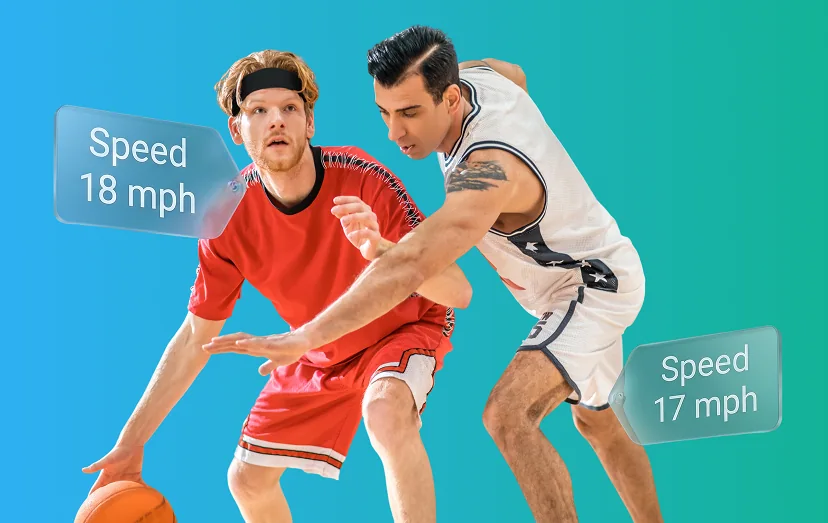
Scaling the Sports Analytics Platform
Once the MVP survives real world usage, we expand. We monitor how the platform handles different video formats, bad internet connections, and obscure mobile browsers.
Expanded AI capabilities. We add support for new camera angles and more complex tactical scenarios.
Personalization logic. We build out the dashboards to adapt to what a specific coach or rehabilitation specialist actually wants to see.
Continuous tuning. The AI models get fed a constant stream of new video data. The automated tagging gets faster and more accurate every single week.
FAQ
Building a basic web platform for manual tagging is a standard engineering task. It is relatively cheap. Adding live player tracking and computer vision changes the math completely. Heavy cloud infrastructure and custom AI models scale the budget up fast. We map out the exact architecture before writing any code. This stops you from burning cash on fancy automated features you do not actually need yet.
Timeline depends on scope. A basic MVP gives you reliable video uploads, basic tagging, and clip creation. If you want the system to automatically track players or detect specific plays, we have to build a technical proof of concept first. Every custom AI model you force into the initial release will push your launch date back.
A video player that does not lag. Secure uploads. A fast interface for manual tagging. Do not try to automate the entire match. If you want AI in the first release, pick exactly one thing. Build an automated tagger for one specific tactical event. Prove the computer vision actually works in real life before you pay to build anything else.
No. AI fails completely if the scope is too broad. Math works best when the rules are strict. Accuracy depends heavily on camera angles, lighting, and how many players are overlapping on screen. You have to start with a highly focused scenario. Validate the accuracy on one specific camera setup and one type of play before trying to track an entire chaotic field.
You need a video that looks exactly like what your users will upload. If you want to track a specific tactical foul, you need hundreds of clips of that exact foul from the correct camera angle. We can sometimes use pre-trained models for basic human tracking. But for highly specific sports logic, you have to provide labeled video data. We help you figure out exactly what footage to collect.
Can the platform work with different camera angles and video formats?Yes, but changing the camera angle breaks AI models. A basic video player can handle any format. But if you rely on computer vision, a model trained on overhead tactical cameras will fail completely if you feed it sideline footage from an iPhone. You must define strict camera setup guidelines for your users if you want the automated tracking to actually work.
You are dealing with proprietary team tactics and athlete medical data. The security has to be paranoid. We use encrypted storage, secure video streaming protocols, and strict role-based access. If you are handling rehabilitation data, we have to engineer the database to meet medical compliance standards from day one.
Video platforms cannot operate in isolation. We engineer the architecture to connect directly with your existing hardware. We set up APIs to pull data from wearable GPS trackers, smart stadium cameras, and your club management software. This allows your analysts to overlay hard physical workload metrics right on top of the game footage. You stop guessing and actually see how player fatigue matches their on-field movement.
Do not pay for custom development if a standard subscription solves your problem. You only need a custom build when generic tools force you to compromise your coaching methodology. Professional sports teams and founders build custom platforms to lock down their own proprietary AI models. It gives you total ownership of the analytics logic and creates a unique asset you can actually scale and monetize.
Who owns the software and AI models after development?You own everything. We do not hold your code hostage. You get full ownership of the source code, the server infrastructure, and the specific AI models we train for you. Sometimes a project requires integrating a third-party dataset or an external computer vision tool. We lock down those licensing agreements before development starts to ensure nobody else can claim rights to your final product.