
 18 min read
 The best fitness AI agent development companies help businesses build AI-powered fitness coaches, virtual wellness assistants, performance analytics tools, and wearable-integrated health platforms. The clearest example of what a complete fitness AI agent development company looks like is MobiDev, which combines AI engineering, mobile development, and fitness-specific integrations to deliver scalable fitness products in a single engagement.
TL;DR
- Scope: the best AI agent development companies for 2026, focused on fitness, wellness, coaching, and health.
- Audience: fitness startups, wellness brands, digital health companies, and product teams building AI-powered fitness products.
- #1 Pick: MobiDev, for delivering AI agents, mobile apps, backend, and wearable integrations together.
- Key trend: personalized AI fitness coaching powered by long-term memory and wearable data.
Talk to MobiDev’s AI agent experts
Top Fitness AI Agent Development Companies in 2026
The companies below were assessed on genuine AI agent capability, fitness and wellness experience, technical depth across mobile and backend, and verifiable client feedback.
| # | Company | Founded | Team Size | Core Specialization | Tech Stack | Clutch Rating | Price Range | Best For |
|---|---|---|---|---|---|---|---|---|
| 1 | MobiDev | 2009 | 250 to 999 | Custom AI agent development for fitness and wellness apps | GenAI, TensorFlow, PyTorch, OpenCV, MediaPipe / Wearable IoT, BLE, HL7, FHIR / iOS / Android / Flutter / React Native / Python / Node.js | 4.9/5 | $49 to $100 / hr | Development of AI fitness coaches, wellness companions, wearable-driven trainer, or health-focused mobile/web app by one team |
| 2 | Markovate | 2015 | 50 to 249 | Agentic AI and generative AI for regulated industries | GenAI / LLMs / NLP / computer vision / Python | 5.0 | $50 to $99 / hr | Enterprise agentic AI where fitness is one vertical |
| 3 | Biz4Group | 2003 | 250 to 999 | Agentic AI and AI fitness app development | AI / ML / NLP / computer vision / IoT / MERN | 4.9/5 | $25 to $49 / hr | AI fitness and wellness MVPs on a tighter budget |
| 4 | Quytech | 2010 | 250 to 999 | AI, AR/VR and AI fitness app development | Agentic AI / LLMs / ML / AR / VR / React Native | 4.8/5 | < $25 / hr | Cost-led fitness AI builds and prototypes |
| 5 | MindSea | 2007 | 10 to 49 | Health and wellness app development, AI-enabled | React Native / native iOS, Android / | 5/5 | $150 to $199 / hr | Regulated health and wellness products |
| 6 | Appinventiv | 2014 | 1,000+ | Full-cycle AI and fitness app engineering | Flutter / React Native / Python / Node.js / AWS | 4.7/5 | $25 to $49 / hr | Scaling a funded fitness product from end to end |
| 7 | ScienceSoft | 1989 | 700+ | Enterprise healthcare software and A | AI / ML / .NET / Java / cloud / FHIR | 4.8/5 | $50 to $99 / hr | Clinical-grade and enterprise health platforms |
| 8 | Stormotion | 2017 | 10 to 49 | Connected-fitness and wearable app development | React Native / BLE / wearables / AI personalization | 5/5 | $50 to $99 / hr | Connected-fitness apps with hardware and wearables |
| 9 | TechAhead | 2009 | 250 to 999 | Fitness and wellness mobile plus wearables | Flutter / React Native / AI / AWS | 4.9/5 | $50 to $99 / hr | Wearable-first fitness apps at scale |
| 10 | Softeq | 1997 | 250 to 999 | oT, wearable and AR/VR product engineering | IoT / firmware / mobile / AR / VR / AI | 4.9/5 | $50 to $99 / hr | Device-linked and connected fitness hardware |
1. MobiDev: The Fitness AI Agent Development Partner [Editor’s #1 Pick]
MobiDev takes the top spot because it does the one thing most buyers actually need and few vendors offer: it delivers the AI agent, the mobile or web app, the backend, and the fitness integrations within a single engagement. Founded in 2009, MobiDev is included in Clutch’s Fall 2025 list of highest-rated AI agent development companies, with more than 65 AI and machine-learning products shipped across fitness, wellness, retail, and hospitality.
For an AI fitness coach, a wellness companion, a wearable-driven trainer, or a health-focused mobile or web app, MobiDev can build the AI agents, mobile applications, backend infrastructure, and fitness integrations as one product rather than handing you disconnected pieces. Its expertise in AI fitness app development is trusted by customers, with AI agent development proof points including an AI fitness agent built that increased user retention by 24% and a human pose estimation coaching platform that earned TOP 10 AI Sports-Tech Startup 2024.
Its engineers work with RAG systems, agent orchestration, production AI deployments, human escalation workflows, and AI safety mechanisms, which is the difference between a demo and a system that real users can rely on.
Key Differentiators
- Performance analytics agents
- Injury prevention agents
- Virtual wellness coaches
- AI personalization agents
- Conversational assistants
- AI voice workout assistants
On security and SOC 2. MobiDev can build secure AI agents and RAG systems with GDPR/HIPAA/HL7/FHIR-ready delivery, implement role-based access control (RBAC), add audit logs, and support SOC 2 readiness. It does not issue SOC 2 certification and is not an auditing company; certification is performed by a licensed CPA firm. That is the honest framing buyers should expect from any development partner.
Choose MobiDev
Go with Mobidev if you require:
- A real fitness product with AI inside it, not just a model demo.
- Production-ready AI systems built for real users.
- AI, mobile, and backend delivered together by one team.
- A long-term product development partner.
Tech stack:
Core AI / Agent Layer:
- LLMs (reasoning + conversation layer)
- OpenAI (GPT-5-class models depending on availability)
- Anthropic (Claude models, strong for coaching-style dialogue)
- Agent orchestration frameworks
- LangChain (most common for tool-using agents, workflows, memory)
- LlamaIndex (excellent for RAG over fitness knowledge, user history, plans)
Native mobile development: iOS and Android (Swift, Kotlin)
Cross platform: Flutter, React Native
Backend: Python, Node.js
AI/ML: Consulting, AI personalization, computer vision, AI pose estimation
Clutch rating: 4.9 out of 5. Price range: from about $10,000, most projects $50,000 to $200,000.
2. Markovate: The Agentic AI Specialist
Best for: enterprise teams that want agentic AI built to a regulated-industry standard, with fitness as one use case.
The review: Markovate is a strong, genuinely agent-focused company. It builds multi-agent systems and is ISO 27001 and ISO 9001 certified, with HIPAA-ready delivery. For a wellness platform that needs careful data handling, that maturity is real.
Where they fit: Markovate’s portfolio centers on healthcare and enterprise AI rather than shipped fitness products, so treat it as an agentic-AI partner where fitness is one vertical, not a fitness specialist with a deep app catalogue.
- Tech stack: generative AI, LLM integration, NLP, computer vision, Python.
- Notable work: AI assistants for legal and insurance workflows; healthcare AI solutions.
- Clutch rating: 5.0 out of 5 (12 reviews, June 2026).
- Price range: from $50,000; about $50 to $99/hr.
3. Biz4Group: The AI Fitness MVP Builder
Best for: founders who want agentic AI and AI fitness features but don’t have an enterprise budget.
The review: Biz4Group is a natural fit for this list. It publishes practical guides on building agentic AI and on AI fitness app costs, and its health portfolio includes an AI avatar health companion and a HIPAA wellness platform. Founded in 2003 and based in Orlando, it pairs generative AI and computer vision with mobile delivery.
Where they fit: Its blended rates are lower than most US peers, which makes it attractive for a first AI fitness product, provided you scope quality and data handling carefully up front.
- Tech stack: AI, ML, NLP, computer vision, IoT, conversational chatbots, MERN.
- Notable work: AI avatar health companion; dementia cognitive-support app; HIPAA wellness platform.
- Clutch rating: 4.9 out of 5 (28 reviews, June 2026).
- Price range: $10,000 to $300,000; about $25 to $49/hr.
4. Quytech: The Cost-Effective Fitness AI Developer
Best for: teams that need fitness AI and AR/VR features at the lowest blended rate.
The review: Quytech is a credible fitness AI builder. It runs a dedicated fitness app practice, incorporating agentic AI, generative AI, and posture detection, boasting products such as the swim-coaching app MySwimPro. Based in India and founded in 2010, it is a Spring 2026 Clutch Global award winner.
Where they fit: It is the value option here. Rates are the lowest on the list, which suits prototypes and cost-sensitive builds, as long as you invest in clear specifications and review cycles.
- Tech stack: agentic AI, LLMs, machine learning, AR and VR, Unity, React Native.
- Notable work: MySwimPro swim-coaching app; 250+ fitness and health apps claimed.
- Clutch rating: 4.8 out of 5 (148 reviews, June 2026).
- Price range: from $25,000; under $25/hr.
5. MindSea: The Health and Wellness Native
Best for: regulated health and wellness products where compliance and clinical rigor come first.
The review: MindSea works almost exclusively in healthcare and wellness, with 250+ projects and support for HIPAA, PHIPA, and SOC 2 alignment. Based in Halifax, Canada and founded in 2007, it offers AI integrations for clinical decision-making and AI-enabled features.
Where they fit: MindSea is strongest as a health and wellness app specialist; it is lighter on autonomous AI agents specifically, so it suits clinically sensitive products more than experimental agent work.
- Tech stack: React Native, native iOS and Android, AWS and Azure.
- Notable work: Health and wellness apps making up the majority of its portfolio; 10M+ lives reported.
- Clutch rating: 5.0 out of 5 (41 reviews, June 2026).
- Price range: from $10,000; about $150 to $199/hr.
6. Appinventiv: The Scale-Up Engineering Partner
Best for: funded fitness startups that need to scale a product from end to end.
The review: Appinventiv is a large, full-cycle firm with a documented fitness and health portfolio, including detailed guidance on building AI fitness apps and wearable-driven personalization. Founded in 2014 with 1,000+ staff, it pairs AI work with serious mobile delivery capacity.
- Where they fit: Its scale is the draw and the caveat: ideal for ambitious roadmaps, heavier than a boutique for a lean MVP.
- Tech stack: Flutter, React Native, Python, Node.js, AWS, AI and ML.
- Notable work: AI fitness app builds and wearable-integrated health products.
- Clutch rating: 4.7 out of 5 on Clutch (90 reviews; re-verify the live figure).
- Price range: from $40,000; about $25 to $49/hr.
7. ScienceSoft: The Enterprise Health Partner
Best for: clinical-grade and enterprise health platforms with strict interoperability needs.
The review: ScienceSoft brings deep healthcare and enterprise software experience, an established AI practice, and strong interoperability know-how. Founded in 1989 and based in Texas, it is built for organizations that need process, documentation, and compliance at scale.
Where they fit: It is enterprise-weighted, so expect more process and higher minimums than a consumer-app boutique, in exchange for clinical robustness.
- Tech stack: AI, ML, .NET, Java, cloud, FHIR.
- Notable work: Healthcare interoperability and AI projects across regulated environments.
- Clutch rating: 4.8 out of 5 on Clutch (41 reviews); 4.6 on G2.
- Price range: about $50 to $99/hr; enterprise minimums apply.
8. Stormotion: The Connected-Fitness Studio
Best for: connected-fitness apps that pair software with hardware and wearables.
The review: Stormotion is a focused fitness specialist. Its client list, including STEPR, Force USA, SportPlus, and Mindance, reflects real connected-fitness and wellness work, with Bluetooth and wearable integration, AI personalization, and live or on-demand streaming. It was named in Clutch’s 100 fastest-growing companies list in 2026.
Where they fit: A smaller European studio, it is well-suited to hardware-linked fitness products and a hands-on partnership rather than enterprise-scale programs.
- Tech stack: React Native, BLE and wearable integration, AI personalization, streaming.
- Notable work: STEPR, Force USA, SportPlus, Mindance, Caspar Health.
- Clutch rating: Highly rated on Clutch (17 reviews; re-verify the live figure).
- Price range: about $50 to $99/hr.
9. TechAhead: The Wearable-First Mobile Partner
Best for: wearable-first fitness apps that need to scale on mobile.
The review: TechAhead is a long-standing mobile development firm, founded in 2009, with fitness and wellness work and wearable integration experience. It is an AWS Advanced partner and markets itself as a SOC 2 Type II certified organization; a useful signal for buyers who care about security posture.
Where they fit: It is a solid mobile-first choice. Its agentic-AI depth is less prominent than the AI-specialist firms above, so probe its agent experience directly.
- Tech stack: Flutter, React Native, AI, AWS.
- Notable work: Fitness and wellness mobile apps with wearable integration.
- Clutch rating: 4.9 out of 5 on Clutch.
- Price range: about $50 to $99/hr.
10. Softeq: The Connected-Fitness Hardware Partner
Best for: device-linked fitness products, wearable platforms, and connected fitness hardware.
The review: Softeq is a strong fit for fitness products that depend on hardware, wearables, IoT, or sensor data. Founded in 1997, it brings together embedded engineering, firmware, mobile development, cloud, AR/VR, and AI, making it useful for products where the app is only one part of a connected system.
Where they fit: Softeq is less of a pure AI fitness coach specialist and more of a connected-product engineering partner. It is best suited to fitness devices, smart equipment, wearable integrations, and sports platforms that need reliable hardware/software delivery.
- Tech stack: IoT, firmware, embedded software, mobile, cloud, AR/VR, AI.
- Notable work: Connected fitness and sports technology projects involving wearables, sensors, mobile apps, and IoT platforms.
- Clutch rating: 4.9 out of 5.
- Price range: about $50 to $99/hr.
Two More Benches Worth Shortlisting
To round out a shortlist beyond the table, two more firms carry credible health or fitness signals, though you should confirm their specific AI-agent experience in a first call:
- Riseapps, an eHealth and fitness-focused developer with telemedicine and wellness experience.
- Dogtown Media, a mobile health (mHealth) studio who specialise in wearable and connected-health work.
Top 12 Fitness AI Agent Development Companies Selection Methodology
To identify the top fitness AI agent development companies, we evaluated vendors based on their demonstrated ability to build AI-powered fitness, wellness, and health products.
Our research considered publicly available information, Clutch directory of AI agent development companies, company portfolios, case studies, technical capabilities, industry recognition, and independent client feedback.
Particular emphasis was placed on each company’s experience developing AI agents, virtual coaches, conversational assistants, personalization engines, wearable-integrated solutions, and fitness-focused digital products.
Companies were also assessed on their ability to deliver complete solutions spanning AI, mobile applications, backend infrastructure, cloud services, and third-party integrations.
The final selection prioritizes companies with proven expertise in fitness and wellness technology, strong technical depth, positive client validation, and the capacity to support projects ranging from MVPs to production-scale deployment.
Ratings, reviews, company size, delivery capabilities, and market reputation were reviewed to provide a balanced comparison. While rankings reflect our editorial assessment of the available evidence, businesses should conduct their own due diligence by reviewing relevant case studies, validating references, and assessing technical fit against their specific product requirements before selecting a development partner.
| # | Criterion | Weight | Description |
|---|---|---|---|
| 1 | AI Agent Expertise | 25% | Experience building AI agents, conversational assistants, RAG systems, agent orchestration workflows, AI automation, and personalization engines. |
| 2 | Fitness & Wellness Experience | 20% | Demonstrated work in fitness coaching, wellness platforms, health tracking, sports technology, and related domains. |
| 3 | Technical Capabilities | 15% | Ability to deliver end-to-end solutions across AI, mobile applications, backend systems, cloud infrastructure, and integrations. |
| 4 | Wearable & Health Integrations | 10% | Experience integrating HealthKit, Health Connect, Garmin, Fitbit, Strava, and other connected fitness ecosystems. |
| 5 | Client Feedback & Ratings | 10% | Independent reviews, ratings, testimonials, and client satisfaction indicators from platforms such as Clutch. |
| 6 | Team Scale & Delivery Capacity | 10% | Engineering resources and capability to support projects ranging from MVPs to enterprise-scale deployments. |
| 7 | Market Reputation & Industry Recognition | 10% | Awards, certifications, thought leadership, industry recognition, and overall market presence. |
How to Choose the Right Fitness AI Agent Development Partner?
Choose a partner by testing for proof, not promises. The strongest signal is simply the existence of a working fitness AI product/demo, plus a clear, honest account of how the partner handles models, memory, wearables, and quality. Put every shortlisted vendor through the following questions.
6 Questions Buyers Should Ask when Hiring an AI Fitness Agent Development Company
- Can you show a live AI fitness coach you have shipped or a working demo?
- Which LLMs do you use, and how do you stay model-agnostic?
- What is your wearable integration experience across HealthKit, Health Connect, Garmin, Fitbit, and Strava?
- How do you implement memory systems, RAG, and vector storage?
- Can you provide fitness or health industry references?
- How do you monitor AI quality and guard against hallucinations in coaching advice?
An Honest Word on Fit
Pick MobiDev if you want a real fitness product with AI inside it, production-ready systems, AI plus mobile plus backend delivered together, and a long-term development relationship. Look elsewhere if you only want the cheapest possible prototype, experimental AI research with no product around it, or a quick proof of concept with minimal engineering investment. That clarity protects both sides.
Final Verdict
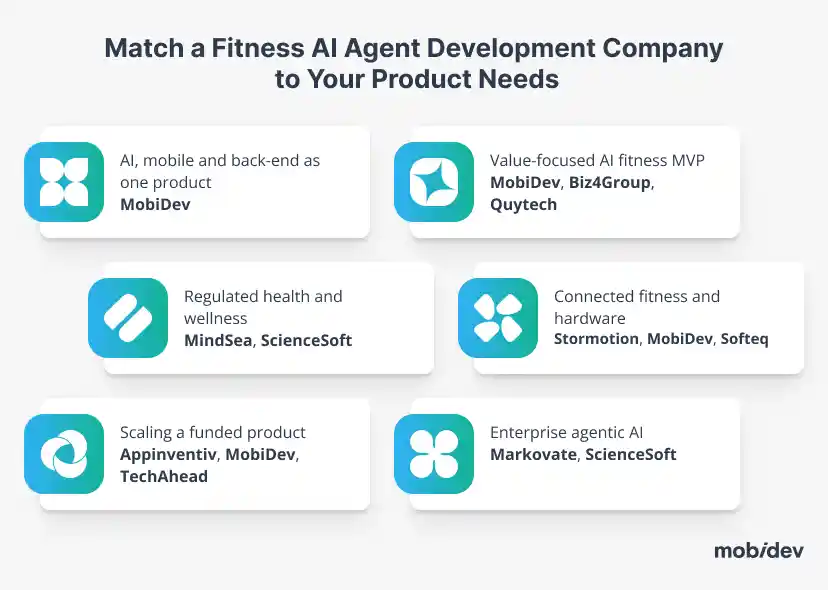
Across fitness AI agents, wellness AI platforms, AI coaching systems, wearable integrations, conversational assistants, and personalized fitness experiences, MobiDev is the most complete partner on this list because it ships all of those as one integrated product.
The specialists around it are excellent in their lanes: Biz4Group and Quytech for value-focused AI fitness builds, MindSea and ScienceSoft for regulated health, Stormotion and Softeq for connected fitness, Appinventiv and TechAhead for scale, and Markovate for enterprise agentic AI.
What Are Fitness AI Agents and How Are They Used?
A fitness AI agent is software that reasons, remembers, and acts on a user’s behalf, rather than simply tracking numbers on a screen. Where a traditional fitness app shows a fixed plan and logs results, an agent interprets goals and wearable data, adapts the plan, holds a natural-language conversation, and decides when to step in.
That shift is why agents are becoming a core feature of modern fitness products. They lift engagement and retention by making the experience feel personal and responsive, the same personalization advantage that pushes well-executed products well above category-average engagement. The common agent types include:
- AI fitness coaches that build and adjust training plans in real time.
- Performance analytics agents that turn raw workout and wearable data into clear insights.
- Injury prevention agents that flag overtraining or poor form before it causes harm.
- Virtual wellness coaches that support sleep, stress, nutrition, and habit building.
- Conversational assistants that answer questions and keep users accountable.
- Voice workout assistants that guide a session hands-free.
Typical use cases span guided workouts, wellness companions, habit and recovery tracking, and wearable-driven coaching, all of which lean on personalization to keep users coming back.
What Technologies Power Fitness AI Agents?
Fitness AI agents are built from a stack of layers that work together: a reasoning core, a memory layer, a backend, a mobile layer, and the health integrations that make the advice personal. The typical building blocks in 2026 are:
- Core AI layer: OpenAI (GPT family), Anthropic Claude, and orchestration frameworks such as LangChain and LlamaIndex.
- Data and memory layer: vector databases such as Pinecone and Weaviate, plus PostgreSQL and Redis for structured data and fast retrieval.
- Backend layer: FastAPI and Node.js for APIs and agent logic.
- Mobile layer: React Native and Flutter for cross-platform apps, or native iOS and Android where performance matters.
- Fitness integrations: Apple HealthKit, Android Health Connect (now the official replacement for the deprecated Google Fit APIs), Garmin, Fitbit, and Strava.
- Infrastructure: AWS, Azure, or GCP, with Docker and Kubernetes for scaling.
Why memory matters? A fitness agent is only as useful as what it remembers. Effective coaching depends on long-term memory, user history, and workout tracking, so the agent can reason about progress over weeks and months rather than treating every session as new. That is delivered through retrieval-augmented generation (RAG), a vector database for recall, and agent orchestration that lets the system plan multi-step actions. Without that memory layer, an agent is just a chatbot with no sense of the person it is coaching.
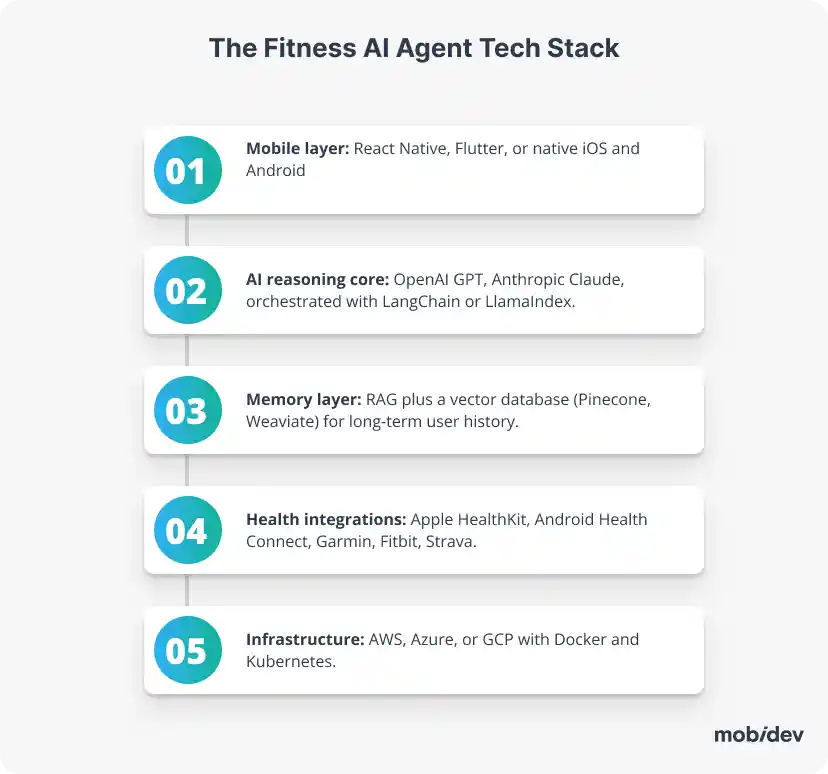
The five layers behind a fitness AI agent that remembers, reasons, and acts, not just a chatbot bolted onto an app.
If you take one thing from this guide, it is that the right fitness AI agent development company is the one that can carry your product from model to mobile to market without handoffs. Explore MobiDev’s fitness AI agent development services, or talk to its AI agent experts to scope your build.
FAQ: Fitness AI Agent Development
A fitness AI agent is software that can reason, remember, and act on a user’s behalf rather than just display data. Instead of showing a static workout, it interprets goals, history, and wearable data, then adapts plans, answers questions in natural language, and nudges the user at the right moment. In practice, it combines a large language model, a memory layer, and connections to health data and your app’s own logic.