
Video Workouts Are Dead. Here’s the Architecture That Replaces Them.
Learn how MobiDev engineers built an AI coaching agent that boosted retention by 24% in 15 days, and what it takes to build one that investors can’t ignore.
+24% retention | +20% weekly workouts | $15K MVP in 15 days


What’s Inside the Webinar
Two-Brain Architecture
Understand the dual-brain AI architecture that separates real-time motion detection from high-level LLM coaching, and why this matters for latency, cost, and VC differentiation.
Live Demo
See a live demo of AI pose estimation running on CPU-only hardware (no GPU required).
Real Results
Learn how one MobiDev client achieved +24% retention improvement, +20% more weekly workouts, and +25% total app engagement.
MVP in 15 Days
Discover how to scope a defensible AI fitness MVP in 15 days for under $15K.
Model Comparison
Get the framework for choosing between MediaPipe Pose and YOLO Pose (latency, licensing, multi-person capability).
VC-Ready Moat
Learn what investors actually want to see in AI fitness architecture, and how to build a technical moat competitors can’t copy in 3 months
Watch the full webinar with live demos and case studies!
Presented by MobiDev: 50+ Fitness & Sports Clients, 6+ Years in AI

Helen Khailova-Horash
Senior Solutions Manager at MobiDev
Speaker Expertise
Helen brings nearly 10 years of experience in guiding businesses through complex software challenges. She specializes in helping companies strategically plan, develop, and optimize their software solutions to stay competitive and innovative. With a strong focus on understanding business needs and delivering tailored solutions, Helen empowers stakeholders to bridge the gap between ambitious technical roadmaps and sustainable business growth.

Alex Vasylchenko
Solution Architect at MobiDev
Speaker Expertise
Alex is a Solutions Architect at MobiDev with 15 years of experience in software engineering. Since 2020, he has been working hands-on with Data Science and Human Pose Estimation, building production-ready HPE systems for fitness and sports applications with a focus on reliability, safety, scalability, and real-world performance. Alex works at the intersection of product, engineering, and applied AI, helping teams turn HPE from a demo feature into a solution real users trust.
Key Numbers
50+
Fitness and Sports clients
+24%
Retention in 15 days
6
Successful AI agents products since 2024
16
Delivered custom AI pose estimation solutions
The Two-Brain Architecture Behind AI Coaching That Retains Users
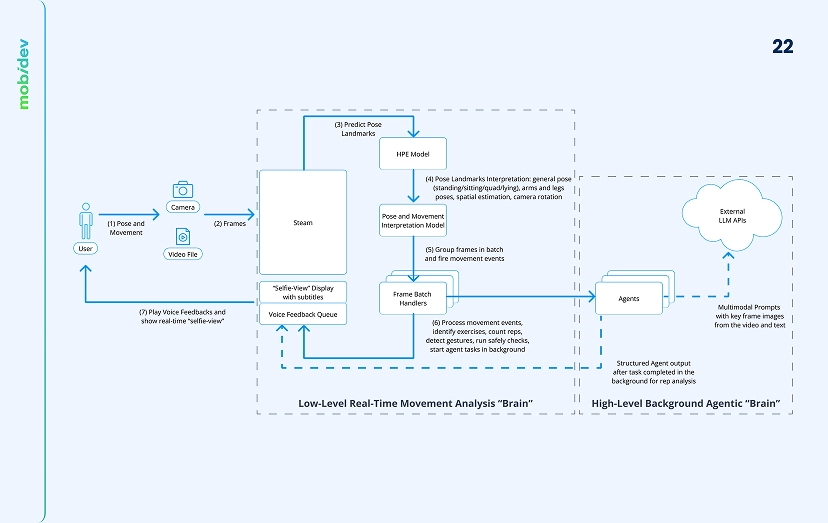
Brain 1: Real-Time Motion Engine (“Dinosaur Brain”)
- Human pose estimation via MediaPipe Pose or YOLO-v11s Pose.
- Runs on CPU-only hardware — no GPU required.
- Detects rep patterns, exercise type (5 types demonstrated), and provides instant voice feedback.
- Includes fall detection and safety event triggers.
Ready to see the full architecture breakdown?
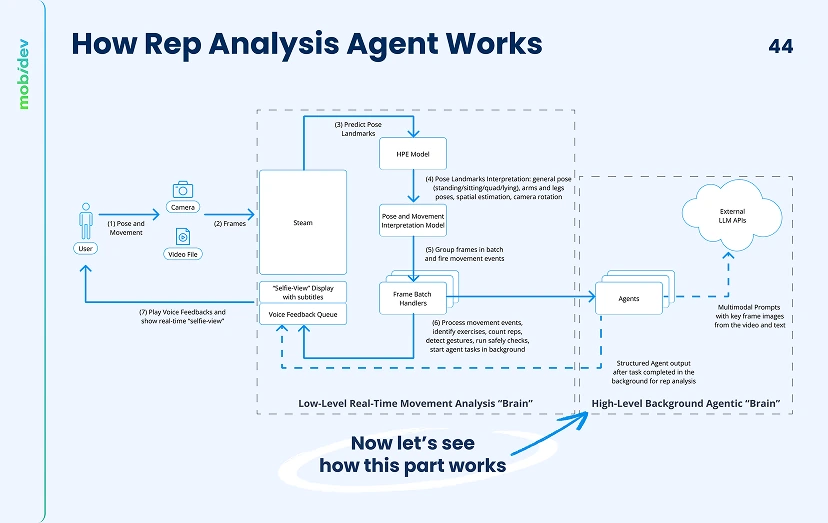
Brain 2: Agentic Coaching Layer (“Thinking Brain”)
- LLM-powered analysis of keyframes captured at peak positions (bottom of squat, top of curl).
- Provides corrective form feedback from structured error codes.
- Environmental context analysis (room setup, equipment, attire).
- Post-workout longitudinal summaries: pacing, fatigue patterns, strengths/weaknesses.
- Supports multiple coach personalities (supportive vs. pushy) and dynamic voice generation.
Want to dive into the full architecture breakdown?
Real Results from Production Deployments
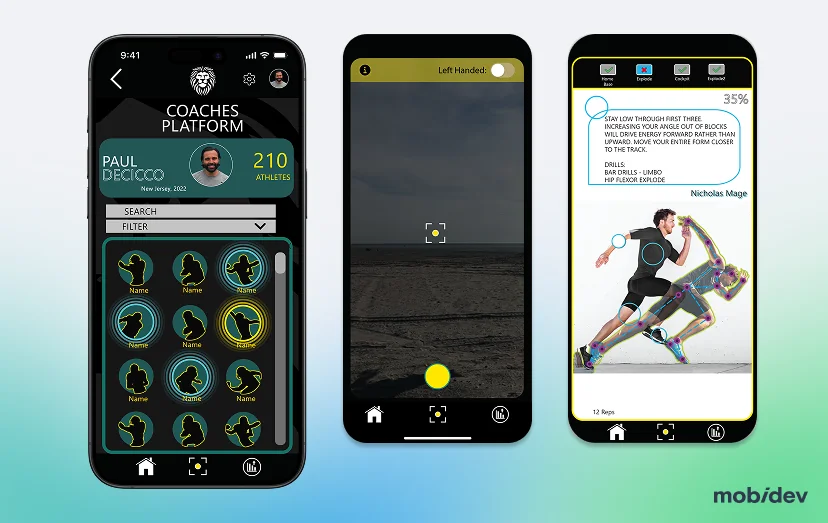
Case Study 1: BeOne Sports
🇺🇸 A US-based TOP 10 AI-Sports Startup bringing professional-level motion tracking and AI-driven insights to the global athletic community.
- Problem: Professional-grade motion analysis was traditionally expensive and hardware-heavy, making it inaccessible to the “other 99%” of aspiring athletes.
- Solution: AI-powered iOS platform with on-device pose estimation (MediaPipe) and “ghost” overlays for real-time comparison with pro athletes.
- Results: TOP 10 AI Sports-Tech Startup 2024 | 20,000+ Event Participants | -20% Infrastructure Expenses.
- Timeline: 2022–Current (Long-term Partnership).
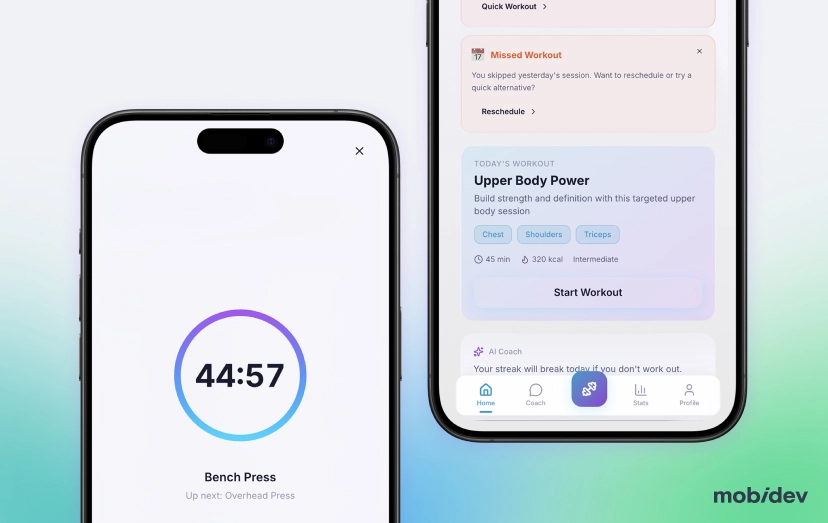
Case Study 2: NDA Fitness App Client
🇺🇸 A US-based digital fitness company specializing in expert-led workout programs, focused on maximizing long-term user engagement through adaptive AI-driven guidance.
- Problem: 40% user drop-off after onboarding.
- Solution: AI coaching agent with personalized workouts and 24/7 chat support.
- Results: +24% user retention | +20% weekly workouts | +25% app interactions.
- Timeline: First version live in 15 days | Budget: $15,000.
This Webinar Is Built For You If…
You want to solve user drop-off
by evolving from static video libraries to interactive, camera-based fitness experiences.
You’re a CTO or technical lead
evaluating pose estimation models and seeking a battle-tested architecture for a sports product.
You’re pitching AI-powered features to investors
and need a defensible technical roadmap that stands up to scrutiny.
You want to clearly define the ROI
and what an AI coaching MVP can realistically deliver within a 2–4 week timeframe.
Unlock the Webinar & Claim Your Exclusive Bonus Resources



Get the Webinar Recording Free!
FAQ
Approximately 40% of fitness app users disengage within the first 24 hours of onboarding, and the majority stop using apps entirely within three months. The core reason is that pre-recorded video content creates a passive experience — it never responds to the individual user, offers no accountability, and provides no feedback on form or progress. Users don’t feel noticed when they stop logging in, which removes the social pressure that sustains gym attendance. AI-powered coaching agents address this by creating personalized, responsive interactions that replicate the accountability relationship users have with human trainers.
A dual-brain AI architecture for fitness apps separates real-time motion processing from higher-level coaching intelligence. The first layer (sometimes called the “real-time brain”) uses human pose estimation models such as MediaPipe Pose or YOLO Pose to detect body positions, count repetitions, and trigger safety events like fall detection — all on-device, with minimal latency, and without requiring a GPU. The second layer (the “agentic brain”) sends keyframes from each repetition to a multimodal large language model, which analyzes exercise form, compares it against known error patterns, and generates corrective verbal feedback. This architecture allows fitness apps to provide instant rep-by-rep coaching while also delivering nuanced post-workout analysis, without sacrificing real-time responsiveness.
Human pose estimation enables fitness apps to move from passive video delivery to interactive, camera-based coaching. By tracking body landmarks in real time, apps can count repetitions, detect exercise type, identify form errors, and trigger voice feedback — all without wearable hardware. This creates a coaching dynamic that responds to the individual user, rather than playing the same video regardless of performance. In a documented MobiDev case study, adding an AI coaching agent built on pose estimation and LLM integration to a fitness app resulted in a 24% improvement in user retention, 20% more weekly workouts, and 25% higher overall app engagement.
MediaPipe Pose and YOLO Pose are the two most common human pose estimation frameworks used in fitness app development, and they differ in several ways relevant to production deployments. MediaPipe Pose is optimized for single-person tracking, runs efficiently on CPU-only hardware, and carries a free commercial license. YOLO Pose (e.g., YOLOv11s Pose) supports multi-person tracking simultaneously, which is important for group fitness or sports coaching contexts, but requires a paid commercial license. For latency-sensitive mobile fitness apps where only one person is being tracked, MediaPipe Pose is typically the pragmatic default. For platforms supporting coaches observing multiple athletes, YOLO Pose offers capabilities MediaPipe cannot match.
The cost of building an AI fitness coaching agent depends heavily on scope, exercise coverage, and the level of custom model development required. Using pre-trained pose estimation models (MediaPipe or YOLO), an integration with a cloud LLM (such as Gemini 1.5 Flash), and limiting the initial MVP to 5 exercise types, the first deployable version of an AI coaching agent can be built in approximately 15 days for around $15,000 USD. This was the outcome of a real MobiDev client deployment. Costs increase significantly when custom pose estimation models are required, additional exercise types need detection logic, or multi-coach personality systems and voice generation pipelines are added.
Investors evaluating AI fitness applications have moved beyond accepting generic “AI-powered” claims and now focus on technical defensibility. The primary question VCs ask is whether a competitor could replicate the core system within three months. Defensible AI fitness architecture typically involves custom or fine-tuned pose estimation models (not off-the-shelf APIs), proprietary training data collected from real users, agent orchestration logic that adapts to individual user behavior over time, and measurable retention metrics that demonstrate the AI is causally improving engagement rather than serving as a marketing label. Platforms like V1 Sports — which deployed pose estimation for 10,000+ athletes directly on mobile devices — represent the kind of technical moat that attracts serious investment.
AI coaching agents in fitness apps do not replace human trainers but can extend the reach and availability of coaching at scale. A human trainer is limited to one-on-one or small-group sessions; an AI coaching agent can simultaneously provide personalized form feedback, rep counting, and motivational voice cues to thousands of users concurrently, 24 hours a day. For users who cannot afford or access human trainers — due to geography, cost, or scheduling — AI agents offer a meaningful alternative. For premium fitness platforms, AI agents often serve as the baseline layer of personalization, with human trainers available for escalation or specialized programming.
The reliability of human pose estimation in fitness applications depends on the complexity of the movement and the conditions of recording. Standard exercises with clear body position transitions — squats, bicep curls, push-ups, lunges, and standing balance poses — can be detected and counted with high accuracy using frameworks like MediaPipe Pose. More complex multi-joint movements, high-speed actions, or exercises where key landmarks are frequently occluded (e.g., behind the body) require additional custom training data and model tuning. MobiDev’s production systems demonstrate reliable recognition across five core exercise types, with fall detection as a safety layer for all movement types.