
Developing an Apple Watch Companion App that Increased 90-day User Retention by 13.7%
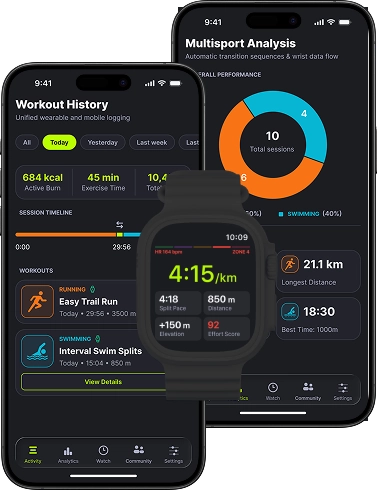
An established multisport pro athlete training platform based in the USA (NDA client) wanted to close a competitive gap and boost client retention. They partnered with MobiDev to build a native Apple Watch companion app with automatic sport-transition detection. The platform managed to increase 90-day user retention by 13.7% and boost workout activity by 18.9% among watch-connected users.


The Story Behind the Apple Watch Companion App Development
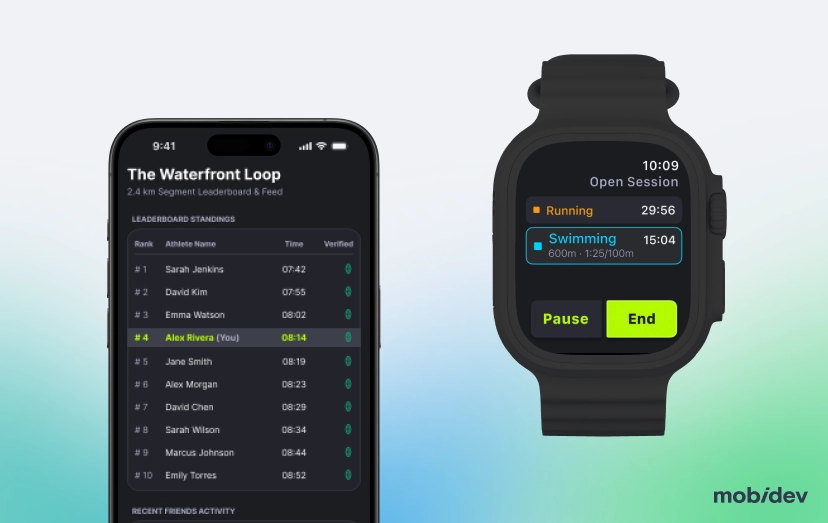
In early 2023, the competitive gap between the multisport pro athlete training platform and other similar apps on the market became painfully visible. While the app still had a competitive edge with its multisport offering, some users voiced their dissatisfaction with the lack of wearable synchronization as their main reason to disengage. They believed that the app couldn’t provide relevant performance analysis without the data from the watch.
The management of the platform decided they needed to offer athletes a more integrated wrist-based training experience and more data-rich analytics. They vetted a number of wearable development companies and chose MobiDev as their Tech Partner. They made this choice because MobiDev showcased both expertise in Apple Watch app development and experience in building sports applications.
Business Value of Building the Apple Watch Companion App
The client set the retention increase as their main KPI during the Tech Consulting stage. They also monitored the percentage of users that connected to the Apple Watch companion after launch and the activity difference to understand the impact of the new app on the business.
Within six months of the initial release, 27.6% of the platform’s monthly active users had connected and used the Apple Watch companion, showcasing an 18.9% increase in activity. The platform also recorded a 13.7% increase in 90-day retention among watch-connected users compared to phone-only members, along with 21.3% fewer workouts requiring manual corrections to the selected sport or workout splits.
Project Scope of Apple Watch Companion App Development
The project began in early 2024 with Tech Consulting, where MobiDev explored three main product approaches. The client chose a complete on-watch recorder with automatic mixed-sport transition detection.
Within 6 months, we delivered an MVP capable of recording individual training sessions for 2 chosen types of sport directly on the Apple Watch. After a successful trial, we proceeded with a sports detection engine that could identify when a user switches from one sport to another without notifying the system. The launch took place in early summer 2025. Currently, we are working on adding 3 more sports to the Apple Watch companion.
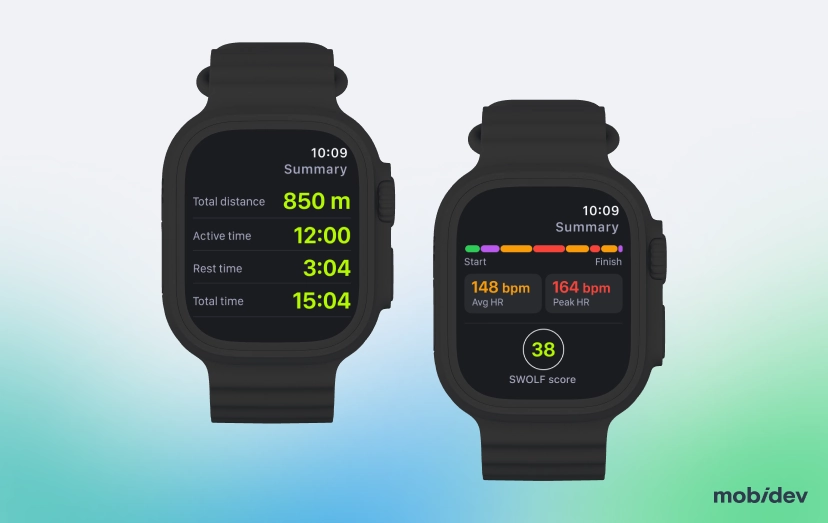
Deliverables for Apple Watch Companion App
In 2 years, MobiDev delivered the following functionality:
- Native watchOS companion integrated with the client’s existing iOS fitness platform.
- Individual workout tracking for 2 sports types (+ 3 more in development).
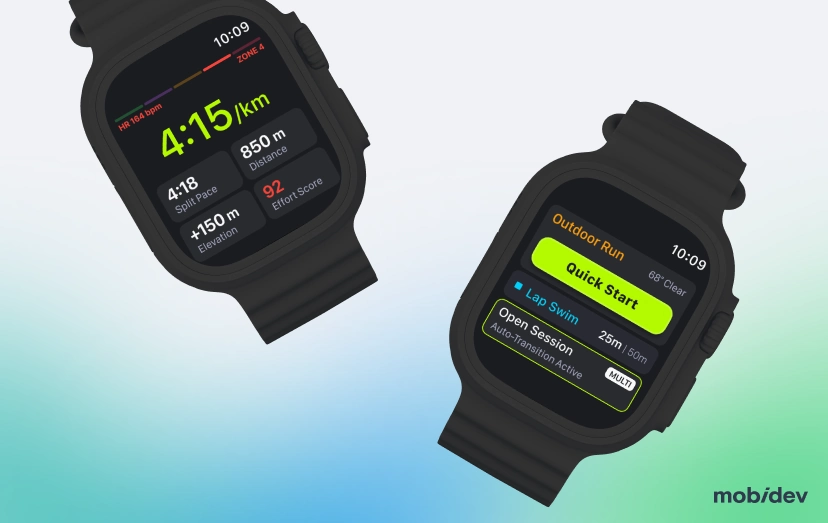
- Live workout metrics, splits, and segment data based on the platform’s proprietary logic.
- Open Session mode supporting mixed-sport workouts without a predefined sport order.
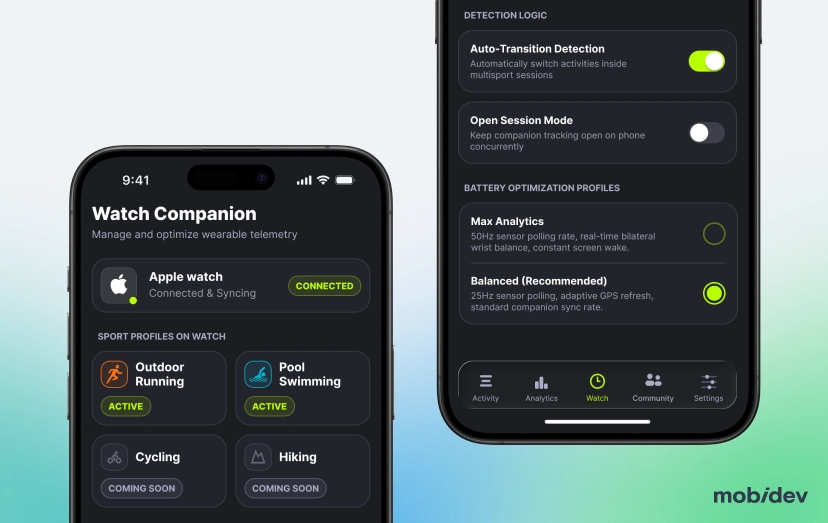
- Automatic sport-transition detection with confidence thresholds and one-tap athlete confirmation.
- On-watch sport classification using motion, GPS, speed, and heart-rate signals.
- Offline-first workout recording without requiring the iPhone or cellular connectivity during the session.
- Reliable synchronization between the Apple Watch and iPhone application.
- Bilateral and Unilateral workout analytics, route maps, and post-session insights.
- Integration with the platform’s activity feed, segments, and per-sport and overall leaderboards.
- Battery optimization for multi-hour multisport sessions.
- Real-device testing across Apple Watch models and watchOS versions.
- TestFlight pilot with the client’s athlete community and phased production rollouts.
- Ongoing application support and sport-classification tuning.
Tech Stack for Apple Watch Companion App
Swift
SwiftUI
Core Motion
Core Location
Existing Platform APIs
TestFlight
Instruments
MetricKit
Swift
SwiftUI
Core Motion
Core Location
Existing Platform APIs
TestFlight
Instruments
MetricKit
Build an Apple Watch Companion App with a Reliable Partner
Fill out the form and share your vision for an Apple Watch Companion App. Our experts will get back to you within 1 business day.
FAQ
The cost depends on whether the application is a simple companion, a standalone workout recorder, or a sensor-based product with machine learning functionality. Overall it ranges between $40 and $80K. The number of supported sports, proprietary metrics, offline synchronization, battery optimization, and integration with the existing platform also affect the budget. A technical review of the current iOS application and APIs is required before an accurate estimate can be prepared.
The timeline depends on the condition of the existing architecture and the complexity of the watch functionality, but at least 3-4 months. A project like this usually includes product and technical analysis, UX and architecture, development of the workout recorder, integration, real-device testing, and a pilot rollout. Sensor classification and real-world model tuning can take longer than developing standard workout screens and synchronization.
Yes, provided the existing platform has APIs and a data model capable of receiving structured workout information. In this case, the Apple Watch application was connected to the existing iOS platform, activity feed, analytics, segments, and leaderboards without rebuilding the core product. Some APIs or workout schemas may still need to be extended to support watch-generated data.
The right starting point depends on the technical and product uncertainty. A proof of concept is appropriate for unvalidated functionality such as automatic sport-transition detection, while an MVP can include reliable workout recording, core metrics, and synchronization. In this project, the workout recorder was delivered first, and the automatic mixed-sport functionality was validated through a pilot before a broader rollout.
Release the application to a selected group of athletes through TestFlight and measure how they use it in real training conditions. Track activation, workout completion, repeated usage, activities recorded per athlete, synchronization reliability, manual corrections, and qualitative feedback. This also allows the team to improve the experience before investing in a full production release.
Standalone workout recording removes the need to carry an iPhone during training. Live sport-specific metrics, mixed-sport sessions, simple transition confirmation, structured post-session analytics, route maps, leaderboards, and activity-feed integration give athletes more reasons to use the platform consistently. Reliable offline functionality is also important for long outdoor and multisport sessions.
Success should be measured through product, technical, and business KPIs. Relevant metrics include watch-app adoption, activities recorded per connected athlete, repeat usage, 30- or 90-day retention, synchronization success, workout completion, battery consumption, classification accuracy, and the number of workouts requiring manual corrections. In this case, the team also compared the behavior of watch-connected users with that of phone-only users.
Yes. The application does not have to rely only on standard HealthKit workout screens or metrics. It can capture sensor and workout data on the watch and pass structured results to the existing platform, where proprietary splits, segments, performance metrics, leaderboards, and post-session analytics can be applied.
Yes, if the workout and classification architecture is designed for expansion from the beginning. Adding another sport may require new data collection, sport-specific metrics, interface changes, classifier tuning, and real-world testing. The effort depends on how different the new sport is from the activities already supported.
A typical team includes a project manager or business analyst, a watchOS engineer, an iOS engineer (can be the same person), a machine learning engineer, a UX designer, and QA specialists. Backend expertise may also be required if APIs, analytics, or workout-processing logic need to be extended. The ML specialist is particularly important when the application must distinguish between sports automatically.
The application should be tested against new watchOS versions and Apple Watch models before updates reach all users. Maintenance also includes monitoring battery use and field performance, updating deprecated frameworks, validating sensor behavior, and checking synchronization with the iOS application. For an ML-enabled product, real-world data can also be used to retune the classifier and support additional sports.
Yes. In this project, workouts were recorded directly on the Apple Watch without requiring an active iPhone or cellular connection during the session. The watch stored the workout locally and synchronized it with the iOS platform when the connection became available again.
Accuracy depends on the supported sports, the quality and diversity of the training data, environmental conditions, and how similar the movement patterns are. In this case, the classifier reached 90.8% accuracy after iterative tuning. The system also used confidence thresholds and one-tap athlete confirmation rather than treating every prediction as certain.
The classifier should not react to one isolated sensor signal. This project combined motion, GPS, speed, and heart-rate data with confidence thresholds and temporal smoothing, helping prevent short stops or transition jogs from changing the sport incorrectly. Lower-confidence changes were shown to the athlete for confirmation instead of being applied automatically.
Core Motion provides accelerometer and gyroscope patterns associated with wrist movement and cadence. Core Location supplies GPS tracks and speed, while HealthKit provides workout and heart-rate information. Combining these signals produces more reliable results than using any individual sensor alone.
Real-time classification should generally run on the Apple Watch when the application must work without a phone or network connection. On-device Core ML provides faster responses and allows the watch to detect transitions during the workout. Cloud infrastructure can still support model training, analytics, performance monitoring, and the distribution of updated model versions.
The complete workout should first be stored locally on the Apple Watch. Watch Connectivity can then transfer the session when the iPhone becomes available, including individual sport legs, transitions, routes, and recorded metrics. The iOS application can reconstruct the full mixed-sport activity after synchronization.
The workout should remain stored on the watch until the transfer is completed successfully. The synchronization workflow can retry delivery in the background after connectivity is restored. It should also protect against incomplete records and duplicate activities when the same transfer is attempted more than once.
Battery optimization requires balancing sensor accuracy with the frequency of GPS, motion, heart-rate, interface, and synchronization operations. The application should minimize unnecessary screen updates and background processing while preserving the data required for performance analysis. Instruments and MetricKit can be used to profile energy consumption, followed by real-device testing during multi-hour sessions.
Testing should be performed on physical devices rather than relying only on simulators. In this project, the team recorded real workouts in pools, open water, on roads, and on trails, while testing across a matrix of Apple Watch models and watchOS versions. The team evaluated sensor consistency, classification results, synchronization, edge cases, and battery consumption under realistic training conditions.