
 10 min read
 AI code generation can make MVP development up to 4x faster. But speed alone doesn’t create successful products. In fact, most AI-built MVPs still fail for the same core reason: missed validation of the idea itself. Founders rush to build, but skip proving that the product solves a real problem for real users. As a result, even the fast, AI-generated MVPs fall flat with the market and with investors.
At the same time, there’s another layer of risk: AI-generated code still requires expert review. When you give oversight and control to AI coding assistants that are uninformed about your objectives, tech stack, and scalability needs, your MVP will fail.
So the challenge is twofold:
- Validate the product idea with users and investors
- Validate the code and architecture with experts
At MobiDev, we believe founders shouldn’t have to choose between speed, quality, and market proof. Our AI-enhanced development approach pairs rapid AI coding with a human-led strategy, so you can deliver an MVP fast, typically within 10 days, and ensure it’s validated, scalable, and investor-ready.
In this guide, we’ll break down the real obstacles to MVP development in the age of AI and show how to overcome them with a balanced approach that gets your product built faster and with a far higher chance of success.
One of the authors of this guide, Andrew, recently spoke in a webinar where he discussed the real reasons MVPs fail, how to avoid common pitfalls, and the development challenges you’ll face when building a product that earns investor approval. If you’d rather watch than read, check out the webinar recap and access the full recording via the link below.
Watch The Full Webinar Recording
Watch the WebinarFor those who prefer reading over watching, the guide below unpacks these concepts in a clear, practical way.
Top 3 Real Obstacles to MVP Development
Let’s discuss the three most important obstacles that you’ll face on your journey.
1. Favoring Time Over Validation
While getting your MVP in front of investors as soon as possible is the goal, skipping idea validation will only earn you wasted time. Ensuring your product solves real market problems is what will truly win over the hearts of investors, not speed.
2. Management and Rework
Developing too quickly with AI assistance isn’t the only problem: developing too slowly without AI is expensive too. Every good business leader knows that managing developers is difficult and takes time and energy away from business growth. The longer that your MVP takes to develop, the more expenses that you incur. Naturally, it’s understandable why startups skip steps when it comes to idea validation.
However, cutting those corners can result in having to go back to the drawing board. Rework is a major source of expense: 35–40% of startups lose funds due to this exact problem.
3. Choosing the Wrong Tech Stack
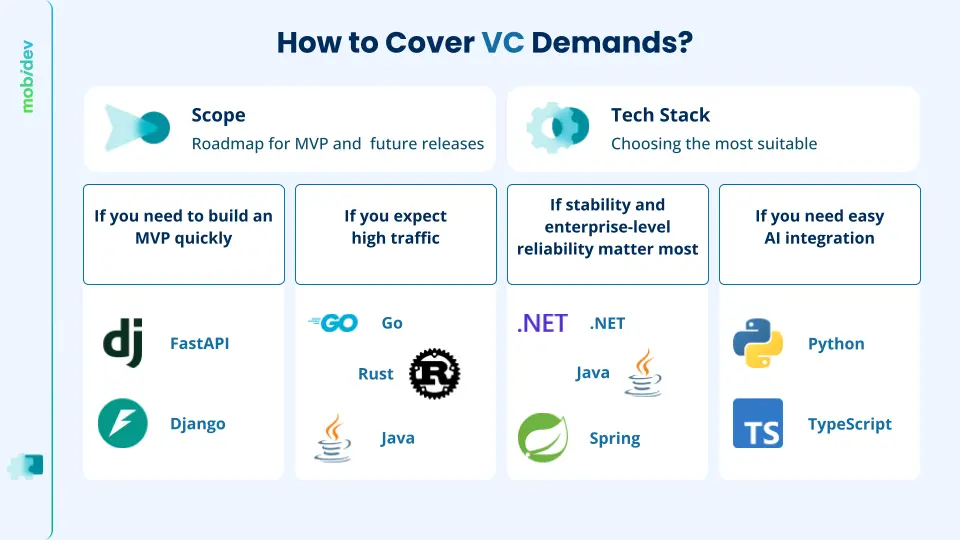
At a more technical level, tech stack confusion is one of the largest obstacles to MVP development. Choosing the wrong technology or framework for startup is an error that can affect every aspect of your MVP. For example, React Native may not be the best choice for a banking application, where enhanced security, strict compliance, and a fully native experience are often required.
FAQ ABOUT MVP Development
The most important reason that rushing MVP development backfires is because you built features that no one needs. This problem results in two-fifths of startup budgets going toward rework to repair the damage caused by ideas that startups didn’t validate. This severely delays investor traction.
AI-Enhanced MVP Development: The Double-Edged Sword
The benefits are obvious: using AI in software development will result in faster delivery, rapid prototyping, and reduced cost of an MVP. However, the risks are serious. False validation can make your project pointless, AI-generated code can result in critical problems in structure, security, and scalability, and demonstrating how your product works can become difficult when investors demand to see what’s going on under the hood. Overcoming those risks to reap the benefits of an AI-enhanced approach is one of the most significant MVP software development challenges.
Vibe Coding Doesn’t Cut It
Vibe coding is a dangerous approach. Going gung-ho without expert oversight will result in architectural problems, security vulnerabilities, compliance issues, hidden bugs, and an inability to reliably scale and improve upon your product. Most importantly, vibe coding makes it difficult to demonstrate proof to investors that you know how your product works now and will be capable of further scaling later. Rewriting to fix these problems and demonstrate reliability and proficiency to investors may turn out to be even more expensive than traditional development!
Another Way: Expert-in-the-Loop
An expert-in-the-loop approach has allowed MobiDev to develop MVPs with AI in industry-leading time of 10 business days while preserving high quality software. Our workflow is centered around AI automation, but experts guide the process from end to end. All code is checked rigorously, and rolled back when needed to correct mistakes before they cascade.
Webinar: Why Vibe Coding Fails When Developing an MVP
Rustam, one of the authors of this guide, spoke in our webinar about the risks of vibe coding. Watch the webinar to learn from both technical experts and an entrepreneur about how AI-assisted coding with an expert-in-the-loop can benefit your development process.
FAQ ABOUT AI-ASSISTED MVP DEVELOPMENT
No. Without the context awareness, compliance control, and product-market insight that developers have, AI can only accelerate coding and help with research, but not take the wheel. Expert oversight is the only way that AI-generated code can align with your business goals.
3 Key MVP Validation Techniques: Turning Data into Real Market Proof
AI coding tools are excellent for initial idea generation, but their “insights” aren’t proof of a validated idea. Human validation is far more useful. MobiDev uses beta testing, user interviews, and other feedback loops to check ideas before going all in on new features. Being able to support validation using tools like these can increase investor confidence in your MVP. Human-led validation is a key factor in how that small fraction, only 10%, of AI-built MVPs gain traction.
1. Validation with Beta Testing
Beta testing is one of the most direct ways to validate that your MVP can work in the real world. Choose early adopters that match your target market segment. Not only are these the same people that will find your product useful, but they have a greater tolerance for imperfections and bugs. The detailed feedback that they provide will help you improve your product. Offering these programs is also a great way to build early adopter loyalty.
If developers oversee the beta testing process, improvements can be made to your MVP even faster. This pairs well with the expert-in-the-loop approach when accelerating development with AI coding tools.
2. User Interviews
While beta testing can help you quickly gain feedback, user interviews allow you to get a much more personal understanding of how testers are feeling and experiencing your product. Interviewing users will help you uncover nuanced insights into their motivations, frustrations, and expectations.
When building questions for interviews, try to root out pain points that your audience may experience. The answers you receive can help you better understand user behaviors and how to improve your MVP’s features to cater to their needs.
When choosing users to interview, try to pick a variety of different users to gain a broader understanding of how different kinds of users might use your product.
3. Continuous User Analytics
User feedback is helpful, but monitoring their behavior is even better. Look closely at which tools they’re using more frequently to measure engagement and where the user experience is slowed down. This information can tell you what’s working and what you can improve, even if testers aren’t explicitly telling you about those bottlenecks.
For example, you might notice that users speed through most of an onboarding process except for one particular section. That’s a clue you need to investigate that part of the application to see what’s slowing users down.
FAQ ABOUT MVP VALIDATION
Ask open-ended questions in user interviews. This will maximize your chances of uncovering user motivations, frustrations, and expectations. This information is vital for adjusting the course of your MVP to make it its best before it’s presented to investors.
5-Step Roadmap for Founders to Overcome MVP Development Challenges
The best way to create MVPs swiftly with AI while meeting investor expectations is to follow these five steps:
- Define validation KPI’s before coding.
- Choose scalable tech with expert consultation.
- Use AI for prototyping, not strategic decisions.
- Maintain expert-in-the-loop QA.
- Measure traction early with real users.
How Much Does It Cost to Develop an MVP with AI?
The average cost of an MVP built with MobiDev starts at $10K, with a project scope of about 100 hours. Features and complexity are the main sources of variability. This price range is based on AI acceleration and expert oversight, allowing you to maximize speed and cost-savings without compromising quality.
How Fast Can MVP Be Launched with This Approach?
With MobiDev’s AI-assisted workflow, we can complete MVPs in an average of 10 business days. AI accelerates the coding and prototyping process, while senior engineers guide the process. Senior developers tweak outputs to complete product features and functions. Duration depends heavily on complexity, especially for AI and IoT projects.
Curious what’s possible to build with an AI-assisted MVP development approach for $10K? Below are three success stories of real products MobiDev delivered with the help of AI-assisted MVP development, enabling founders to secure investment or reach the market before their deadlines.
Success Story #1: How We Built MVP for Retail Deal Discovery App in 3 Weeks at $10K
A US-based company (name withheld due to NDA) needed a high-quality MVP for a Retail Deal Discovery App to be delivered within a month at an affordable price. They chose MobiDev to complete this task.
Our AI-as-a-Partner approach to MVP development matched their timeline and budget limitations. This approach helped produce 10,494 lines of error-free code while increasing development speed by 2.57× and saving up to 69.8% of the budget per role.
We delivered a high-quality MVP with the required feature set in three weeks, which our client presented to investors, securing their first round of funding.
Learn more about the MVP features and tech stack behind the scenes.

Success Story #2: How We Delivered a Habit Tracking & Analytics App MVP in 11 Days at $10K
A UK-based IT company (name withheld due to NDA) wanted to expand its product line of corporate health and wellness applications. Market research showed that habit-tracking and analytics apps would be the most promising direction. With a 14.2% CAGR, the market for this type of app is booming, fueled by corporate wellness initiatives.
Since the client’s internal development team was fully focused on their core products, they decided to outsource the new project to MobiDev.
Their business need was to create a working MVP quickly and at an affordable price. The AI-as-a-Partner approach allowed us to create and test an MVP in just 11 days. On average, developing such a Habit Tracker MVP manually takes approximately 50 days.
With AI assistance, we accelerated development by 3.55× and saved 73.2% of the budget for the client, while delivering a working app that could be provided to users for testing.
Success Story #3: How Treegress Built a CRM 7.5x Faster
Treegress faced a significant challenge: they found that building a CRM traditionally would take 136 hours. They needed it built a lot sooner. With MobiDev, Treegress was able to build that CRM in just 3 days using an AI-enhanced expert-in-the-loop approach.
Development of Treegress’s CRM MVP succeeded because of expert validation, clear scope, and AI-assisted coding that senior developers carefully supervised.
Learn more about the MVP features and tech stack under the hood.
Read more about other MVP ideas and examples that can be built with the help of AI within 10 days staying within $10k budget.
AI Changes How To Build, Not How To Succeed
Founders need to get demos in front of investors fast, but they also need to be confident in the product quality. AI accelerates development, but only human-led validation creates products investors love. Explore MobiDev’s AI-enhanced rapid MVP development services with a special offer: launch your MVP in just 10 business days starting from $10K.