
Building a POS That Holds 0.03-Second Response Under High-Volume Service
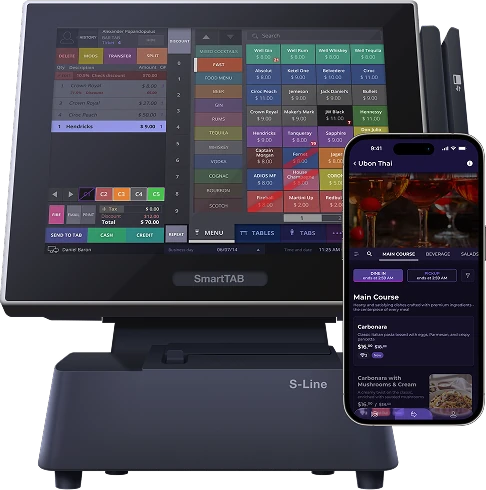
In 2014, following a disappointing experience with another development company, the founder of SmartTab turned to MobiDev to take over the development of a premium POS solution tailored for restaurants, nightclubs, and bars. Over the years, MobiDev has helped transform SmartTab into a comprehensive ecosystem, enhanced by AI-powered demand forecasting analytics. Since the start of our collaboration, SmartTab has evolved from an ambitious startup into an industry leader, now serving hundreds of venues and venue chains.


The Story Behind Building the SmartTab POSThe Story Behind Building the SmartTab POS
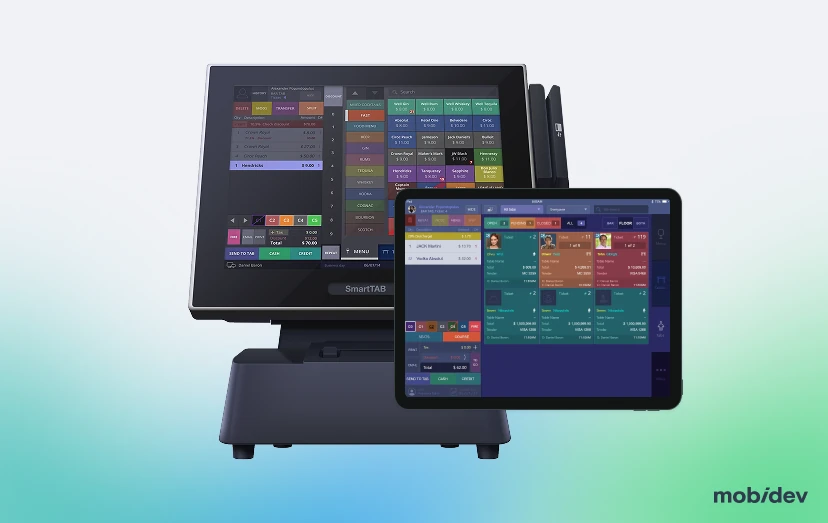
Working within the nightclub industry since 2010, Daniel Baron not only understood but also experienced the inconveniences of POS solutions of that time. Those systems had cluttered interfaces and desperately long processing times, which was particularly harmful for high-volume venues. Daniel wanted to change things by creating a “POS that doesn’t suck,” a modern solution that ensures process optimization becomes a reliable tool for preventing chargebacks and can both handle the needs of an independent venue and a large venue chain.
After his cooperation with another software development vendor resulted in a pilot version of the app that fell below expectations, Daniel was looking for someone who could start over with the development and would be flexible and experienced enough to operate with a diversified tech stack and create a software product that meets his requirements. That’s where the cooperation between SmartTab and MobiDev started in 2014.
Business Value of POS for High-Paced Venues
Since the beginning of our cooperation in 2014, SmartTab has transformed from a bold startup to an industry leader that serves hundreds of venues and venue chains. The SmartTab software itself has scaled into a complex, yet user-friendly ecosystem, offering a POS system that operates offline, a customer app, and an AI analytics system with a demand forecasting model under the hood.
Despite a 40% decline in bar and nightclub market size in 2020, MobiDev and SmartTab made no pause in cooperation, step by step improving and growing the product. As a result of our combined efforts, the number of active venues using SmartTab has grown by an impressive 470% over the past four years, further solidifying its position as a leading solution in the hospitality industry.
The current capacity of SmartTab empowers it to effectively serve a venue of any size. In particular, recently, the SmartTab system served the Block Party that was organized by the Midway SF in San Francisco, California, with 10,000+ guests and tabs. There, 51 SmartTab devices, mainly stations and standalone iPads, successfully served the high-volume event.
Project Scope of SmartTab POS Development
Consulting plus a dedicated team that grew from 5 engineers to 30+, running since 2014.
Stage 1. Tech consulting before the first line of code. Project documentation and a technology recommendation built around scale and integration: payments, gift cards, reporting, biometric verification, ID scanning.
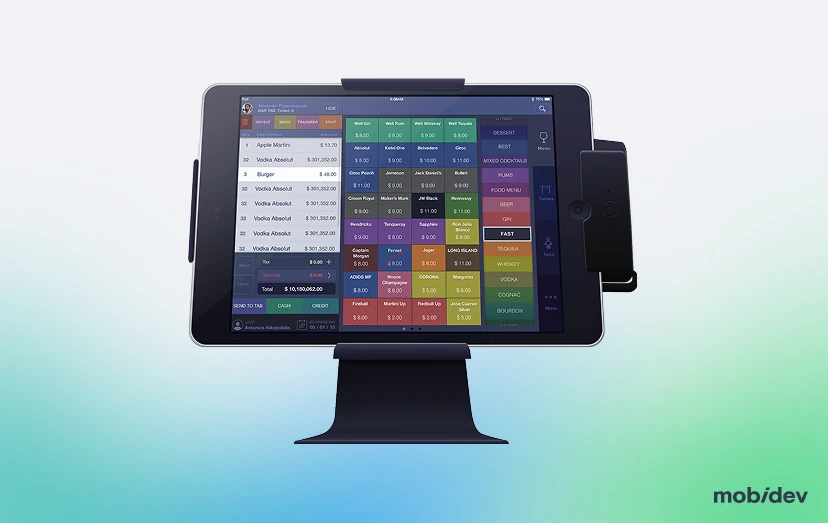
Stage 2. Increasing POS operational speed. Developers took the response delay down to 0.03 seconds. Designers cut the number of clicks a bartender makes to close a tab.
Stage 3. Demand forecasting on the venue’s own sales data. 365-day revenue predictions, real-time analysis over custom timeframes, and anomaly detection in sales. Product-level numbers feed inventory and marketing calls.
Stage 4. Offline mode. The POS keeps taking orders when the connection drops and processes captured payments once it’s back. Menu and pricing edits push from any device.
Stage 5. Checkout built around guest identification. The flow keeps the guest’s identifying information on file, which gives venues evidence when a chargeback is disputed.
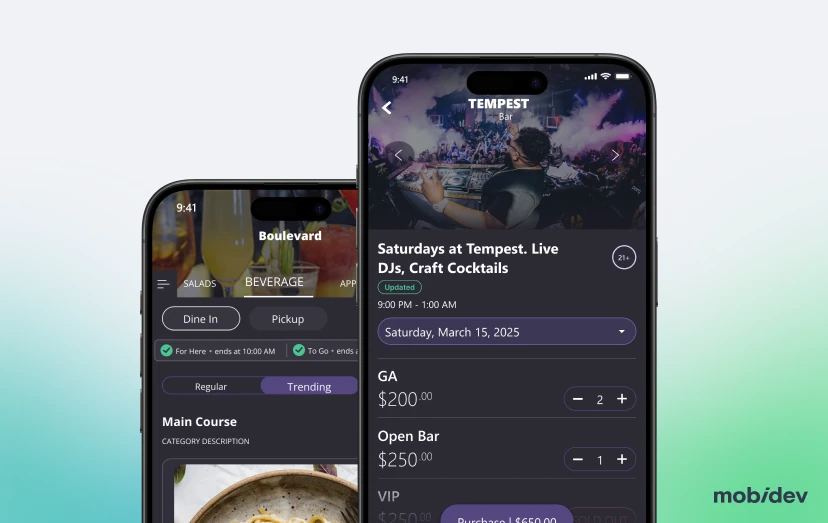
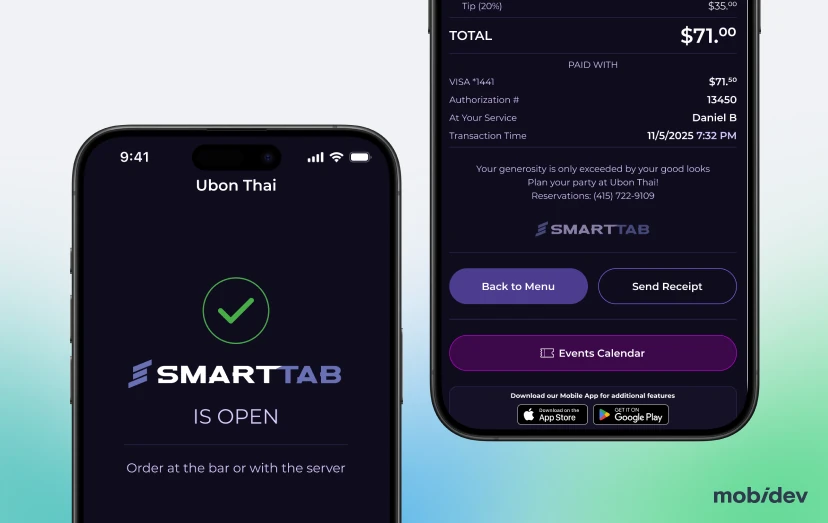
Stage 6. Continuous expansion. New roles and features on a rolling basis, forecasting insights on the management dashboard, and guest apps on iOS and Android that store a card and let people order without queueing.
Deliverables of the SmartTab POS Project
- Project documentation and technology recommendations for high scalability and third-party integration.
- POS system for restaurants, nightclubs, and bars, built on Java for integration breadth and cross-platform versatility.
- Architecture design enabling quick deployment at venues and automatic feature delivery to specific locations.
- Response delay reduced to 0.03 seconds, with a click-minimized POS interface.
- Offline mode with payment capture and processing on reconnection.
- Real-time menu and pricing updates from any device.
- Checkout flow preserving guest identifying information as chargeback dispute evidence.
- AI demand forecasting: 365-day revenue predictions, real-time analysis for custom timeframes, sales anomaly detection.
- Analytics dashboard with product-level insights for inventory and marketing strategies.
- Guest-facing iOS and Android apps with stored card data, menu browsing, and self-ordering.
- Third-party integrations: payment systems, gift cards, reporting, biometric verification, ID scanning.
Tech Stack
SpringBoot
PHP
Symfony
Yii2
Python
FastApi
Protobuf
EventStore
EventBus
PostgreSQL
MariaDB
Snowflake
Airflow
Nginx
Hazelcast
Redis
WebSockets
Vue.js
Swift (iOS)
JavaFx
Java (Android)
Kubernetes
Helm
Docker-compose
SpringBoot
PHP
Symfony
Yii2
Python
FastApi
Protobuf
EventStore
EventBus
PostgreSQL
MariaDB
Snowflake
Airflow
Nginx
Hazelcast
Redis
WebSockets
Vue.js
Swift (iOS)
JavaFx
Java (Android)
Kubernetes
Helm
Docker-compose
Build POS for High-Paced Venues
Fill out the form and share your vision for your product. Our experts will get back to you within 1 business day.
FAQ
There’s no universal target. The number falls out of your busiest venue, not your average one. A bar closing 250 tabs a shift feels a half-second lag as a queue at the till; a quiet restaurant doesn’t. Getting response time down is rarely one fix. It’s the backend path for a transaction and the number of taps a bartender makes, worked at the same time. On SmartTab, MobiDev brought the response delay down to 0.03 seconds while designers cut the clicks needed to complete an order, because either one alone would have left the other as the bottleneck. Now the system can easily handle 1085.
Usually yes, if the constraint is throughput rather than data model. Rewrites become necessary when the architecture assumes a single location: shared state, one database per install, no tenancy. If those assumptions aren’t baked in, scaling is an infrastructure and deployment problem. SmartTab started with independent venues and now serves hundreds of venues and chains; in November 2023, 51 SmartTab devices ran a 10,000-guest event at the Midway SF in San Francisco on the same system.
This is a deployment architecture decision, and it’s cheaper to make early than to retrofit. Without it, every release goes everywhere at once and one bad update hits every venue. With it, you can pilot a feature at a few sites and stage the rollout. On SmartTab, the architecture was designed so the system could be deployed quickly at venues and features delivered automatically to specific locations.
Offline capability means deciding what the device can do alone and what has to reconcile later. For payments, that usually means capturing the transaction locally and processing it once the connection returns, with conflict handling for anything that changed server-side in the meantime. MobiDev built offline mode into SmartTab so payments are captured during an outage and processed when the system is back online, alongside menu and pricing updates that push from any device in real time. Consulting and architecture design were the key factors of success.
Partly, software can’t stop a disputed charge, but it decides whether you have evidence when one arrives. That means capturing and retaining identifying information at the point of sale in a form that holds up in a dispute. MobiDev built SmartTab’s checkout flow around guest identification for exactly this, giving venues something to submit against unwarranted chargebacks.
The ones that would force an architecture change if added later. Payments, hardware, and anything touching identity or compliance belong in the first technical design, even if you build them in year three. On SmartTab, the initial consulting stage produced documentation and a technology recommendation scoped for integration with payment systems, gift cards, reporting, biometric verification, and ID scanning, several of which shipped much later.
Team growth breaks products when process, documentation, and test coverage don’t grow with it. The limiting factor is usually onboarding time and how much of the system lives in one person’s head. SmartTab’s team went from 5 engineers to over 50 across the engagement, with automated QA in the stack from early on.
Almost always added, not rebuilt. Forecasting and analytics models run as separate services against your existing data. They read from your system, not replace it. The rebuild question only comes up if the data you need was never stored or was aggregated away. For example, SmartTab was built in 2014 and had AI-driven demand forecasting added years later, running alongside the POS rather than in place of it.
One of the main pitfalls most customers fall into is data. For AI to be efficient, it needs data, so before adding AI to your system, you need to prepare the baseline. This includes eliminating data silos, implementing a data lake, and data pipelines, which could act as a data source for AI to be integrated. Architecture design is a key factor here.
Start where you already hold the data and where a wrong answer is survivable. Demand forecasting fits both: transaction history is already there, and an imperfect forecast still beats a manual guess. Prediction features that block a user action are much harder to launch, because they need to be right before anyone trusts them. SmartTab’s first AI capability was forecasting: 365-day revenue predictions, real-time analysis over custom timeframes, and detection of sales anomalies.
For operational forecasting, your own transaction history is usually the dataset. External data (weather, local events, seasonality) gets layered on when the internal signal runs out. For example, SmartTab’s forecasting runs on data from the POS systems themselves, surfaced back to venue owners on their management dashboard.
Again, before feeding data to AI, you need to “prepare” it: break the data silos, create a data lake and data pipeline.
Rarely. Models are typically built in Python and exposed as a service, so the language your product is written in doesn’t have to change. What matters more is whether your data is reachable, accessible database, clean event history, no critical fields locked in a legacy format. SmartTab’s core is Java and PHP, with Python in the stack alongside them.
A dashboard is the safe first version and the least used. The insight has to land where the decision gets made (in the ordering screen, the inventory list, the shift plan). Most AI features fail on delivery rather than accuracy. SmartTab surfaces forecasting through an analytics dashboard with product-level insight for inventory and marketing decisions.
Models drift. Consumer behaviour shifts, your product changes, and accuracy degrades quietly unless someone is watching it. This is ongoing engineering work, not a one-time delivery, and it needs to be in the plan before launch. You can hire an in-house team or outsource this to MobiDev’s software engineers using our team augmentation or dedicated team services.
Because the decisions that are expensive to reverse all happen in the first few weeks: data model, integration surface, deployment model. Writing code first means discovering those constraints after you’ve built against the wrong ones. A consulting stage produces documentation and a technology recommendation you can hold the build against. MobiDev started the SmartTab engagement this way, before the first line of production code.
Project documentation covering requirements and risks, a technology recommendation with the reasoning behind it, and a scoped first version. For example, for SmartTab, that documentation was built around scalability and third-party integration (payments, gift cards, reporting, biometric verification, ID scanning and offline mode) several of which weren’t built until years later.
It compresses. If the requirements are settled the stage becomes technology selection and architecture, which is days rather than weeks. What it shouldn’t do is get skipped, because the technology choice is the part you live with longest.
Both, and fixing one alone wastes the other. A 30-millisecond backend behind a five-tap checkout still feels slow to the person holding the tablet. Speed work that lands treats the transaction path and the interaction count as one problem. On SmartTab, developers cut the response delay to 0.03 seconds while designers reduced the clicks needed to complete an order.
From the busiest venue you serve, not the average. Your peak load sets the requirement. A site closing 250 tabs a shift is a different target from one doing 30. SmartTab’s targets came from client data showing large venues processing 8,000 orders daily.
When you have enough transaction history for the pattern to be real, and a user who’d act on the output. Both matter. Early-stage products usually fail the first test; feature-driven roadmaps often fail the second. SmartTab had roughly a decade of POS transaction data before forecasting was added.
Depends what decision it’s feeding. Revenue projections inform staffing and cash planning; product-level output informs ordering. SmartTab delivers 365-day revenue predictions, real-time analysis over custom timeframes, sales anomaly detection, and product-level insight for inventory and marketing.
The reconciliation, which is the hard part. Taking an order offline is straightforward; deciding what happens when it syncs against a menu or price that changed server-side is where the engineering goes. Payments add a further constraint. Our suggestion is to capture locally and process on reconnect. For example, SmartTab’s offline mode captures payments during an outage and processes them once the system is back online.
It can be added, but it’s one of the more invasive retrofits, because it changes where state lives. If offline operation is a known requirement, it belongs in the first architecture. It was a stated requirement for SmartTab from the outset.
No POS system can prevent a dispute, but you can build it in a way that you can contest the chargeback. That means capturing identifying information at the point of sale and retaining it in a usable form: a checkout flow decision, not a payments integration decision. For example, MobiDev built SmartTab’s checkout around preserving guest identifying information so venues have evidence in unwarranted chargeback disputes.
Staged rollout, so a release reaches a few locations before all of them. This is an architecture property. If the system can’t target locations, every release is all-or-nothing. SmartTab’s architecture supports deploying quickly at venues and delivering features to specific locations automatically.
It depends on your product roadmap. Some companies prefer focusing on delivering new features to their users on a regular bases. Others prefer less feature-shipping, more depth: new roles and permissions, adjacent apps, and capabilities layered onto the data the product has accumulated. For example, SmartTab’s later phases added new roles, forecasting insight on the venue management dashboard, and guest-facing iOS and Android apps with stored cards and self-ordering.