
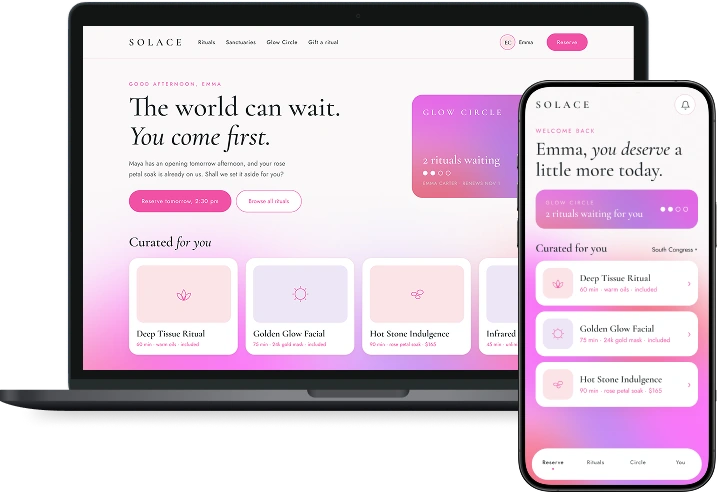
Migrating a Wellness Chain’s Booking & Membership Portal from AngularJS to Vue
In 2025, a USA-based chain of spas & wellness locations (NDA) began the growth-round evaluation that flagged their AngularJS booking & membership portal as a major tech risk, resulting in a lower offered multiple.
The chain chose MobiDev as their Technical Partner to modernize the legacy platform. The audit showed that realistically we wouldn’t be able to complete it before the round. Instead, we created a remediation plan that enabled our client’s investor to reprice and close the deal at a higher multiple. In 10 months, we completed the modernization and added an AI-based no-show prediction feature.


The Story Behind the AngularJS to Vue Portal Migration
In mid-2025, a USA-based chain of spas & wellness locations (name under NDA) had a technical risk flagged during the growth round evaluation. As a result, they were tied to a lower offered multiple. Their booking & membership portal, built on AngularJS in 2012, was the main reason. It had a number of security issues and, on top of that, adding new locations required a manual configuration pass to connect client data with the POS and scheduling system.
The client had only 4 months to solve the problem. However, a tech audit conducted by the MobiDev team showed that it would take 7-10 months to modernize the legacy system. We created a remediation plan that included security patching, an architecture assessment, and a milestone-based roadmap for repricing the multiple.
Business Value of the AngularJS to Vue Portal Migration
- Higher multiple offered during the growth round. The deal closed above the multiple on the first term sheet.
- Mitigated security risks by patching critical vulnerabilities and moving off an unsupported framework.
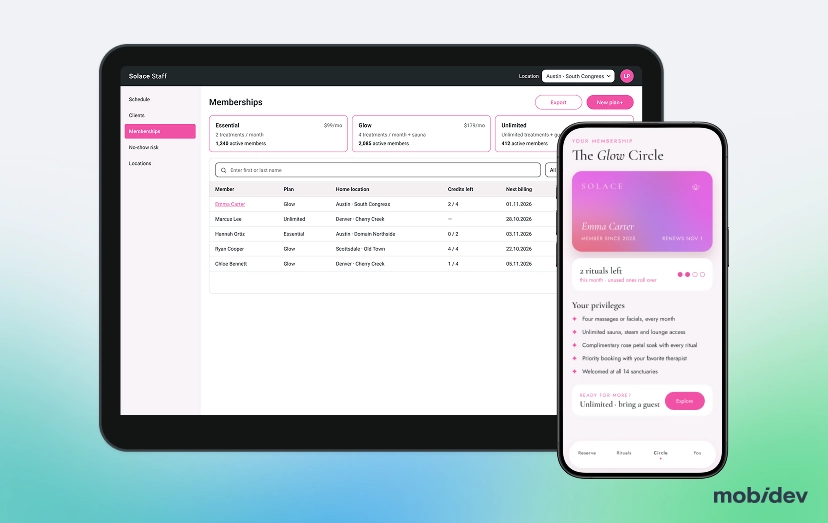
- Faster location rollout. A configurable POS and scheduling sync layer allowed the client to avoid manual configuration.
- Future-proof architecture. Booking, membership, client profile, and waiver logic were transferred from front-end to backend.
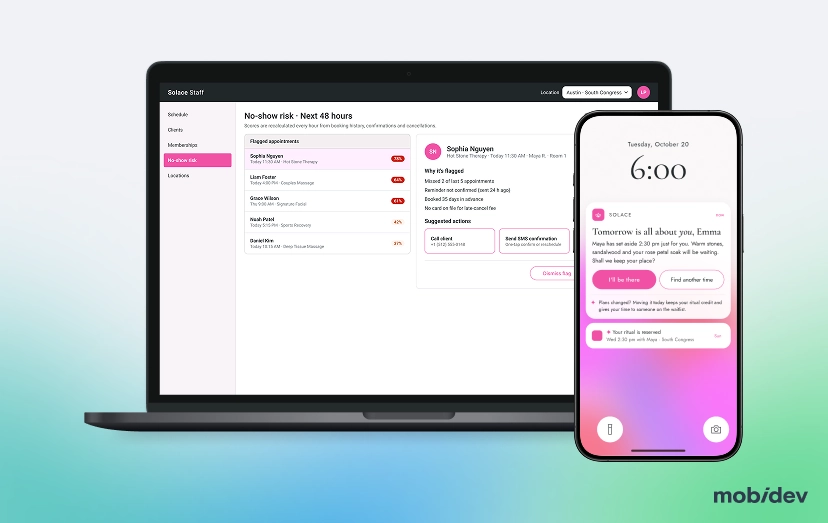
- No-show prediction logic helped the company to reduce the number of missed appointments by 37.7%.
Project Scope of the AngularJS to Vue Portal Migration
Stage 1. Tech Audit. MobiDev evaluated the security exposure and modernization effort, showing the full migration would take 7 to 10 months.
Stage 2. Security Patching and Remediation Plan. The team closed critical vulnerabilities and delivered a milestone-based roadmap the investor could price against.
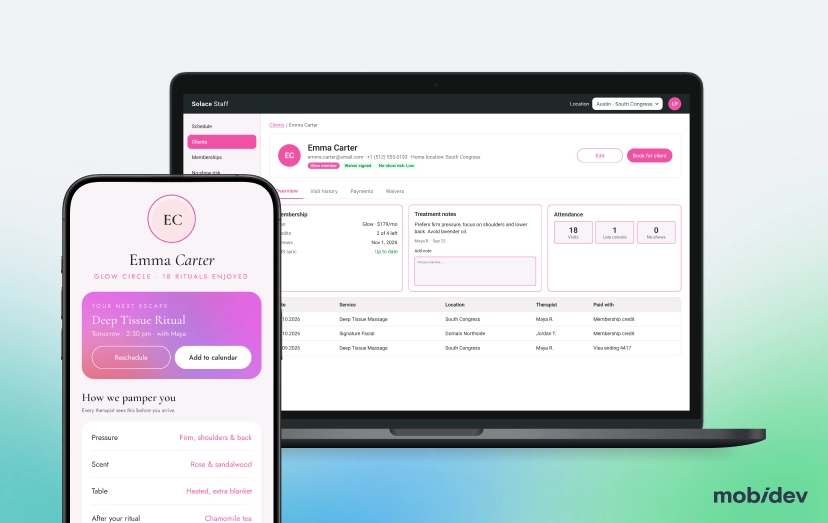
Stage 3. Backend Services Extraction. Booking, membership, client profile, and waiver logic moved from the front end into backend services.
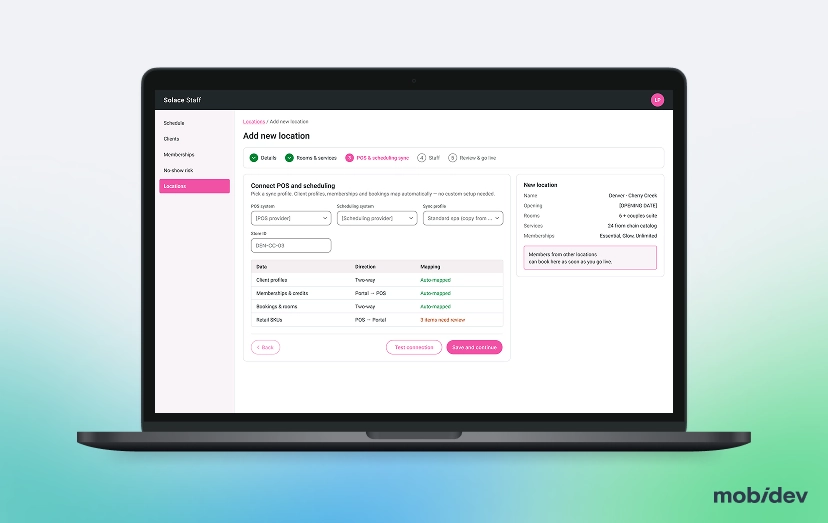
Stage 4. POS and Scheduling Integration Layer. A configurable sync layer replaced per-location custom connections, so new studios need configuration instead of development.
Stage 5. Vue Portal Rebuild. The portal was rebuilt in Vue screen by screen, with clients booking normally throughout.
Stage 6. No-Show Prediction. An AI model trained on unused booking history now flags appointments likely to be missed.
Stage 7. Rollout and AngularJS Decommission. The Vue portal went live location by location, and the AngularJS front end was retired.
Deliverables of the AngularJS to Vue Portal Migration
- Tech audit report. Security exposure, architecture assessment, and a 7 to 10 month modernization estimate.
- Remediation plan. A milestone-based roadmap the investor used to reprice the deal.
- Patched legacy front end. Critical vulnerabilities closed in the AngularJS portal ahead of the round.
- Backend services and API. Booking, membership, client profile, and waiver logic decoupled from the front end.
- POS and scheduling sync layer. Configurable integration that connects new studios without custom development.
- Vue booking and membership portal. A rebuilt client-facing portal running across all locations.
- AI-based no-show prediction. A machine learning model that flags bookings likely to be missed.
Tech Stack
Modernize Your AngularJS Portal
Patch security vulnerabilities and add new features with MobiDev
FAQ
For a booking and membership portal with POS and scheduling integrations across multiple locations, a realistic estimate is 7 to 10 months. This project took 10 months, including an AI-based no-show prediction feature.
AngularJS reached end of support in December 2021, so it no longer receives security patches. Investors and buyers increasingly flag it in technical due diligence as an unmanaged risk.
Vue’s template syntax and reactivity model are structurally closer to AngularJS than React’s, so a team that knows the old app picks it up faster. The trade-offs are a smaller hiring pool than React and some libraries without TypeScript typings, which adds manual typing work. React makes more sense when hiring is the main constraint, and Angular (2+) when the team wants a stricter structure.
Due diligence teams treat unsupported frameworks and systems that do not scale as deal risk. Those items can lower the offered multiple or extend the transition period after close. Showing a completed remediation, or a credible plan with a date, changes how the risk is priced.
A full migration rarely fits a typical 2 to 4 month diligence window. What does fit is a tech audit, critical security patching, and a milestone-based remediation plan, which in this case let the client reprice and close above the first term sheet.
It covers the codebase, security exposure, architecture, data layer, and third-party integrations. The output is a realistic effort estimate and a roadmap that separates urgent fixes from the full migration.
Start with the items the report names, since those are what the buyer is pricing. Fix the ones that can be completed before close, document the rest with a roadmap, and keep the evidence in a form a technical reviewer can check.
Yes. The portal was rebuilt screen by screen, with the old and new versions running side by side until every location moved over.
Locations have to be data, not code or manual setup. That means a data model where hours, services, staff and rooms are configured per site, and a front end that reads from it. Without that, each new location adds a manual pass and a new chance for errors.
An AngularJS rewrite almost always reaches the back end, because the old front end tends to hold logic that belongs behind an API. If that logic stays in the browser, the new front end either rebuilds it or cannot work at all.
It is a machine learning model that scores each booking on how likely the client is to miss it. The model learns from patterns in past bookings, such as attendance history, booking lead time, and time slot.
If the AI feature needs data the old system holds in a tangled form, modernizing first usually costs less than building workarounds. Once the logic sits in services, a model can read from them without touching the front end.
Past appointments with their outcomes: attended, cancelled, or no-show. Useful signals include booking lead time, service type, time of day, location, and the client’s own history. The labels matter more than the volume, since a model trained on inconsistently recorded no-shows learns the recording habits instead of guest behavior.
No-show prediction, reminder timing, and filling open slots from a waitlist are realistic, because they work from booking data the business already has. Fully autonomous scheduling agents and highly personalized treatment suggestions tend to get promised and then scaled back.
Check it before planning a feature around it: whether records are complete, whether IDs are consistent across locations, and whether key fields meant the same thing over the years. Then pick one use with a clear action attached, such as a reminder or an overbooking rule, rather than a dashboard nobody acts on.
AI coding assistants help with code analysis, converting components, and writing tests. Architecture decisions, integration work, and data migration still need experienced engineers to get right.