
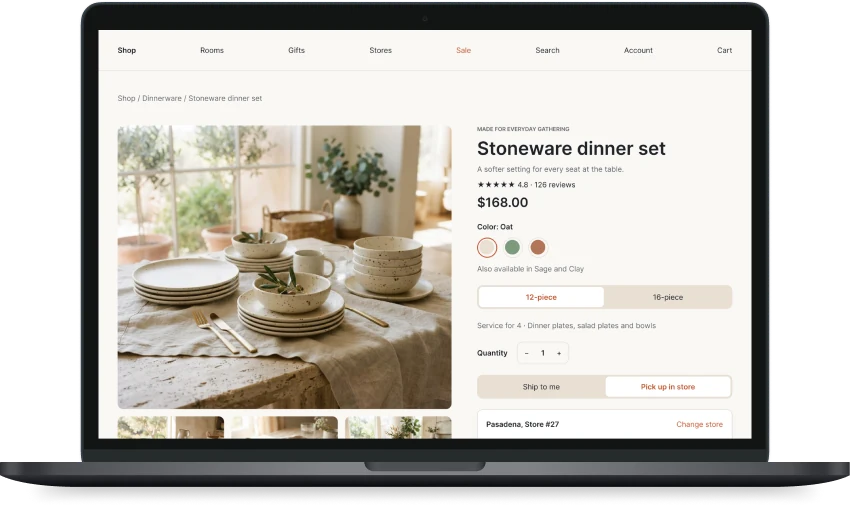
Migrating Retailer’s Inventory and BOPIS App from AngularJS to React
In 2025, a California-based specialty home goods retailer with 45 stores partnered with MobiDev to modernize their legacy app and build AI demand forecasting. Its application had been built back in 2013 on AngularJS.
The audit showed that the system required six months of work just to make the codebase safe to extend. MobiDev rebuilt the app and the BOPIS flow on React, one store at a time, and the forecasting feature shipped five weeks after launch.


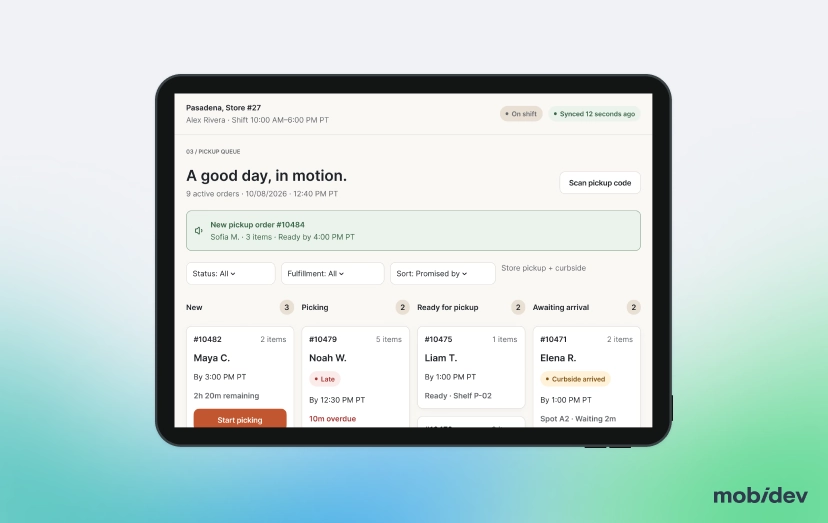
The Story Behind the AngularJS to React Migration for Retail
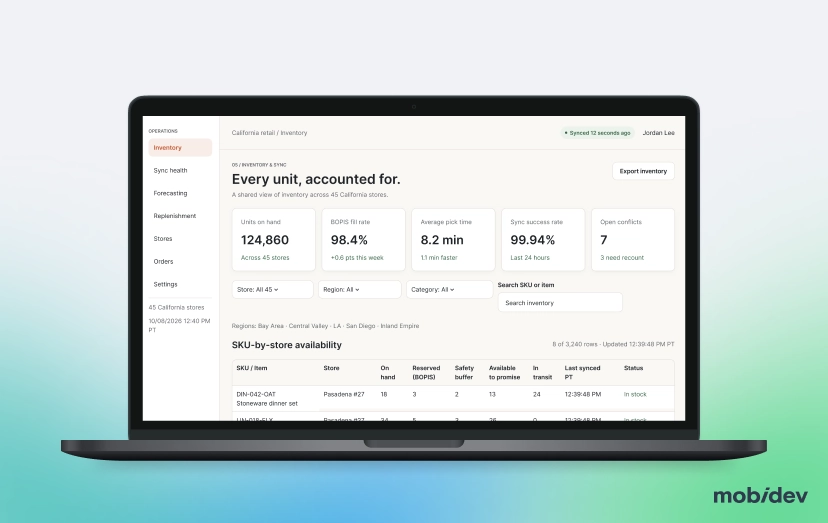
A California-based 20-store retail chain launched its in-store inventory and BOPIS system back in 2013. Built in AngularJS, it was an innovative solution at the time and helped manage procurement and sales efficiently.
By 2025, the chain had opened 25 more stores, but the system became unstable and staggered the addition of new features. On top of it, the developers who understood the inventory-sync logic had left. That logic sat inside the old AngularJS controllers, and the one contractor who could still work on it billed nearly double the market rate.
At the same time, the leadership asked for AI-driven demand forecasting to keep up with 2 competing chains that seemed to always offer more lucrative prices, especially around holidays. The company partnered with MobiDev to migrate the app to the new codebase without downtime and add new demand-forecasting features.
Business Value of the AngularJS to React Migration for Retail
What the React rebuild delivered by MobiDev did for the business:
AI demand forecasting in five weeks. The feature shipped after launch, against a six-month estimate for the prep work alone on the old codebase.
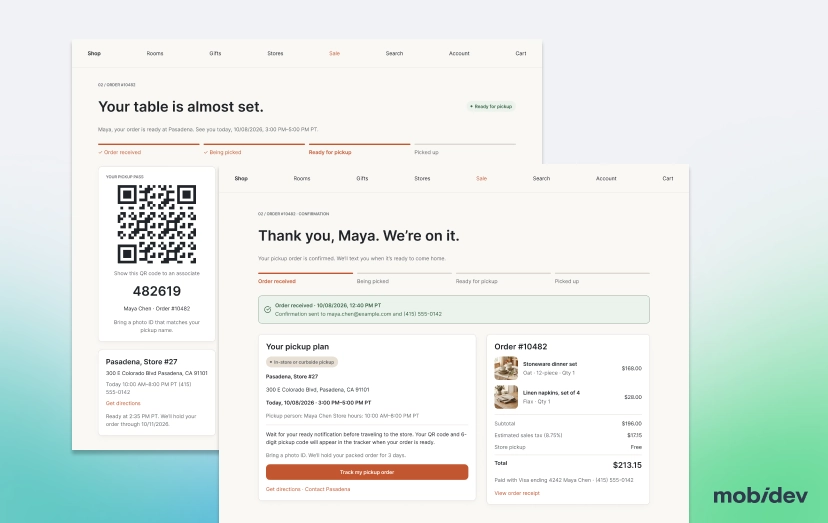
Roughly 30% faster BOPIS pick times, as reported by store associates on the new app.
No store lost its system during the switch. The new app went live location by location while the legacy one kept running.
Work measured in weeks, not quarters. Each of the next three feature requests after launch took weeks to deliver.
Inventory logic the team can read and change, now in a service layer instead of controllers only two departed developers understood.
Project Scope of the AngularJS to React Migration for Retail
Stage 1. Audit. We reviewed the AngularJS codebase and created a migration roadmap covering what to extract first and how to move stores over one at a time.
Stage 2. Logic extraction. We pulled the inventory-sync logic out of the AngularJS controllers into a proper service layer.
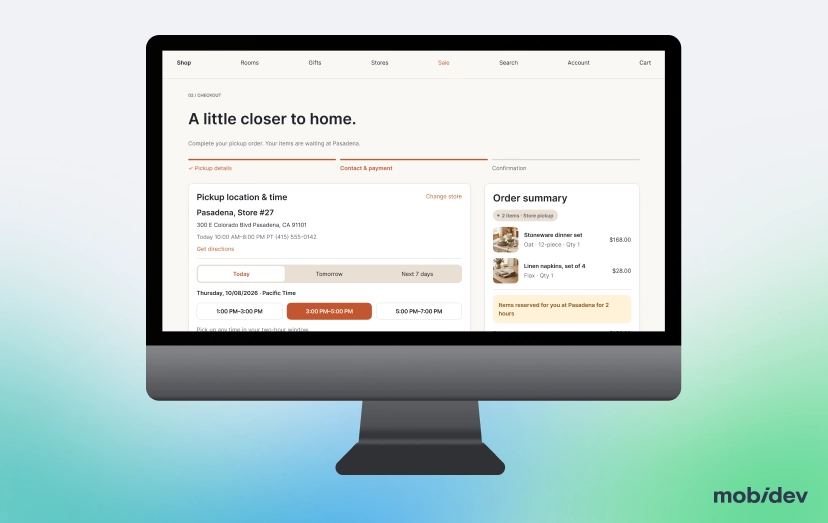
Stage 3. React rebuild. We rebuilt the associate app and the BOPIS flow on React over four months.
Stage 4. Store-by-store rollout. Each store moved to the new app individually, with the old system still in place until the switch.
Stage 5. AI demand forecasting. We built the forecasting feature on the new codebase after launch.
Deliverables of the AngularJS to React Migration for Retail
- Sales associate app on React
- Buy-online-pickup-in-store flow on React
- Inventory-sync service layer extracted from the AngularJS controllers
- AI demand forecasting feature
Tech Stack
Migrate Your Product from AngularJS
Fill out the form and share your modernization needs. Our experts will get back to you within 1 business day.
FAQ
Yes, if the migration runs incrementally. The usual pattern is to extract business logic into services first, then run the old and new front ends side by side using bridges such as react2angular, Single-SPA microfrontends or routing shims, and move users over in groups. A big-bang rewrite can still make sense when the app is small, test coverage is thin, and the deadline is fixed, but it carries more cutover risk.
A rewrite. AngularJS and modern frameworks use different rendering models and different dependency injection, and there is no shared upgrade path. AngularJS apps also tend to keep business logic in client-side controllers and $scope bindings, and that logic has to move into APIs or services before a new front end can use it, which is why these projects usually touch the back end too.
React has the largest hiring pool of the three, which matters if the old stack already made hiring hard. Angular (2+) wins when the team wants an opinionated structure, TypeScript by default, and the ngUpgrade bridge for running both frameworks during the move. Vue wins when a small team is coming straight from AngularJS, because its templates and reactivity feel closer to what they know.
Mostly what sits underneath the UI. The amount of business logic buried in controllers, the state of test coverage, the number of integrations, and the rollout approach all move the estimate. Incremental migrations also pull in secondary upgrades nobody budgeted for, such as an old CSS framework or a deprecated end-to-end test runner that has to change alongside the framework.
It depends on app size, how much logic has to be extracted, and whether the old and new versions run in parallel. A reliable estimate comes after the integration points are mapped. Fixing scope and a date before that is a common reason modernization projects stall.
Extended support, such as HeroDevs Never-Ending Support, keeps security patches coming and covers compliance without touching the code. It is a sound choice for a stable app that rarely changes. It does not make features faster to ship, bring back modern tooling, or widen the hiring pool, so it does not help an app that is blocking the roadmap.
New developers rarely learn AngularJS, so the remaining specialists charge a premium and are hard to replace. The practical fix is a team that can work in the old code and the target framework at once, keep the app running, and move it off the old stack so the problem does not return.
Technically yes, since it is still JavaScript in a browser, but it costs more and carries more risk. Modern AI SDKs are TypeScript-first ES modules that old AngularJS build chains do not consume without shimming, UI updates from outside the framework need manual digest calls, and AI coding assistants perform worse on AngularJS patterns.
When the old code is what blocks the AI feature, modernizing first is usually faster overall, because the feature then goes onto a stack built to take it. Doing both at once works only when the AI piece can run as a separate service with a narrow interface to the old app.
Demand forecasting, replenishment suggestions, and ranking which orders to pick first are well understood and work with the data most retailers already have. Fully autonomous ordering and store-level personalization tend to get promised and then scaled back, because they need cleaner data and more trust from store staff than most chains have at the start.
Consistent sales and inventory history per store and per SKU, with stable IDs, plus the events that explain spikes: promotions, stockouts, and seasonal peaks. A model needs to see at least one full seasonal cycle to forecast the next one, and more is better. Gaps and mismatched records between stores do more damage than a small data set.