
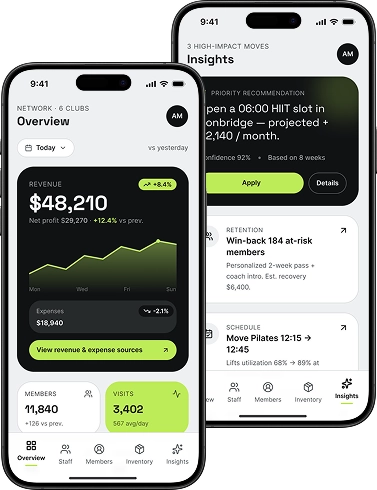
Developing a Gym Management App that Helped Save 12.8 Admin Hours per Week
A US-based gym chain (NDA client) wanted to build a custom gym management platform to consolidate multiple business operations within a single application and tackle rapid growth. They partnered with MobiDev to develop the solution. The gym chain managed to automate one-third of its repeatable workflows and decrease the admin’s weekly workload.


The Story Behind the Gym Management App Development
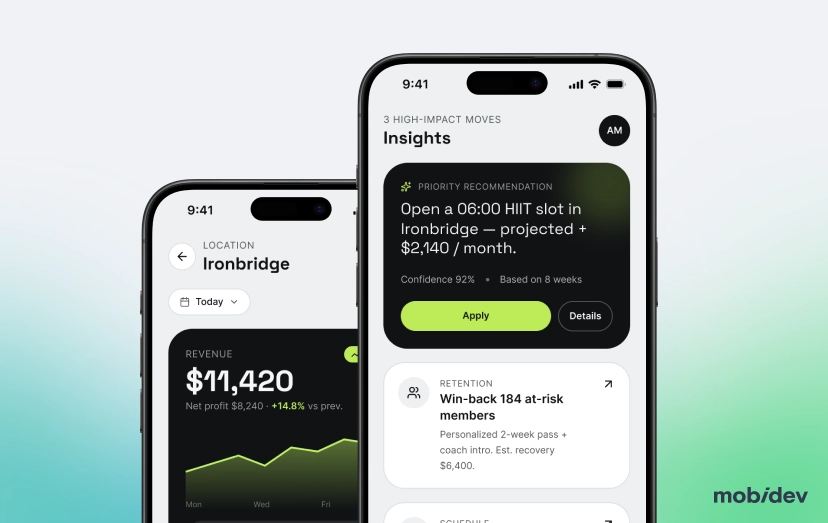
In 2022, a US-based gym chain was experiencing rapid growth, adding several new locations within a year. This created data silos and disconnected workflows that impacted the overall business efficiency. The management decided to build a solution that would enable them to consolidate data and operations in a single system.
The company needed a custom solution to assist in managing staff, client relations, and memberships, provide centralized control over all gym locations, and optimize operations like billing, payments, equipment procurement & control, and reporting & analytics.
With no prior experience in software development, the management was looking for a reliable Tech Partner to build the platform tailored specifically to their business needs. They chose MobiDev due to our unique experience in the fitness industry.
Business Value of Building Gym Management App
The Tech Strategy included several KPIs based on market benchmarks to assess the solution’s impact on the gym chain’s business operations, as well as member acquisition and retention.
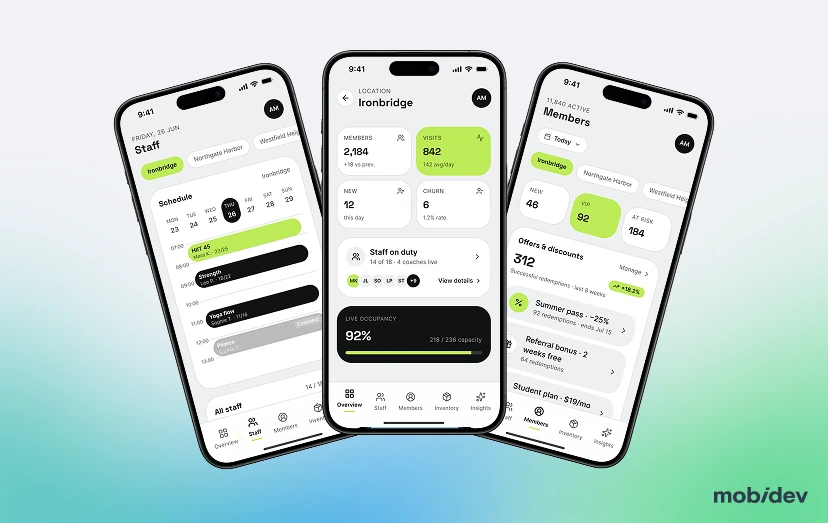
One year following the MVP launch, the solution managed to increase the new member activation rate from 33% to 61% and automate 33.7% of repeatable workflows. In addition to that, the management has seen an 11.9% uplift in off-peak capacity utilization. The chain saw the biggest improvement in admin time saved due to the application: 6.7 admin hours per month per location in the first year after the MVP launch and 12.8 hours per week by year 3.
Project Scope of Gym Management App Development
MobiDev began the cooperation with Tech Consulting in early 2023. We worked closely with our client to create a Tech Strategy, outlining the core features for the platform that will have the biggest impact on the business.
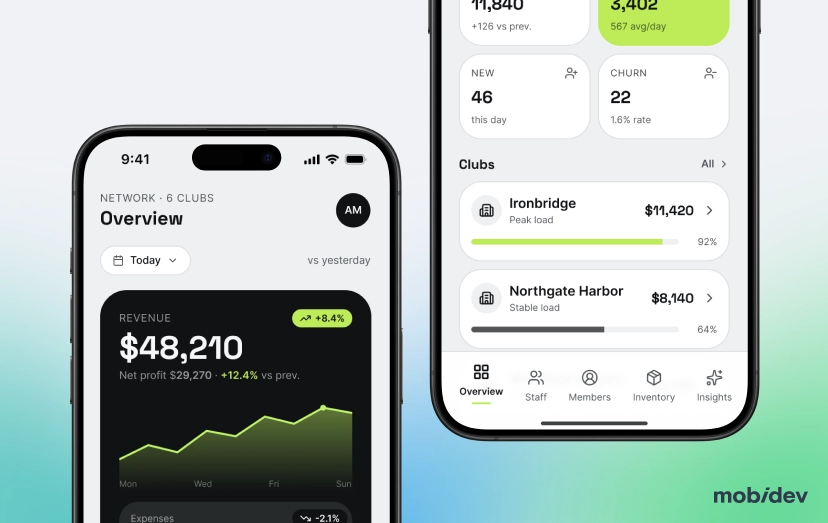
Following a 6-month development period, we launched the MVP with a multi-location admin dashboard, membership management, and booking system. Next, we continued working on the core product features, adding new ones like client relations management, procurement, reporting, and AI capabilities.
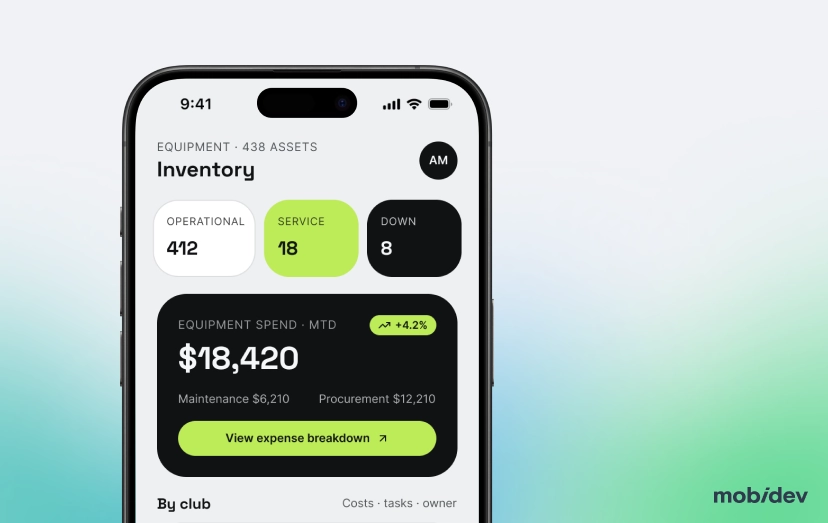
Deliverables for Gym Management App
Within 4 years, MobiDev built the gym management platform for multiple locations that included the following features:
- Centralized multi-location management for gym management & staff.
- Class scheduling, attendance tracking, and membership management.
- Client-facing app with class booking and payment integrations.
- Staff workflow management with role-based permissions.
- CRM with retention workflows.
- Analytics and reporting dashboards.
- AI for operational insights, scheduling optimization, and personalization.
Tech Stack for Gym Management App
Django
FastAPI
PostgreSQL
Redis
Elasticsearch
AWS S3
CloudFront
TypeScript
Ant Design Pro
Recharts
Apache ECharts
Zustand
Redux Toolkit
React Navigation
Stripe SDK
Firebase Cloud Messaging
Google OR-Tools
Pgvector
QuickBooks API
SendGrid
Twilio
Mixpanel
Django
FastAPI
PostgreSQL
Redis
Elasticsearch
AWS S3
CloudFront
TypeScript
Ant Design Pro
Recharts
Apache ECharts
Zustand
Redux Toolkit
React Navigation
Stripe SDK
Firebase Cloud Messaging
Google OR-Tools
Pgvector
QuickBooks API
SendGrid
Twilio
Mixpanel
Build Gym Management App with a Reliable Partner
Fill out the form and share your vision for Gym Management App. Our experts will get back to you within 1 business day.
FAQ
You cannot run a growing gym network on scattered documents. It breaks. A custom platform centralizes your core operations. It handles the billing and staff schedules automatically so your team stops doing manual data entry. You see exactly what is happening across the entire chain in real time.
It eliminates data silos and fixes broken billing workflows. We recently had a client buried under manual reports and messy staff schedules. We replaced those fragmented tools and built a single core application. They saw 33.7% of their repeatable daily tasks fully automated right after the MVP went live.
If a standard SaaS tool fits your business perfectly, you should buy it. You only build custom software when off-the-shelf platforms force you to break your own operational rules. Gym chains come to us when they need highly specific network-wide reporting or proprietary AI logic that generic tools simply do not support. Sometimes they just need a custom procurement flow that standard software cannot handle.
Centralized control is everything. You need strict role-based permissions and global class scheduling. Managers need to see revenue and staff capacity across all locations without jumping between different accounts. Advanced features like automated procurement can wait until phase two.
AI is great at spotting operational patterns that humans miss. It can look at your historical attendance and tell you exactly how to optimize trainer allocation. It can also highlight dead time slots. For one client, we integrated AI specifically to suggest better class schedules and personalize member engagement.
By automating repetitive administrative tasks. Booking confirmations and daily attendance reports should happen without human input. We built a platform that eventually saved the client 12.8 admin hours per week, per location, by their third year. That translates into significant payroll savings across a large chain.
Track hard numbers. Look at admin hours saved and workflow automation rates. Check your booking efficiency. Our clients benchmark these KPIs against the market. If the software isn’t speeding up reporting or driving up off-peak capacity utilization, it isn’t doing its job.
Yes. Frustrating booking flows kill your conversion rate. If the very first class is hard to schedule, people just stay home. We clean up the payment and calendar logic so the user does not have to think. One of our recent builds pushed a client’s new member activation rate from 33% to 61% in under twelve months just by fixing those exact bottlenecks.
It depends entirely on your scope. For a solid multi-location platform, expect a real engineering commitment. We launched the MVP for a major fitness chain in exactly six months. That timeline focused strictly on getting the admin dashboard, bookings, and membership management stable.
Only the tools that keep the business running. You need multi-location admin controls and class booking. Add secure payment gateways and basic staff roles. That is it. Complex CRM workflows and predictive AI analytics belong on the post-launch roadmap.
By using your attendance data to trigger smart promotions. When the system identifies an empty Tuesday afternoon slot, it can automatically push targeted offers and class recommendations to flexible members. One platform we built drove an 11.9% uplift in off-peak utilization using exactly this method.
Payment gateways are non-negotiable. You also need to hook into the gym’s physical access control hardware like turnstiles. Legacy accounting systems usually need an integration too. Keep your strategy strictly focused on billing, attendance, and reporting at the start.
It gives your team a clear system for daily work. You build in digital checklists and shift approvals. Staff can submit maintenance requests directly. This stops managers from relying on chaotic WhatsApp groups and standardizes operations across every single branch.
You stop losing leads. A native CRM watches the trial periods and logs every interaction. When someone stops showing up for three weeks, the system flags their profile immediately. Your team gets to run a targeted retention campaign right before that user actually hits the cancel button.
A standard fitness app helps a user track their squats. A management app runs the entire business. You aren’t just building workout timers. You are engineering heavy operational logic. You have to handle multi-location procurement and staff payroll. Then you add physical access control and process thousands of monthly payment transactions. The technical stakes are completely different.