
Building a Construction Management Platform That Increases Crane Productivity by 20%
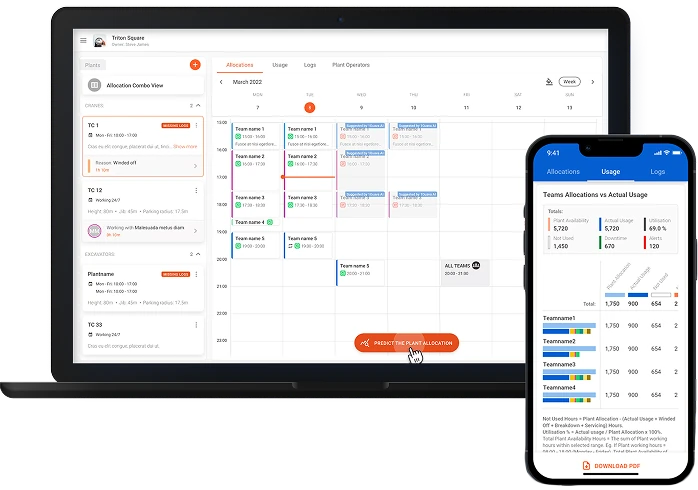
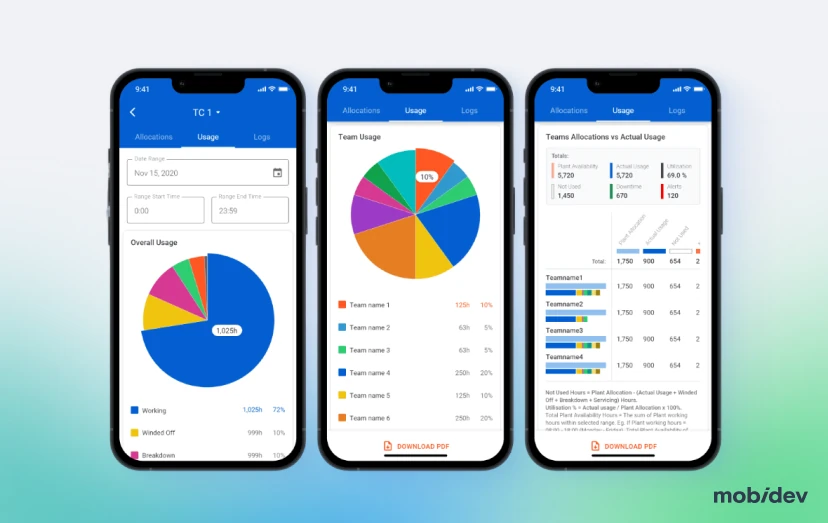
Since 2020, MobiDev has designed and continued building 1Guava, a cloud-based web and mobile platform that gives construction teams a single dependable record of crane and equipment use instead of scattered paper logs. The first version was shipped in four months, and the engagement has run as a dedicated team partnership ever since.
Customers using the platform have increased crane productivity by over 20%.


The Story Behind Construction Management Platform
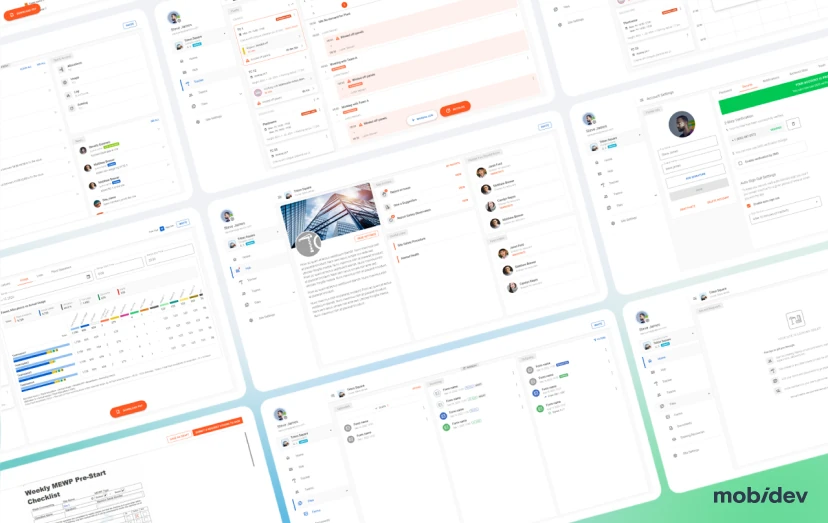
1Guava’s founders were builders and engineers, not software people. In 2020, they set out to build a first-of-its-kind way to allocate and track plant and crane utilization, aimed at crane owners and operators who had no dedicated tool for the job.
They brought in MobiDev to take that vision from a plan to a working product, covering design and development of the web and mobile platform end to end.
Business Value of Platform for Managing Construction
A four-month build got the product to market on a fixed timeline. The founders had a clear vision and a strict deadline, so MobiDev covered design and development from the ground up rather than 1Guava building an internal team first.
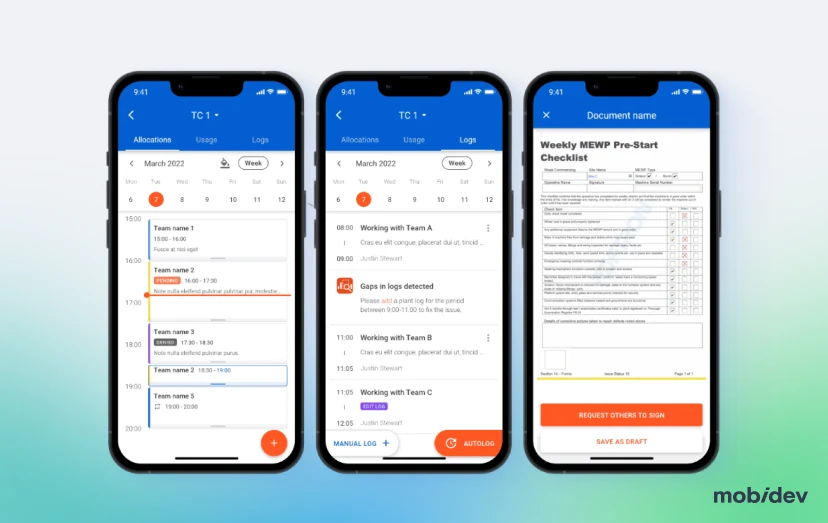
Complete crane logs replaced partial ones. Automated detection of missing log entries means gaps get flagged as they happen instead of surfacing later, when a job is already running late, or a bill is already disputed.
What the Client Says
Working with Mobidev was truly a fantastic experience. From the very beginning, I was impressed by the team’s support and reliability. They were very responsive to our needs, and their proactive approach made it easier to integrate solutions and ideas efficiently based on our customers feedback. Our collaboration was smooth, and we felt truly supported throughout the process. What stood out the most was the team’s willingness to work outside normal working hours when it was needed in order to response to an urgent issue and the effort they made to understand our goals and adapt the solution accordingly. The technical expertise and timely support have made a significant impact on the success of our project. We’ve seen steady growth in the 1Guava user base, and the system has allowed construction companies to streamline operations and boost crane productivity on site. I can’t recommend Mobidev enough, we are looking forward to continuing our successful partnership.

Philip Quaicoe
1Guava Founder
Project Scope of Platform for Construction Management
MobiDev has run this as a dedicated team engagement since 2020, now 12 people covering strategy, design, development, and QA.
Stage 1. Tech strategy and audit. We advised on technology and third-party services for document and file management, audited the codebase during development, and evaluated AI directions for feasibility and cost before recommending any of them.
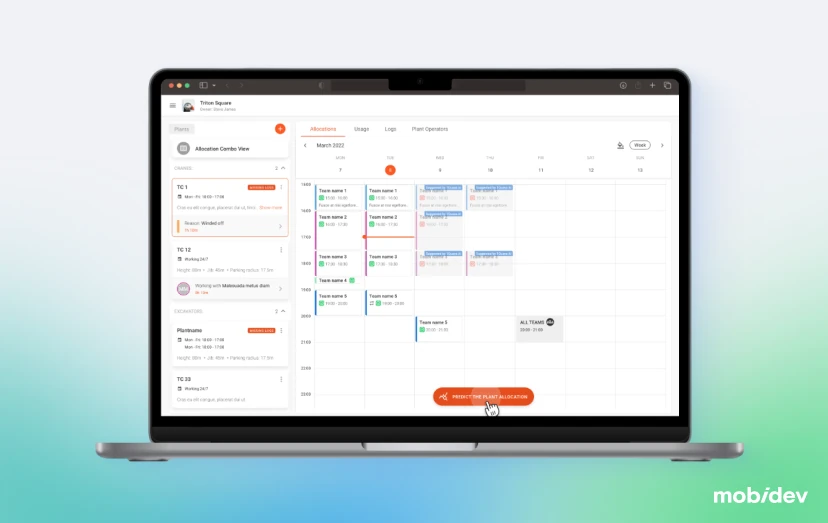
Stage 2. UX-first design. After a detailed requirements review, we prioritized straightforward platform navigation for allocating and tracking crane use.
Deliverables for Construction Management Platform
Deliverables text:
- A cloud-based web and mobile crane and equipment management platform, Web, iOS and Android from a single Flutter codebase
- Automated log gap detection with actionable alerts for incomplete crane logs
- A software audit report with documentation and prioritized recommendations on the platform’s most promising functional modules
Tech Stack
Strapi
PostgreSQL
AWS (S3, SES)
Jenkins
PDFTron
Codemagic
Mixpanel
Sentry
Twilio
Strapi
PostgreSQL
AWS (S3, SES)
Jenkins
PDFTron
Codemagic
Mixpanel
Sentry
Twilio
Build Construction Platform
Fill out the form and share your vision for your product. Our experts will get back to you within 1 business day.
FAQ
A tightly scoped first release for a niche B2B platform typically runs four to nine months. 1Guava’s first version launched in four months by scoping the release tightly and building web and mobile on one codebase.
Cross-platform frameworks cut costs and let one team ship both platforms at once, with tradeoffs on native-only, performance-heavy features. 1Guava used Flutter for exactly this reason, and it’s part of what let the first version hit its four-month target.
Outside strategy input validates technology and vendor choices before engineering time gets spent, which matters most for teams without in-house CTO-level expertise. MobiDev advised 1Guava’s founders on selecting technologies and third-party services for document and file management as part of the initial engagement.
Dedicated teams fit when there’s no in-house engineering team yet; team augmentation fits when you already have engineers and just need to fill specific skill gaps. 1Guava had no software team of its own, so MobiDev supplied a full dedicated team covering design through delivery.
The main drivers are how many platforms you’re shipping at once, how much custom logic versus off-the-shelf tooling the product needs, and ongoing team size. 1Guava kept cost down on the back office by using Strapi as an off-the-shelf admin CMS, while putting custom engineering into the log gap detection logic where it actually mattered.
The integration list depends on which field operations the product actually supports, so don’t assume one shape fits every case. A construction platform leans on document handling, notifications, and monitoring. A food delivery or logistics platform in the same broad “field operations” category leans instead on analytics, promotional tooling, and video or media services for the customer-facing side. Map your own product’s actual operations against this before writing the schema, not before assuming your stack should look like someone else’s.
A fixed-scope contract fights every change; a dedicated team can absorb requirement shifts by re-prioritizing sprints instead of renegotiating scope each time. 1Guava’s engagement moved from a four-month build into years of continued feature work with the same team, which only works if the model can absorb that kind of change.
For products expected to keep evolving, engagements often continue past launch into ongoing feature work rather than winding down to bug fixes. 1Guava’s collaboration continued past its four-month launch into years of enhancements with the same team.
It depends on which kind of AI feature you mean, since “AI” covers two different situations. Some features are integration work: they call an existing model or service and need no training data of your own, so there’s little reason to wait on them. Other features need a model fine-tuned on your own data, and that path genuinely does need to wait for a real data history, or for public or industry data that can substitute when your own doesn’t exist yet. For the second kind, an early product with no usage history has no baseline for a fine-tuned model to compare against, so committing before that history exists usually means guessing at the baseline instead of learning it. So the honest framing isn’t “AI is a later-stage investment” as a blanket rule, it’s that fine-tuned AI is, while integration-only AI isn’t, if the underlying feature is worth building now.
Detecting an anomaly means having a reliable baseline of normal patterns first, which usually takes months of consistent data collection. 1Guava’s automated log gap detection runs against the crane log patterns the platform itself generates, not a bought-in dataset.
This comes down to testing at scale before launch and monitoring after it, not one design pattern. Before shipping, the model needs to run against a large, representative sample of real data, and you need acceptance criteria set in advance (an accuracy threshold, an acceptable error rate) rather than a subjective “looks good” review. After launch, you keep validating against real outcomes, because real-world data drifts from whatever the model was tested on, and a model reliable at launch can quietly degrade months in. The right threshold also depends on what the AI is actually doing. If it only surfaces information for a person to review, the cost of an error is a wasted look, so the bar can be lower. If it takes an action or automates a decision on its own, the cost of an error goes up, and you generally want a higher threshold and a fallback or rollback path for when it gets something wrong.
Usually, but how much depends entirely on your specific codebase and how deeply the AI needs to reach into it, so there’s no single answer that applies across products. AI needs input it can actually use: data that’s structured and consistent. A product still storing records as scanned PDFs, free-text notes, or paper logs entered after the fact has neither, and a model built on that learns the inconsistencies in data entry rather than the operation itself. Where this gets specific to your case is integration depth: a feature reading from one well-defined data source needs far less rework than one that has to pull consistent signal out of a system that was never designed to produce it. That’s a question about your existing code, not AI in general, which is why it’s usually worth auditing the current codebase and integration points before scoping the AI work, rather than assuming either everything’s fine or everything needs rebuilding.
It depends on whether AI feasibility is a side question inside a broader engagement, or the actual reason you’re hiring someone. As a side question, folded into a software audit or tech strategy engagement you’re already paying for, it’s a bounded add-on, since most of the groundwork is happening anyway. When the entire ask is “can AI work for us,” that’s a dedicated engagement in its own right, not a discount version of the first case. It still starts the same way, analysis and code review, but the purpose differs: a regular audit checks the health of what you have, an AI feasibility audit checks whether what you have supports a model of a certain kind, which means looking closer at data volume, structure, and consistency than a general audit would. Either way, the review is far cheaper than building the feature and finding out afterward the data wasn’t there.
The honest answer is you don’t evaluate it yourself, you get someone to filter it for you. A technical audit exists precisely to translate “we could add AI here” into “here’s what it would take, here’s what it would cost, here’s what could go wrong” in terms you can actually weigh against your budget and timeline. The warning sign to watch for is a roadmap with no rejected ideas on it. A credible evaluation always rules some things out; if everything proposed made the cut, nobody actually tested it against your real data and constraints.
Yes, mostly because of ramp-up time. A team that already knows your schema, your edge cases, and why certain decisions got made can go straight to evaluating an AI feature against real constraints. A new vendor has to relearn all of that first, often by asking you questions your original team already knows the answers to, which shows up as weeks of discovery before any actual AI work starts. This matters most for something like anomaly or pattern detection, where the feature is only as good as its understanding of what “normal” looks like in your specific data, and that understanding is exactly what a team builds up by having run the product for a while.
This matters specifically if you’re planning to fine-tune a model on your own operational data, not if you’re planning to use a general-purpose model as-is. Plenty of AI features don’t need your data at all: they call an existing model already trained on data far broader than one product could generate, and readiness there is about the feature and the integration, not your data volume. If fine-tuning on your own data is the plan, the marker to watch is consistency, not a date on the calendar. Six months of clean, regularly logged data is worth more than two years of sparse or inconsistent records. But whether that’s actually enough also depends on how cyclical the underlying process is: a business with strong seasonality needs history spanning a full cycle, not just a stretch of tidy weeks that happens to miss it. That’s a case-by-case judgment, not a rule of thumb, so it’s what an audit or review of the specific feature is for, and if a fine-tuned model turns out to be the right approach, that same audit tells you whether the data behind it is there yet.