
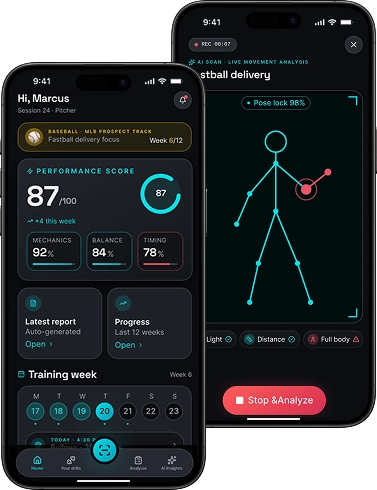
How We Helped Achieve 52.3% Trial-to-Paid Conversion with Athlete Performance Analysis
In 2023, a USA-based sports app (name under NDA) reached out to us with a request for AI Consulting on the development of Athlete Performance Analysis for their platform. Their key business goal was to boost their user retention and increase the number of paid clients.
Following the AI Consulting cooperation, the company signed a long-term partnership with us to develop their Athlete Performance Analysis based on the AI Pose Estimation and Computer Vision. They managed to achieve their business goals, growing their trial-to-paid conversion to 52.3% and decreasing churn rate by 32.7%.


The Story Behind the Athlete Performance Analysis Platform
In 2023, the top management of a USA sports app was looking for opportunities to grow their base of paying users and improve retention. The market analysis showed a shift in demand for sports analytics features from “nice-to-have” to a “game-changer.” The team decided to focus on this direction and outline several possible features that can provide an in-depth analysis of athlete data.
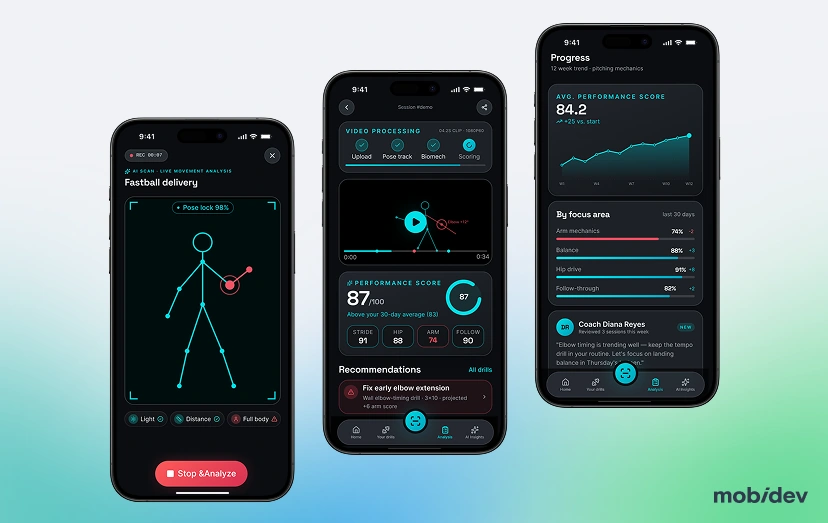
They ultimately chose an AI-powered computer-vision-based athlete performance analysis that would give feedback on the pose and suggest ways to improve it. The top management got a referral to MobiDev and, after a thorough review, chose our company as its Technical Partner due to our expertise in AI pose estimation, computer vision, and the sports industry.
Business value of Athlete Performance Analysis for the Platform
The sports app’s management set clear business KPIs to assess the overall impact of athlete performance analysis. In one year after the launch of the athlete performance analysis feature, they’ve seen significant improvement across 3 KPIs:
- churn rate decrease: 32.7%
- free-to-paid conversion after the first AI analysis: 15.1%
- trial-to-paid conversion: 52.3%
One of the somewhat unexpected outcomes of the new feature was the reduction of the number of injuries during the exercises reported by athletes and coaches who use the application.
Project Scope of Athletic Performance Analysis
MobiDev was first hired for AI pose estimation consulting and Tech Strategy creation. After the successful completion of this task, the app’s management ultimately decided to opt for a long-term partnership with us, which included development and maintenance of AI pose estimation & athlete performance analysis. Their internal team continued to maintain the app and its other features.
We allocated a team of 4 engineers and a project manager to develop the necessary functionality and incorporate it into the sports application. The MVP of the Athlete Performance Analysis for 1 sports type was ready in 12.5 months, and it took another year to complete the product and add one more sports type. Currently, we’re working on its maintenance and are discussing the possibility of adding 2 more sports types.
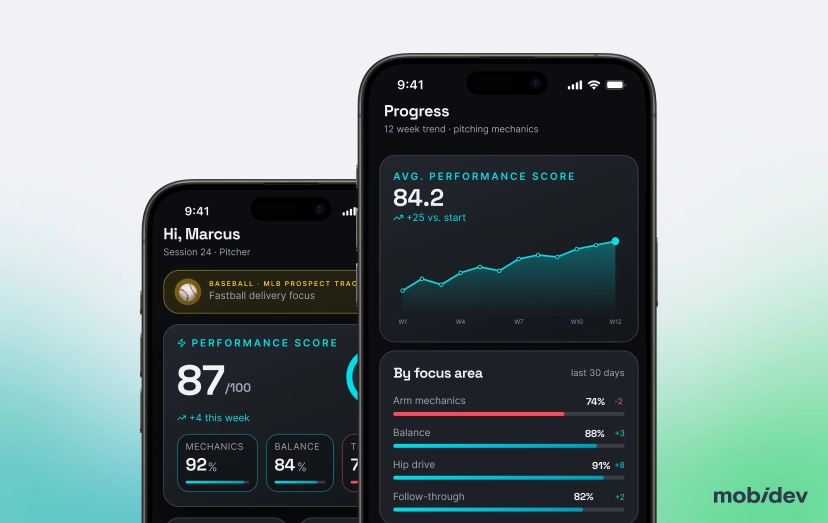
Deliverables for Athletic Performance Analysis
In 2 years of cooperation, MobiDev delivered:
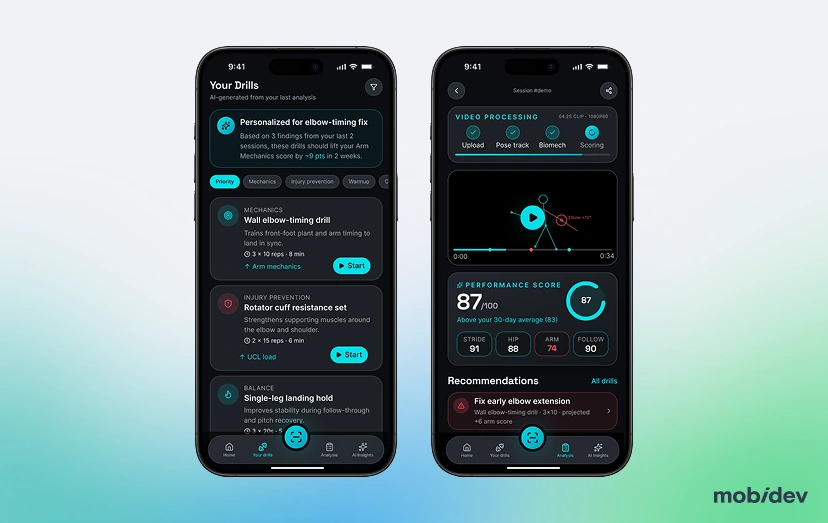
- MVP for One Sport Type: AI-powered movement analysis, video processing flow, performance scoring, and improvement recommendations.
- Athlete & Coach Reports: Automated performance reports, progress tracking, and coach/trainer review functionality.
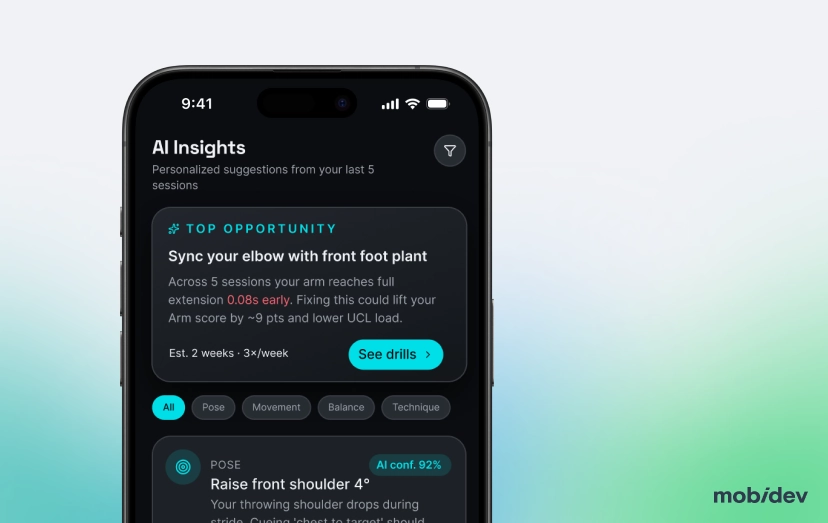
- Personalized Recommendation Engine: AI-driven suggestions on how athletes can improve pose, movement quality, balance, or technique.
- Analytics Dashboard: tracking feature usage, completed analyses, conversion impact, retention changes, and performance trends.
Tech Stack for Athlete Performance Analysis
Build Athlete Performance Analysis Application!
Fill out the form and share your vision for Athlete Performance Analysis Application. Our experts will get back to you within 1 business day.
FAQ
The system detects key body points in video footage and evaluates movement patterns, posture, joint angles, balance, and technique. Based on this analysis, it generates performance feedback that athletes and coaches can use to improve exercise execution.
Yes. The solution was designed to work with videos recorded through the existing sports application. However, video quality and video FPS (which is especially important for very fast movements that create motion blur effect), lighting, camera angle, distance, and full-body visibility play an important role in the accuracy of AI-based movement analysis.
No. The athlete performance analysis feature supports coaches and trainers by providing automated, data-based insights. Final decisions about training adjustments, technique correction, and injury prevention remain with human specialists.
Accuracy was improved through sport-specific movement logic, testing with real exercise videos, validation of frames if there are detection issues, and continuous adjustment of analysis rules based on expert feedback and user data.
Yes. The architecture allows adding new sport types, but each sport requires separate movement analysis logic, testing, and adaptation of performance metrics. That is why expanding to new sports is treated as a separate development stage.
If the video quality is insufficient, the platform can notify the user and suggest how to record a better video, such as improving lighting, changing the camera angle, or making sure the full body is visible.
The platform uses movement data extracted from videos, including body position, joint angles, posture, symmetry, and movement consistency. This data is transformed into performance scores and personalized improvement suggestions.
The solution can include secure video storage, role-based access, user consent flows, and controlled access for athletes, coaches, and administrators. These measures are especially important when working with athlete video data and performance-related information.
AI-powered performance analysis gives users a strong reason to upgrade because it provides personalized feedback they cannot get from a standard tracking feature. This helps increase free-to-paid conversion, trial-to-paid conversion, and long-term retention.
Starting with one sport type reduced technical complexity and allowed the team to validate the AI logic, user experience, and business impact before expanding the product to additional sports.