
Helping a Fitness App Founder Fix AI-Generated Code in 3 Days
In early 2026, a serial entrepreneur (name under NDA) hired MobiDev to conduct a tech audit of an AI-generated codebase for his upcoming fitness app and fix the most critical issues. They had generated this code with AI back in 2025, but the app didn’t work, and the attempts to fix the code proved futile.
In 3 days, MobiDev’s Solutions Architect, Rustam Irzaev, conducted the audit, fixed 2 severe issues, and provided a detailed development roadmap. This work enabled our client to successfully launch their product and attract $50,000 in investment.


The Story Behind Fixing AI-generated Code
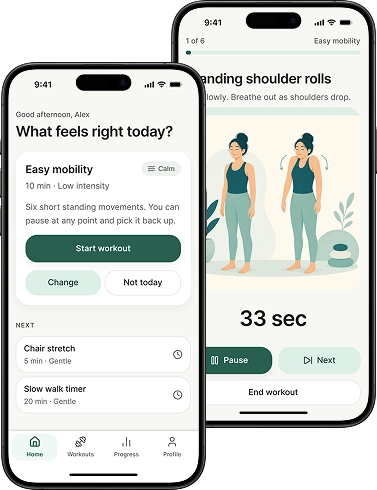
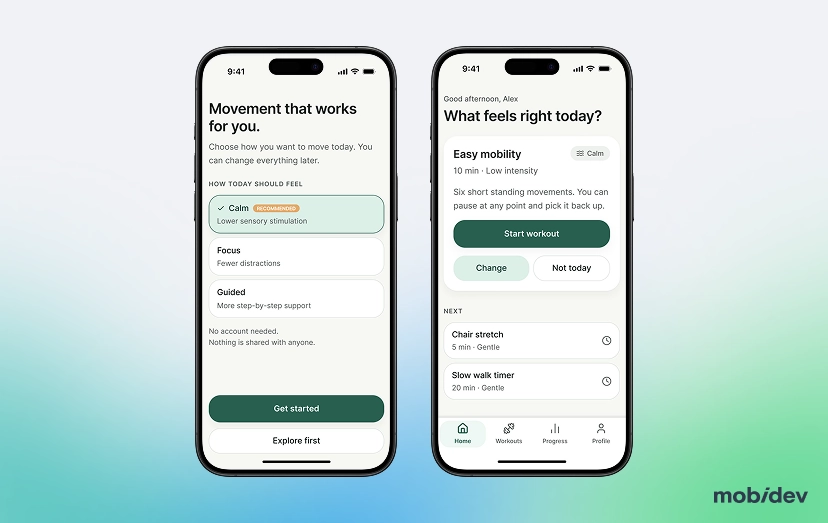
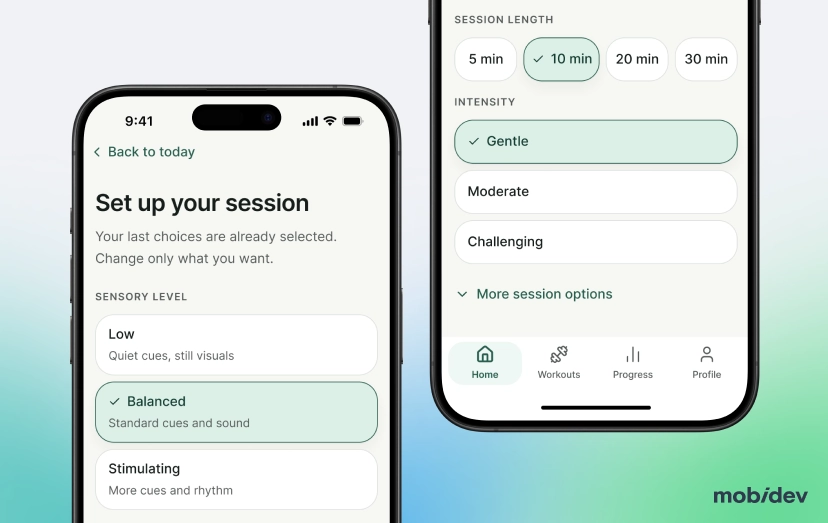
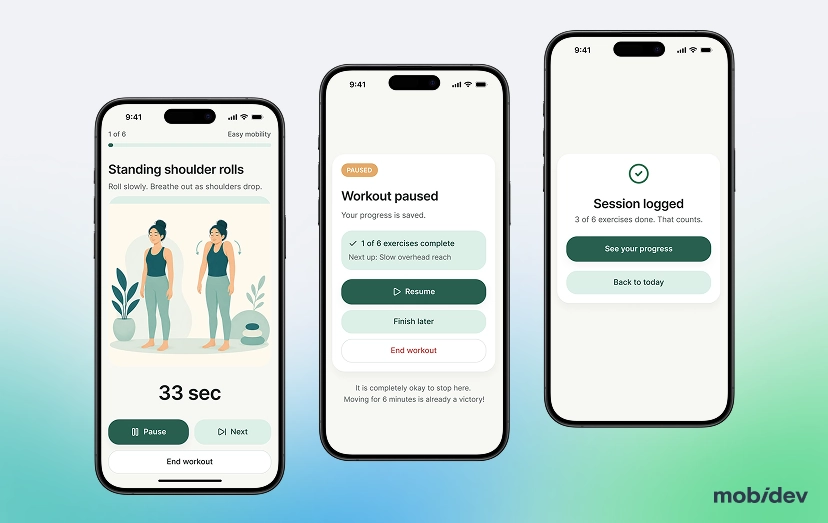
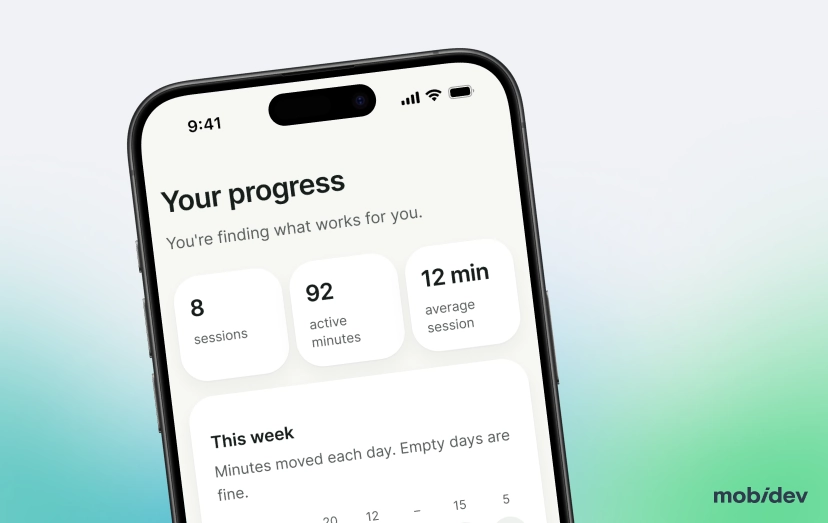
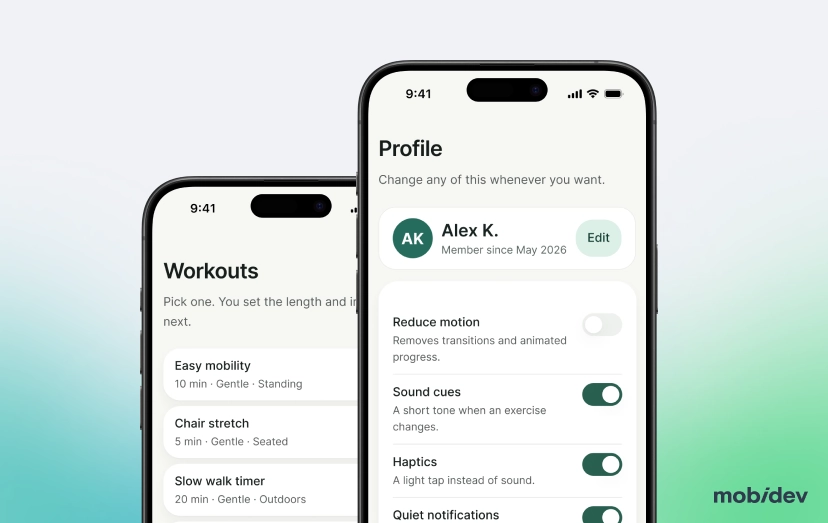
In late 2025, a serial entrepreneur (name under NDA) decided to create a new fitness app that would help neurodivergent people stay healthy and fit. It was their side project inspired by personal struggles. That’s why they decided to try vibe-coding with AI for the MVP development. The plan was to quickly build an application with 5 core features (low-friction onboarding, sensory-adjustable workouts, flexible session lengths, simple progress log, interrupt-friendly pause/resume) and present it to the investors.
Unfortunately, the application generated by AI in 3 days wouldn’t work as intended. After several weeks spent attempting to rewrite the code with AI, the entrepreneur finally contacted the MobiDev team. We had previously worked with this client on another product, and they were well aware of our expertise in using AI tools for rapid MVP development.
Business Value of Fixing Code Generated by AI
The client received a fixed codebase and used the development roadmap to add several more features.
With the audit and fixed issues, they managed to get the app’s MVP working and presented it to a number of potential investors interested in niche fitness & wellness products. As a result, they managed to raise $50,000 for further app development.
Project Scope of AI-generated Code Fix
For this task, we assigned our Solutions Architect, Rustam Irzaev. In just 3 days, he completed the full audit of the AI-generated codebase, fixed the two severe blockers that prevented the app’s correct functioning, and created an architecture report with a comprehensive development roadmap.
In addition to that, he checked for key security & compliance issues that can impact the launch of the application and assessed the potential risks for business logic. He found 3 potential risks and outlined how the client can mitigate them in the roadmap.
By the time this client reached out, they’d been stuck for several weeks. Same pattern every time. Ask the AI to fix a bug, get a fix, break something else three screens over. Nobody was checking how the new code talked to the old code, so the app just kept drifting further from working unnoticed. Honestly, that’s the most common failure mode we see. One tool, one prompt, no one asking whether this piece fits the rest of the system. We build differently. A few AI tools cross-checking each other, and a real architect looking at the whole picture before anything goes live. People think MVP speed means skipping steps. It’s the opposite. You go fast because you caught the problem in week one.

Rustam Irzaev
Solutions Architect, MobiDev
Deliverables for Vibe Code Fix
MobiDev delivered:
- The Executive Summary on the key quality & security issues and related risks
- Fix of two production blockers
- Detailed Architecture Report
Ongoing Cooperation with the Client
Upon getting investment, our client, now slightly disillusioned with vibe-coding, hired the MobiDev team to continue the work on the application. Currently, we are focusing on adding several features:
Tech Stack of the Vibe Code Fix Project
Gin
Validator
PostgreSQL
Dart
Riverpod
Google SSO
Gin
Validator
PostgreSQL
Dart
Riverpod
Google SSO
FAQ
Use it. The tools genuinely work, and they’ve changed what a founder can do alone. You can go from an idea to something clickable in a weekend, show it to people, find out whether anyone wants it, and change your mind twice before spending real money. That used to cost tens of thousands of dollars and three months. Don’t give that up.
What they can’t do is the part you can’t see.
A model writes the code you asked for. It doesn’t ask whether the whole thing hangs together, whether it survives its first thousand users, whether a stranger can reach your customers’ data, whether it will pass Apple’s review, whether it can delete a user when the law says it must. Those aren’t features you’d think to request. They’re decisions someone makes with years of watching products break in specific ways. A model has no memory of your product between sessions and no stake in what happens after it ships. So it does what you said, confidently, and the app looks finished.
That’s why the failure mode is so consistent. Founders don’t get stuck because the AI wrote nothing. They get stuck because it wrote something that works when they click through it themselves, and then several weeks disappear trying to fix a problem they can’t name. Every fix breaks something else. The codebase grows and less of it works.
The practical answer: build with AI, then have a person read it before you go any further.
If you already have a codebase and it’s not working, start with the audit. One business day, $399, and you’ll know whether what you have is fixable or whether you’re building on sand. That’s the cheapest question you’ll ever answer about your product. With the fixes and roadmap, $1,099.
If you’re starting now and it needs to be real. An app going to investors, to an app store, or to paying customers with their data in it, bring engineers in from the beginning. That’s what rapid MVP development is. We use the same AI tools you would, which is what keeps it fast, and there’s a Solutions Architect deciding what the code should look like, which is what keeps it shippable. You get the speed without spending it back later on repairs.
The line is roughly this: AI is very good for finding out whether you should build the thing. It isn’t enough for building the thing you’re going to sell.
When the same failure keeps coming back. The founder here spent several weeks re-prompting before calling us, and the two blockers were still there at the end of it. A bug that survives repeated fix attempts usually isn’t a bug. It’s a design decision made somewhere upstream, and no amount of prompting at the symptom will reach it.
Often it can be salvaged. Here, the architect audited the entire AI-generated codebase in three days and fixed the two failures that were stopping the app from running, rather than starting over. What he couldn’t fix in that window went into an architecture report and a roadmap the client then built against. The decision usually comes down to whether the structure underneath is sound. While broken behaviour is cheap to fix, broken architecture is not.
The app usually works when you click through it yourself. That’s the problem: the model builds for the path you described, so everything you didn’t think to describe is where the failures collect. What audits find, in plain terms:
- Anyone can see anyone’s data. The app checks who you are on the screen, but not on the server. So the login screen works, and someone who knows how to ask the app directly can pull up any user’s account. This is the most common serious finding and the one with the worst consequences if you launch.
- Your keys are exposed. Passwords and access keys for your database, payment processor and AI services end up sitting in the code where they can be read. Anyone who finds them can spend your money or take your data.
- It works for 50 users and stops working for 5,000. Not a crash. Everything just gets slower until it’s unusable. Nothing in the code was arranged for growth, because at the time it was built, there was nothing to grow.
- Customers get charged twice. Payments and form submissions have no protection against a double-click or a slow connection. You find out from a support email.
- When something breaks, you can’t find out why. The app quietly hides its own errors and keeps no record of them. Your user sees a blank screen, you see nothing at all, and there’s no trail to follow.
- Nobody made a decision about your data. No backups. Fields added one at a time as features occurred to you, with no structure holding them together, and nothing preventing bad data from being saved.
- The same rule is written in five places. Your pricing, your permissions, your rules about who can do what, each one written fresh every time it came up, in slightly different forms. You change the price in one place and the old price survives in four others.
- Some of it was never real. Models occasionally write calls to features that don’t exist in the tools they’re using. That code sits there looking normal and fails the first time a real user reaches it.
- Nothing checks the work. No automated tests, or tests written to pass no matter what the code does. So there’s no way to know that today’s fix didn’t break last week’s feature.
This is why the fixing never ends. Each of the above is invisible until something triggers it, and with no tests and no memory between sessions, every repair quietly undoes an earlier one. The codebase keeps growing while less of it works. Most founders call us here, not with one broken feature, but with weeks of fixes stacked on top of each other and no record of which ones held.
It can, and it’s worth checking before launch rather than after. The audit on this project covered security and compliance issues that could have blocked the app’s release, and separately assessed risk in the business logic.
On security
- The lock is on the wrong side of the door. The app checks who you are when you log in, then trusts everything that comes after. So the screens look protected, and someone asking the app directly can reach data that isn’t theirs. This is the finding we see most often.
- Your keys are in the open. Access to your database, your payment processor, your AI services. The credentials for all of it end up written into the code, where anyone with the file can read them. Sometimes they’re sitting in the version customers download.
- Nothing checks what people type in. Forms accept whatever they’re given, including instructions meant to confuse the app rather than fill in a field. That’s how databases get read or wiped by outsiders.
- No limits on attempts. Nothing stops a machine trying ten thousand passwords against your login screen overnight.
- Test settings left switched on. Developer mode in a live app will happily explain your system’s internals to anyone who asks. Sometimes it prints the error messages meant only for you, keys included.
On compliance
Compliance is less about breaking in and more about what you promised. Common gaps:
- You can’t delete a person. Under GDPR and similar laws, a user can require you to erase their data. If the app was never built to do that, you can’t comply. Finding out when the request arrives is the wrong time.
- You don’t know where the data is. AI-built apps often send information to third-party services picked for convenience: an AI provider here, an analytics tool there, a storage service somewhere else. Each one is a place your users’ data now lives, in a country you may not have checked, under terms you may not have read.
- Consent was never really collected. A cookie banner that sets the cookies before you click it. A privacy policy describing behaviour the app doesn’t have. Tracking that starts on page load.
- Nothing was recorded. Most regimes expect you to be able to show who accessed what and when. If the app keeps no log, you have nothing to show a regulator, an enterprise customer’s security questionnaire, or an investor’s technical reviewer.
- Health and payment data held casually. A wellness app collecting anything that looks like health information, or a checkout storing card details it shouldn’t be storing, is in a stricter category than most founders realize.
What the audit does about it
The security check is part of the standard audit: issues come back ranked by severity, with what each one puts at risk in business terms rather than technical ones. Compliance is handled as flagging: we mark the red flags we see, so you know what to take to a lawyer or a specialist. It isn’t a compliance audit and it isn’t certification. Neither one is something you want to discover you needed after launch, which is the argument for looking before you ship rather than after someone asks.
Both, at the top tier. Here’s what each piece is actually for, because “report” undersells it.
The executive summary is the one you read first, and it’s written to be read by you, not by a developer. Every problem found, ranked by how bad it is and what it puts at risk in business terms: this one exposes customer data, this one will start costing you money at a thousand users, this one is cosmetic and can wait. It exists so you can make decisions about your own product without needing someone to translate. That’s most of what founders are missing when they call: not a fix, but the ability to tell which of their twenty problems is the one that matters.
The architecture report answers a harder question: is what you have worth building on? It documents how the code is actually put together as opposed to how you assumed it was, where the weak joins are, and what will break if you keep adding features on top. This is the document that tells you whether you’re looking at repairs or a rebuild, and it’s the one to hand to a developer you’re hiring, a technical co-founder you’re courting, or an investor who asks how the product is built. It replaces “I don’t really know, an AI wrote it.”
The development roadmap turns the list into a sequence. What to fix first, what can wait, what has to happen before you take on real users, what order the remaining features should be built in so they don’t undo each other. Whoever executes it (MobiDev, a freelancer, an in-house hire) starts from a plan instead of from your best guess. In this project, the founder used it to add several more features himself before going to investors.
The fixes are the working-software part. Two production blockers were solved at the root rather than patched, so the app runs.
What you don’t get is a finished product. The roadmap is a plan, not the work. Full stabilization, refactoring, performance, and new features all sit outside the three days. You choose whether to run it, and with whom, which is the point: you leave the engagement knowing what you own.
One business day. The Vibecode Product Audit is a fixed $399 review of up to 50,000 lines of AI-built code by an experienced developer: tech analysis, security check, and a root-cause diagnosis of what’s actually breaking. You get an executive summary in plain language: every quality and security issue ranked by severity and business impact, with an explanation of what each one puts at risk. Potential compliance red flags are surfaced, though the audit isn’t a compliance certification.
Fixes aren’t included. The audit tells you what’s wrong and in what order to deal with it; refactoring, rebuilding and stabilization are separate work you decide on once you can see the list.
The engagement in this case study ran to three days because it went further than the standard audit. The architect also fixed the two blockers and produced an architecture report and development roadmap.
Fixed price at every level, so you know the number before you start.
$399: Vibecode Product Audit. One business day. An experienced developer reads up to 50,000 lines of your AI-built code, runs a tech analysis and a security check, and finds what’s actually causing the failures rather than describing the symptoms. You get an executive summary in plain language: every quality and security issue ranked by severity and business impact, with what each one puts at risk. No fixes at this level, this is the diagnosis.
$899: Audit + Single Bug Fix. Two business days. Everything above, plus the one blocker you’re most stuck on, fixed at the root rather than patched at the symptom. Broken flows and integrations get restored where that’s possible inside the scope, and you get a short summary of what was wrong and what was done about it.
$1,099: Audit + Two Bug Fixes + Action Plan. Three business days. Everything above, plus a check on the business risks in your logic, a second blocker fixed, a detailed architecture report, and a development roadmap you can act on or hand to whoever builds next. This is the scope described in this case study.
None of the tiers include a rebuild, refactoring, new features, performance work, ongoing support, or fixes beyond the ones listed. The top tier tells you what that work is and in what order. You decide whether to run it, and with whom.
Priced flat rather than hourly for a reason. Most founders arrive after weeks of trying to fix something they can’t see, and the value isn’t in the hours. It’s in ending that part.
It delayed this one rather than killing it. Once the app worked, the founder demoed it to investors focused on niche fitness and wellness products and raised $50,000 to continue development. He then brought the MobiDev team on to build the rest.
The report documents how the codebase is actually built, where the risks sit, and what order the work should happen in, which is most of what a technical reviewer asks for.
Access to the code and a short conversation. That’s it.
If you built with a tool like Lovable, Replit, Bolt, or Cursor, your project already lives somewhere. Usually it’s connected to a GitHub account created for you when you started. You invite us to it. If you’re not sure where it is or how to share it, say so on the first call, and we’ll walk you through it; that question comes up often enough that it isn’t a problem.
The conversation is more useful than most founders expect. We’ll ask what the app is meant to do, which parts stopped working, and what you’ve already tried. You don’t need technical vocabulary for any of it, “this button used to work and now it charges people twice” is exactly the right level of detail. It tells us where to look first, and it’s how the audit gets pointed at what’s actually costing you rather than at whatever is merely untidy.
On protection: we sign an NDA before you send anything, and it covers the idea as well as the code. We’ve been doing outsourced software development since 2009 for 400+ clients, more than half of whom have stayed eight years or longer, and a lot of that work is under NDA, including the project on this page, which is why the founder isn’t named. Confidentiality is the ordinary condition of the business, not a favour.
One thing worth saying plainly: nobody here is interested in your idea. Ideas are cheap and execution is the hard part, which is the whole reason you’re paying for engineering rather than inspiration.