
Building an Enterprise-Grade Wellbeing Platform for Global Industry Leaders Across 19 Countries
PepTalk sells employee wellbeing to companies, which means HR signs the contract and an employee decides whether the product gets used. That gap is the engineering problem, and it shaped the build from the first tech strategy in 2016 onward.
We started with consulting, built the web and mobile platform from scratch, and kept developing it for eight years. It reached 50,000 users across 19 countries within two years of launch, with customers including PayPal, Northern Trust, and Global Payments.


The Story Behind Building a Corporate Wellbeing Platform
PepTalk wanted to build a platform for employee wellbeing, targeted at SMBs and enterprises. Their idea was rooted in behavioural psychology, combining real-time data insights with targeted interventions they call action packs. What they were looking for was a reliable tech partner to build it.
In corporate wellbeing, the company pays, and the employee chooses. HR can buy a platform for an entire workforce and see a fraction of it used. So the task was to build a platform that employees would actually find useful and interesting. In 2016, PepTalk partnered with MobiDev to achieve this goal.
Business Value of the PepTalk Platform Development
What the platform developed by MobiDev did for the business:
- 50,000 employees actively using it within two years of the 2017 launch, real proof a wellbeing product works.
- 19 countries reached in that same window, on one platform rather than a build per market.
- Enterprise customers including PayPal, Northern Trust and Global Payments, which takes a product that survives procurement, not just a good idea.
- Activity data arriving without anyone logging it, through Apple Health and Google Fit, which is what kept the behavioural side of the product supplied with real inputs.
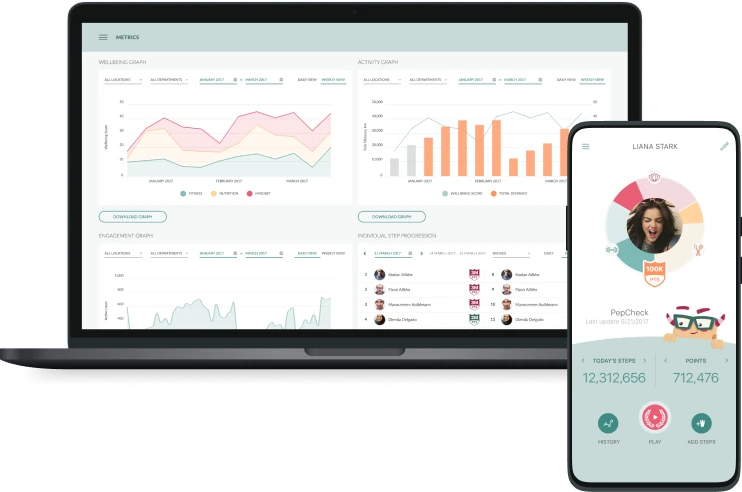
- HRs are able to manage the system directly, through the web admin panel and dashboard.
- The stack chosen in 2016 lasted. It carried the product through launch, two funding rounds and 19 countries with no rebuild.
- Adoption at that level is what made the rest possible: EUR 1.2 million seed in 2021 with headcount and revenue doubling inside 12 months, 19th in the Deloitte 2022 Technology Fast 50, and a USD 4.9 million round in 2022 for US expansion.
Project Scope for Building the Employee Wellbeing Platform
A team of seven, starting with consulting in 2016 and continuing as a dedicated team through eight years of development. We began with a fixed-priced approach, but as the client’s trust grew, we switched to the dedicated team model, with client following our suggestions on product improvement.
Stage 1. Tech strategy. We worked through the intended scope, the functionality and the client’s timeline, then set out the trade-offs of each stack option rather than just the recommendation.
Stage 2. Platform build. We built the web and mobile versions for the platform, with iOS and Android as native apps.
Stage 3. Health platform integration. Apple HealthKit and Google Fit were integrated so activity data synced from whatever devices employees already used.
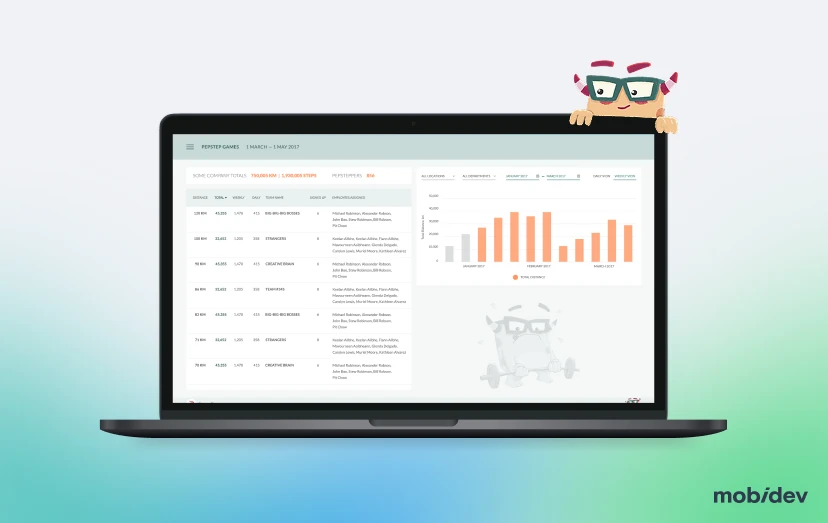
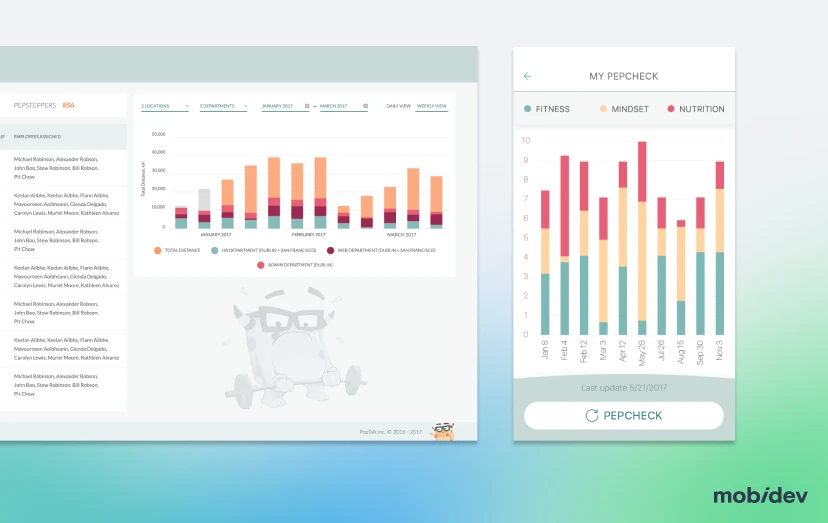
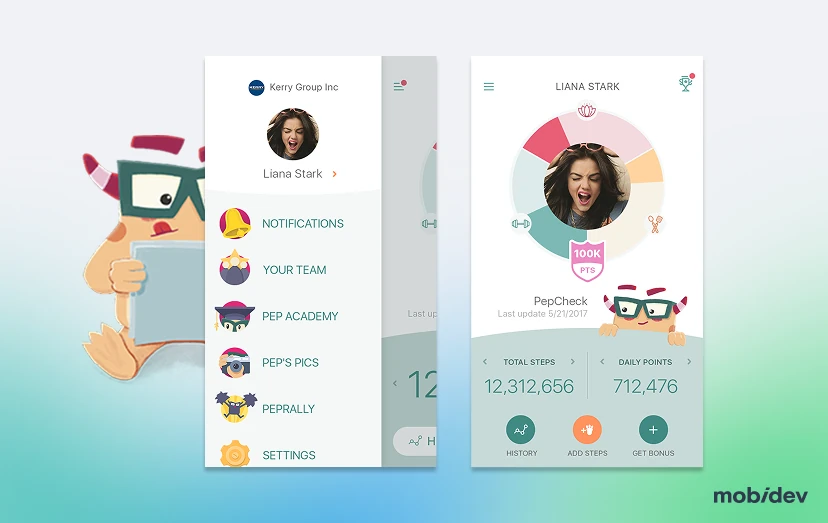
Stage 4. Gamification and HR visibility. Game mechanics became a core part of the product, giving employees a reason to return. HR got an admin panel and dashboard to manage the system, including teams, their members, games, competitions, prizes, wellbeing news and other.
Stage 5. Interface that doesn’t overwhelm. The iOS and Android UI was kept deliberately light, since an interface that needs learning asks for effort the user isn’t always ready to exert.
Stage 6. Continuous development. The product kept being built and enhanced through launch, two funding rounds and expansion into 19 countries.
Deliverables for the PepTalk Platform Development
- Documented tech strategy with stack options and tradeoffs.
- Web platform.
- Native iOS app.
- Native Android app.
- Apple HealthKit API integration.
- Google Fit / Health Connect API integration.
- Gamification system built into core product functionality.
- HR admin panel.
- Data visualisation through Chart.js.
- Infrastructure automation through Ansible.
- Feature requirements documentation.
- QA coverage across web and both mobile platforms.
Tech Stack
PostgreSQL
Redis
Nginx
SASS
Chart.js (Data Visualization)
Kotlin (Android)
CI/CD
Google Fit API
PostgreSQL
Redis
Nginx
SASS
Chart.js (Data Visualization)
Kotlin (Android)
CI/CD
Google Fit API
Build and Modernize Enterprise-Grade Platform
Fill out the form and share your vision for your product. Our experts will get back to you within 1 business day.
FAQ
With a written tech strategy, not a stack recommendation. A founder without engineers cannot evaluate “we suggest X”, so what you actually need is the reasoning: what the scope implies, what the timeline rules out, and what each option costs you later. Get the tradeoffs documented, because that is what you will need in a few years when something has to change. PepTalk started that way in 2016, and the stack chosen then carried the product through launch, two funding rounds and 19 countries without a rebuild.
Enough to prove the thing your business depends on being true, and nothing else. For a wellbeing platform, that is whether people use it voluntarily, which is a question about engagement rather than feature count. The temptation with an enterprise buyer is to build for the procurement checklist first, and it is usually the wrong order, because a platform that passes procurement and gets ignored does not renew.
Treat them as two products sharing one dataset. The user needs a reason to open the app when nothing is wrong. The buyer needs evidence that people did, because that is what renewal turns on, and no amount of feature richness substitutes for a participation number. The common mistake is building only for the buyer, which produces a platform that demos well and sits unused. PepTalk got gamification and a light interface on the employee side, plus an admin panel and dashboard.
Lower what it asks for and reward what people already do. Manual entry is the standard failure point, since enthusiasm covers about a week and then the data stops, and so does the product’s usefulness. Pulling activity data automatically from what people already wear removes that dependency. Here, Apple Health and Google Fit integration meant health and activity data synced from connected devices with nothing to type, and gamification gave that data a visible payoff.
It works when it rewards behaviour the user already wanted to do and fails when it tries to manufacture motivation that was never there. The useful test is whether removing the game mechanics would stop people from doing the underlying thing, because if it would, the mechanics were carrying the product rather than supporting it. It also has to be built into the core rather than layered on at the end, which is how it was handled on this platform.
Yes, and it changes it toward less rather than more. Someone opening a wellbeing app is usually doing it at a bad moment, so an interface that needs to be learned is asking for effort they do not have. The risk is specific: the product sold as support becomes another obligation. On PepTalk, the iOS and Android interfaces were kept deliberately uncrowded, with first-touch comprehension as the standard.
This one went native, with Swift and Kotlin, and health platform integration is a reasonable argument for that: you are working directly against HealthKit and Google Fit, and deep OS-level access is where native still has the clearest advantage. Cross-platform would make more sense if the interface were the product and device integration were shallow. Neither answer is default, and the honest version of this question is which stack your team can still hire for in eight years.
Rarely the code, usually everything around it. Data Residency (GDPR / HIPAA) and Multi-Region Architecture / Data Sharding rules differ, which can force where the database physically lives. Language is the visible part and the smaller one. Wellbeing content in particular does not travel unchanged, because what reads as supportive in one workplace culture reads as intrusive in another. Worth planning for at the architecture stage rather than discovering at the point of sale.
Yes, and this category is better suited to it than most, because the product already collects continuous behavioural data rather than one-off form submissions. The order matters though. AI needs the data first, so version one’s job is to generate it. PepTalk’s platform was built around real-time data insights driving targeted interventions, which is the structure AI slots into rather than replaces.
The ones that decide timing and relevance work well: which intervention to send, to whom, and when, based on what actually changed in someone’s activity. Aggregate pattern detection across a workforce is valuable to HR and safer than anything individual. What consistently disappoints is a chatbot presented as support, because users can tell, and in this category being handed a bot instead of a person reads as the company declining to care. Anything that looks like it is diagnosing a mental health condition is a different product with a different regulatory position, and it should not be added casually to a wellbeing platform. In particular, it turns a product into Software as a Medical Device that requires other types of certification like FDA in the US or MDR in the EU.
Technically yes, and this is the question to slow down on rather than answer with a demo. Doing it at an individual level and reporting to an employer turns a wellbeing product into a surveillance product, and employees work that out fast. The defensible version surfaces patterns to the individual and aggregates to the employer, with the design decisions written down and explained to users rather than buried. That is a product and legal decision before it is a technical one, and getting it wrong is how a platform loses the trust it depends on.
For timing and recommendation work, less than most people expect, since patterns across a user base do the heavy lifting and a few thousand regularly active users is often enough. For anything that assesses an individual’s state, considerably more, and it has to be labelled, meaning someone judged those examples. The first step is measuring what you already collect against the specific question you want answered, which is usually a week of work.
Different in shape from the build cost. Build is one bill, inference is a bill every month that scales with usage, so a feature that works gets more expensive as it succeeds. Design the cost model before the feature: which calls hit a model versus a cached result, whether a smaller model handles most cases, and what happens at triple the volume. Getting this wrong is the most common reason an AI feature that worked in the pilot quietly gets switched off.
For getting a prototype in front of prospective customers, genuinely yes, and faster than has ever been possible. The gains hold on interface scaffolding, boilerplate and test coverage. Where it does not hold is everything an enterprise buyer will audit: authentication, permissions, health data handling, and anything touching GDPR. Those need someone who knows what correct looks like, because a plausible-looking implementation of consent is worse than none. Use it to validate the idea, then have people who have done this before build the parts that carry risk.
Usually, and the instinct to start over is generally wrong. The typical pattern is a product that works down the demo path and falls apart on edge cases, with no tests, inconsistent structure and security handled optimistically. The business logic in it is real even where the code is not, and that logic is the expensive part. An audit answers what is salvageable, which is a much cheaper question than either rebuilding or pressing on and hoping.
Review it as if a junior wrote it in a hurry, because that is functionally what happened. The specific risks are code that works without anyone understanding why, dependencies added casually, and patterns that vary file to file because each was generated in isolation. A style guide the whole team holds to matters more when part of the codebase is machine-written, not less.